



Cardano price prediction remains one of the most discussed topics among crypto investors, as Cardano continues to be one of the largest cryptocurrencies in the market. However, its long-term future is still heavily debated.
Some investors believe its research-driven approach gives it strong long-term potential, while others argue that its slower development has allowed rivals like Ethereum and Solana to pull ahead.
So, where could ADA go from here?
Although no one can predict cryptocurrency prices with certainty, looking at Cardano’s technology, ecosystem, price history, and broader market trends can help build a more realistic outlook. In this guide, we’ll explore the key factors that could shape ADA’s future before sharing our Cardano price predictions for 2026, 2027, 2030, and 2035.
Key Takeaways
- Cardano remains one of the largest Layer 1 blockchains by market cap
- Its long-term success depends more on adoption than technology alone
- Competition from Ethereum and Solana remains a key challenge
- ADA’s price is strongly influenced by broader crypto market cycles
- Our long-term outlook covers 2026, 2027, 2030, and 2035 scenarios
What Is Cardano?
Cardano is a Layer 1 blockchain launched in 2017 by Charles Hoskinson, one of Ethereum’s co-founders. It was built to support smart contracts, decentralized applications (dApps), and digital assets while focusing on security, scalability, and long-term sustainability.
One thing that sets Cardano apart is its research-first approach. Instead of rushing out new features, many upgrades go through peer review and extensive testing before they’re introduced to the network. While this has helped build Cardano’s reputation for reliability, some critics believe it has also slowed adoption compared with faster-moving competitors.
Like Ethereum, Cardano uses a Proof-of-Stake (PoS) consensus mechanism, but its version is called Ouroboros. Instead of mining, users can stake ADA to help secure the network and earn rewards, making the blockchain significantly more energy-efficient than traditional Proof-of-Work systems.
Over the years, Cardano has expanded beyond simple transactions. Today, its ecosystem includes decentralized exchanges (DEXs), lending platforms, NFT projects, stablecoins, and governance tools. Although it still trails Ethereum and Solana in DeFi activity, the network continues to grow through ongoing upgrades and ecosystem development.
What Is ADA?
ADA is Cardano’s native cryptocurrency and powers almost everything on the network.
It’s used to pay transaction fees, stake tokens to help secure the blockchain, and participate in on-chain governance. As Cardano moves toward community-led governance, ADA holders can also vote on funding proposals and future protocol upgrades, giving them a direct say in the network’s development.
Unlike some cryptocurrencies with unlimited issuance, ADA has a fixed maximum supply of 45 billion coins. That helps make its long-term tokenomics more predictable. Still, supply is only one piece of the puzzle. Like any cryptocurrency, ADA’s price ultimately depends on demand, adoption, investor sentiment, and the overall direction of the crypto market.
Cardano Price History
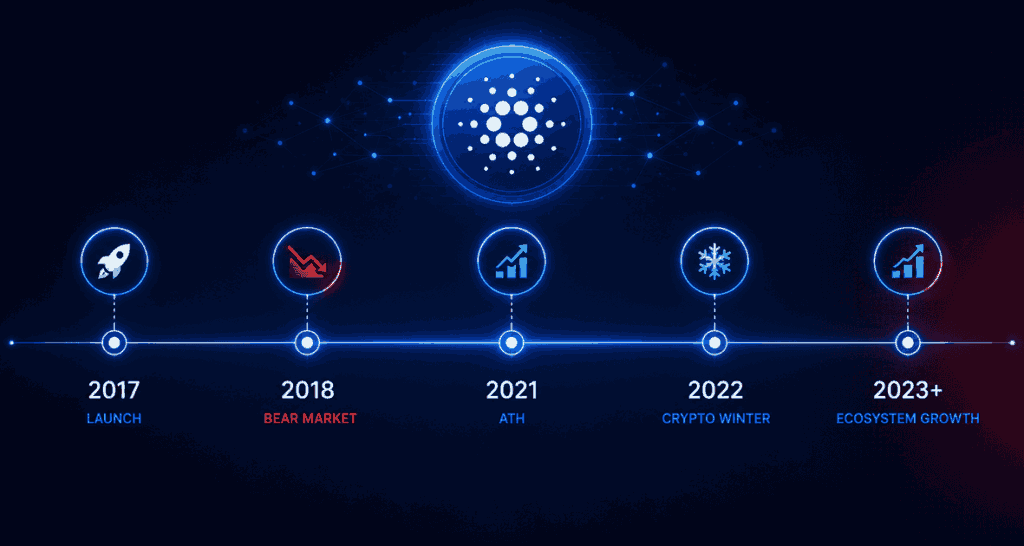
Cardano’s price has gone through several dramatic ups and downs since its launch in 2017. Like most cryptocurrencies, its performance has been shaped not only by the project’s own progress but also by broader market cycles.
Looking at those past cycles can provide useful context before making any long-term price predictions.
2017–2018: Riding the First Crypto Boom
Cardano entered the market during the 2017 crypto bull run, when investor interest in blockchain projects was soaring. As capital flowed into the market, ADA quickly gained attention and climbed alongside many other altcoins.
However, the momentum didn’t last.
When the crypto market entered a prolonged bear market in 2018, ADA lost more than 90% of its value. The decline reflected a broader market sell-off rather than problems unique to Cardano, reminding investors just how volatile cryptocurrencies can be.
2020–2021: A New All-Time High
The next major rally came during the 2020–2021 bull market.
A combination of record liquidity, growing institutional interest, and anticipation surrounding Cardano’s smart contract launch helped fuel demand for ADA. Investor optimism continued to build as the network prepared to expand beyond simple transactions.
That momentum pushed ADA to an all-time high of around $3.10 in September 2021, making Cardano one of the largest cryptocurrencies by market capitalization.
2022: The Market Turns
Like nearly every major cryptocurrency, ADA struggled during the 2022 bear market.
Rising interest rates, inflation concerns, and the collapse of several high-profile crypto companies triggered a sharp decline across the industry. As investors moved away from risk assets, ADA fell more than 80% from its peak.
Despite the price correction, Cardano’s development continued. The team remained focused on improving the network, introducing new upgrades, and expanding its long-term roadmap instead of reacting to short-term market sentiment.
2023–Present: Focusing on Long-Term Growth
As the crypto market gradually recovered, Cardano shifted its attention toward scalability, governance, and ecosystem expansion.
Recent upgrades have focused on technologies like Hydra, Mithril, and Ouroboros Leios, all of which aim to improve transaction throughput, network efficiency, and long-term scalability. At the same time, Cardano has continued rolling out community-driven governance, giving ADA holders a greater role in shaping the network’s future through voting and treasury proposals.
While Cardano still trails Ethereum and Solana in areas such as DeFi activity and total value locked (TVL), the ecosystem has continued to evolve. Whether those improvements eventually translate into higher ADA prices will largely depend on adoption, execution, and the overall direction of the crypto market.
Why Investors Still Watch Cardano Price Prediction?
Even after several market cycles, Cardano price prediction remains a widely discussed topic, as Cardano continues to be one of the most closely watched Layer 1 blockchains.
Part of that comes down to its loyal community and consistently high staking participation. The project also continues to release network upgrades, fund ecosystem development, and push toward greater decentralization through on-chain governance.
That said, Cardano still has important hurdles to overcome. Its DeFi ecosystem remains smaller than some competing networks, and attracting more developers, users, and liquidity will be crucial if it wants to strengthen its position over the long term.
For that reason, predicting ADA’s future isn’t just about looking at past price charts. It’s also about understanding the factors that could drive adoption in the years ahead.
In the next section, we’ll examine the key catalysts that could influence Cardano’s price and assess how they may shape our forecasts for 2026, 2027, 2030, and 2035.
What Could Influence Cardano’s Price?

Like most cryptocurrencies, ADA’s price is influenced by more than just its own technology. Broader market conditions still play the biggest role, but Cardano’s ecosystem, user adoption, and network development can also affect its long-term value.
Here are the key factors to watch.
1. Network Development and Upgrades
Cardano continues to improve its network through upgrades like Hydra, Mithril, and Leios, which aim to boost scalability and efficiency. Although these upgrades don’t directly increase ADA’s price, they could attract more developers and users over time. On the other hand, delays or slower adoption may reduce their impact.
2. Ecosystem Growth
A stronger ecosystem often leads to more network activity, which can support demand for ADA. Cardano now hosts decentralized exchanges, lending protocols, stablecoins, NFTs, and other applications. However, its ecosystem is still smaller than those of Ethereum and Solana, so continued growth will be important for its long-term outlook.
3. DeFi Adoption
Decentralized finance remains one of the biggest use cases for smart contract blockchains. Cardano’s DeFi ecosystem has expanded since smart contracts launched, but it still trails several competitors in total value locked (TVL). If more users and liquidity move onto the network, ADA could benefit from increased utility and demand.
4. Developer Activity
Cardano has consistently ranked among the most actively developed blockchain projects, with regular updates and ongoing research. Active development doesn’t guarantee higher prices, but it does suggest the network continues to evolve rather than stand still. Over time, successful upgrades could help strengthen adoption.
5. Competition From Other Layer 1 Blockchains
Cardano competes with established networks like Ethereum and Solana, as well as newer projects such as Sui and Aptos. To remain competitive, it needs to keep attracting developers, users, and liquidity. Otherwise, competing ecosystems could continue expanding more quickly.
6. The Broader Crypto Market
Like most altcoins, ADA is heavily influenced by the overall crypto market. Bitcoin‘s performance, investor sentiment, interest rates, and broader economic conditions often have a greater impact on price than Cardano’s own developments. That’s why any Cardano price prediction needs to consider both the project’s fundamentals and the wider market environment.
Taken together, these factors suggest that Cardano’s long-term outlook depends on more than just price momentum. Continued network development, ecosystem growth, and favorable market conditions could support ADA over time, while stronger competition or a weaker crypto market may limit its upside.
With those factors in mind, let’s look at our Cardano price prediction for 2026, 2027, 2030, and 2035.
How We Approach This Cardano Price Prediction
- We focus on long-term fundamentals rather than short-term price movements
- We evaluate adoption, ecosystem growth, and developer activity
- We consider historical market cycles and macroeconomic conditions
- We avoid fixed price targets and instead use scenario-based forecasting
Cardano Price Prediction 2026
By 2026, Cardano’s price will largely reflect whether recent development efforts start showing up in real usage. At this stage, the market is less interested in roadmaps and more focused on actual on-chain activity.
A more stable outcome would likely see ADA moving in line with broader crypto cycles, with gradual support coming from ecosystem growth but without a major breakout.
If momentum returns to the wider crypto market and Cardano continues improving scalability and attracting developers, ADA could attempt to revisit higher levels seen in previous cycles.
However, if activity remains limited or liquidity stays concentrated in competing ecosystems, price movement may remain relatively contained.
Overall, 2026 is less about direction changes and more about whether Cardano can convert development into measurable demand.
Cardano Price Prediction 2027
By 2027, the focus typically shifts from expectations to results. At this point, investors are likely to judge Cardano based on how active the ecosystem has become rather than what it is trying to achieve.
If the network continues expanding and market conditions remain supportive, ADA could build on earlier recovery trends and strengthen its position in the market cycle.
But if growth in users and applications remains slow, performance may depend more on general market sentiment than project-specific momentum.
This makes 2027 an important checkpoint year, where Cardano’s long-term direction becomes easier to evaluate in practice.
Cardano Price Prediction 2030
By 2030, Cardano’s valuation will likely depend on whether it has secured a meaningful position among leading smart contract ecosystems.
A stronger outcome would involve sustained ecosystem expansion, deeper DeFi integration, and broader real-world usage, which could support significantly higher long-term valuations.
In a more moderate outcome, Cardano continues to develop and maintain relevance, but remains behind larger ecosystems in terms of adoption and liquidity. In this case, price performance would likely follow general market trends rather than outperform them.
If competitive pressure continues to dominate the sector, ADA’s growth could remain limited despite ongoing technical progress.
At this stage, long-term positioning matters more than short-term momentum.
Cardano Price Prediction 2035
Looking toward 2035, forecasts become less about price precision and more about relevance within the broader blockchain industry.
If Cardano successfully maintains development and gains long-term adoption across multiple use cases, it could still hold a meaningful position in the market and benefit from overall crypto expansion.
A more neutral outcome would see Cardano remain active and functional but not among the dominant ecosystems, with performance largely tied to overall market growth.
In a less favorable scenario, faster-moving platforms could capture most of the activity, leaving Cardano with a more limited role in the ecosystem.
At this distance, the key question is not how high ADA goes, but whether it continues to matter in the evolving crypto landscape.
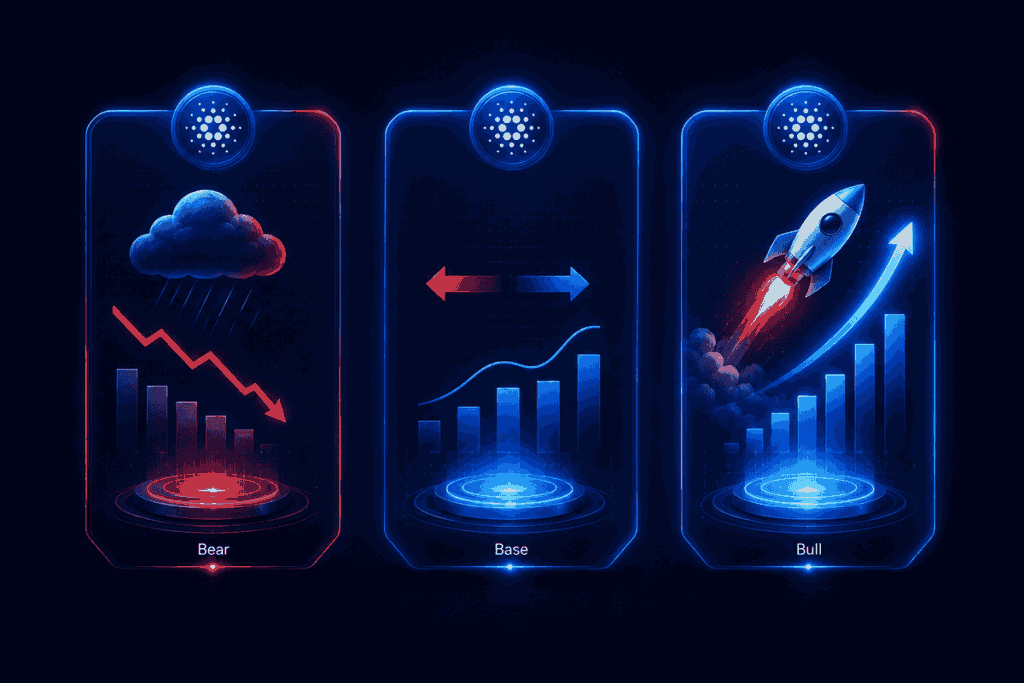
Cardano Price Summary Table (ADA Forecast 2026–2035)
| Year | Bear Case | Base Case | Bull Case |
| 2026 | $0.45 – $0.75 | $0.80 – $1.40 | $1.50 – $2.50 |
| 2027 | $0.50 – $0.90 | $1.00 – $1.80 | $2.00 – $3.20 |
| 2030 | $0.70 – $1.50 | $1.80 – $3.50 | $4.00 – $7.00 |
| 2035 | $0.90 – $2.50 | $3.00 – $6.00 | $8.00 – $15.00 |
Risks to Our Cardano Price Prediction
While Cardano has a strong development track record, several risks could affect the Cardano price prediction outlook in the long term.
The most obvious is competition. Ethereum, Solana, and newer Layer 1 blockchains continue to evolve quickly, and Cardano needs to keep pace to maintain relevance.
Another factor is adoption. If decentralized applications and liquidity fail to grow meaningfully, ADA’s demand could remain limited despite technical improvements.
Macro conditions also matter. Higher interest rates, tighter liquidity, or stricter regulation could reduce overall demand for risk assets like cryptocurrencies.
Finally, delays in key upgrades or slower-than-expected ecosystem growth could reduce investor confidence over time.
What Could Change This Forecast?
- Faster-than-expected Cardano ecosystem adoption
- Major breakthroughs in scaling or DeFi growth
- Strong institutional inflows into ADA
- Unexpected regulatory shifts in crypto markets
Is Cardano a Good Investment?
Cardano may appeal to long-term investors who believe in its research-driven approach and gradual development strategy. The project has consistently continued building through different market cycles, which is something many investors view positively.
However, like all cryptocurrencies, ADA remains highly volatile and heavily influenced by market sentiment. Its long-term performance will depend not just on technology, but also on adoption, competition, and broader economic conditions.
For that reason, Cardano is often seen as a long-term speculative asset rather than a stable investment.

Conclusion
Cardano price prediction ultimately comes down to more than just technology or development progress. Cardano remains a well-established blockchain project with continued development and a strong community, but its long-term success will depend on whether that progress translates into real-world usage and sustained adoption.
While ADA still has upside potential in favorable market conditions, its performance will likely continue to be shaped by competition, market cycles, and broader crypto sentiment rather than technology alone.
FAQs
It’s possible, but it would likely require strong adoption, a favorable crypto market cycle, and continued growth in the Cardano ecosystem.
This is more challenging. It would need a much larger overall crypto market and significant long-term adoption across DeFi and other use cases.
There’s no exact answer. ADA’s value in 2030 will depend on ecosystem growth, competition, and overall market conditions.
Cardano may suit long-term investors who believe in its approach, but it remains a volatile asset. Risk management is important in any crypto investment.
Cardano focuses on a research-driven development approach and uses the Ouroboros Proof-of-Stake system. Ethereum has a larger ecosystem today, but both continue to evolve in different ways.
Yes. Cardano continues active development, with ongoing upgrades focused on scalability, governance, and ecosystem growth.


