


Whether you are looking to protect your personal data from potential exchange hacks or simply prefer the original peer-to-peer spirit of Bitcoin, trading without identity verification is still entirely possible.
The crypto landscape has evolved significantly. While many old-school centralized platforms have been forced to implement strict identity checks, a robust ecosystem of decentralized networks and privacy-centric platforms ensures you can still trade freely. This guide walks you through the top options available today and covers everything you need to know about how to manage your digital assets anonymously.
KYC: What does it mean?
Before choosing a platform, it helps to understand what KYC actually means.
Short for Know Your Customer, KYC is a mandatory identity verification process used by traditional financial institutions and most mainstream cryptocurrency exchanges. To comply with global anti-money laundering (AML) and fraud prevention regulations, these platforms require users to submit sensitive personal data, typically including:
- A valid passport, driver’s license, or national ID card
- A real-time selfie or live facial scan
- Proof of address, such as a recent utility bill or bank statement
While these strict measures are designed to deter illicit activity, they present a clear trade-off for everyday users. Handing over highly confidential documents always introduces data security risks, regardless of how trustworthy or secure an exchange claims to be. A single corporate data breach could expose your physical address and government identity to the dark web, which is precisely why privacy-conscious traders seek out alternative platforms.
This is where a no kyc crypto exchange comes into the picture as a powerful alternative.
What Is a No KYC Crypto Exchange?
A no KYC crypto exchange allows users to buy, sell, or swap cryptocurrencies without completing a full identity verification process. As privacy becomes a growing concern in the crypto industry, more investors are searching for ways to manage their digital assets while sharing less personal information.
💡 Depending on the platform, users may be able to:
That does not mean every platform operates the same way. Some exchanges allow limited trading without identity verification, while others only require KYC after users exceed certain withdrawal limits. Understanding these differences can help you choose a platform that matches your trading habits and security preferences.
Whether you are a long-term Bitcoin holder, an active altcoin trader, or simply exploring decentralized finance, this guide explains how no KYC exchanges work, their advantages and drawbacks, and what to consider before using one.
How Does a No KYC Exchange Work?
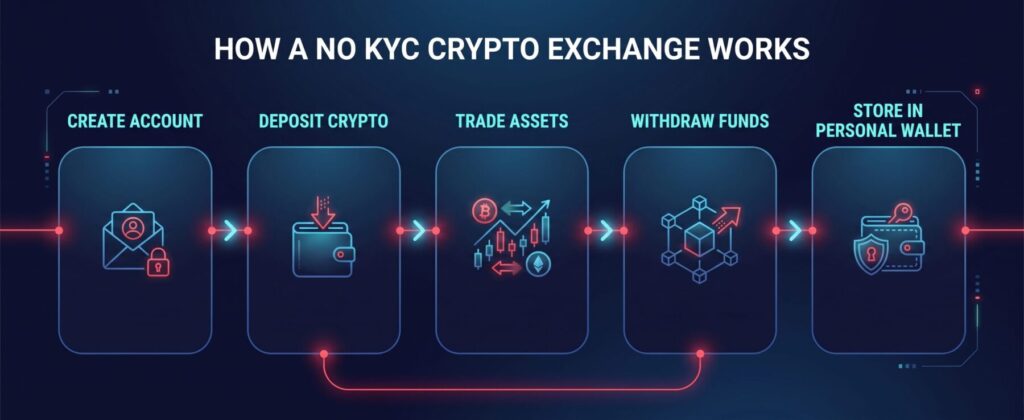
The experience is usually much faster than registering with a traditional exchange.
In many cases, the process looks like this:
Step 1: Choose a Suitable Platform and Create an Account or Connect Your Wallet
Look for a reputable exchange that supports the coins you want to trade and clearly explains its verification policy.
Depending on the platform, you may only need:
- Email address
- Strong password
- Two-factor authentication
Some decentralized exchanges skip accounts altogether and allow users to connect a wallet directly.
Step 2: Deposit Cryptocurrency
Transfer your Bitcoin, Ethereum, USDT, Dogecoin, or another supported asset from your existing wallet or exchange.
Always double-check the receiving address before confirming the transaction.
Step 3: Trade Your Assets
Once your deposit is confirmed, you can swap cryptocurrencies or place buy and sell orders depending on the platform’s available features.
Step 4: Withdraw to Your Wallet
After completing your trade, many experienced investors prefer transferring their assets to a personal wallet rather than leaving them on an exchange.
This gives you greater control over your private keys and reduces reliance on a third party.
Some decentralized exchanges go a step further by removing user accounts entirely. Instead, you simply connect your crypto wallet and trade directly on the blockchain.
This approach gives users greater control over their assets while reducing the amount of personal information stored on centralized servers.
Why Do Some Crypto Users Prefer No KYC Exchanges?
Different investors have different priorities. Privacy is only one reason people look for alternatives to traditional exchanges. Many users prefer these platforms because they offer:
Faster Registration
Opening an account usually takes just a few minutes since there is no need to upload documents or wait for manual approval.
Better Privacy
Some investors prefer limiting how much personal information they share online. Reducing the amount of stored personal data may also lower the risk associated with future data breaches.
Easier Global Access
Certain regions have limited access to cryptocurrency services. Depending on local regulations, some users choose no KYC exchanges because they provide access where traditional exchanges may not.
Quick Crypto Swaps
Many experienced traders simply want to exchange one cryptocurrency for another without unnecessary registration steps.
Pros and Cons of No KYC Crypto Exchanges
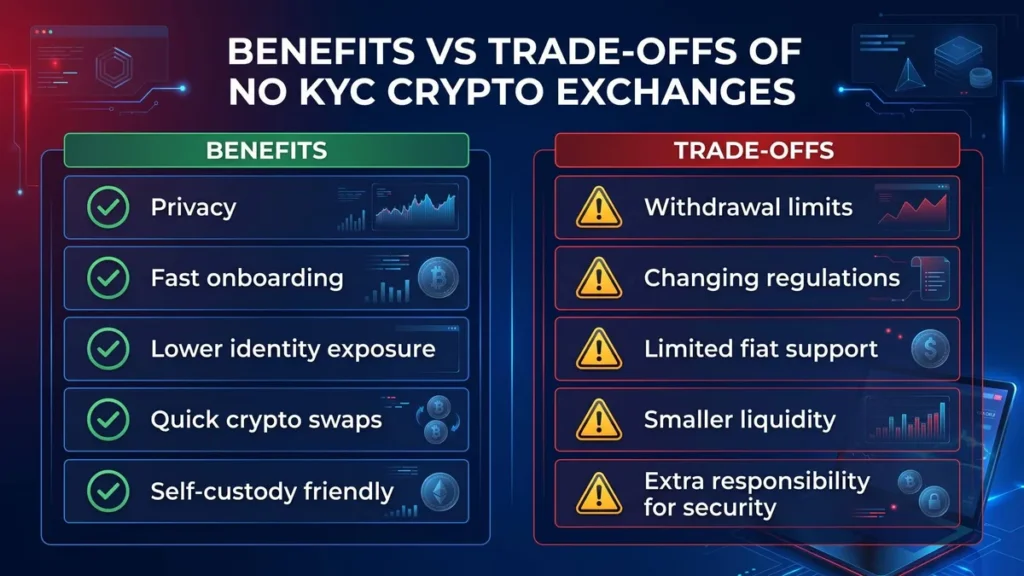
Every platform involves trade-offs. Understanding both the benefits and limitations helps you make better decisions.
Advantages
Disadvantages
Greater privacy
Lower withdrawal limits
Faster account setup
Some platforms offer fewer features
Less personal information required
Regulatory rules may change over time
Convenient for crypto-to-crypto trading
Customer support may be limited
Lower risk of identity document leaks
Some exchanges may have lower liquidity
The right choice depends on your goals. Someone making occasional swaps may prioritize convenience, while a high-volume trader may value deeper liquidity and advanced trading tools.
Is a No KYC Exchange Right for You?

No KYC platforms appeal to many different types of crypto users, but they are not a one-size-fits-all solution.
They may be suitable if you:
- Already own cryptocurrency
- Value privacy
- Make occasional crypto swaps
- Understand blockchain transactions
- Prefer self-custody of your assets
On the other hand, fully regulated exchanges may be a better fit if you frequently purchase crypto with bank transfers or require advanced fiat services.
In the next section, we will compare some of the best no KYC crypto exchanges, explore no KYC crypto exchange apps, and explain how to choose the right no KYC crypto wallet to keep your assets secure.
Best No KYC Crypto Exchanges
Now that you understand how these platforms work, the next step is choosing one that suits your needs. There is no single exchange that fits every investor. Some focus on quick crypto swaps, while others offer advanced trading tools, lending services, or peer-to-peer transactions. If you want to avoid KYC verification entirely, there are several reliable options for purchasing Bitcoin anonymously.
Below are some popular platforms to consider. Since exchange policies may change over time, always check the latest verification requirements before signing up.
Exchange
Best For
Standout Feature
IZAKA-YA
Beginners and long-term holders
Trading, wallet, and crypto lending in one platform
MEXC
Spot and futures trading
Large selection of cryptocurrencies
CoinEx
Altcoin investors
Beginner-friendly interface
Bisq
Privacy-focused Bitcoin users
Fully decentralized trading
IZAKA-YA
For users looking for more than just a trading platform, IZAKA-YA combines cryptocurrency trading with wallet services and crypto lending. This makes it suitable for investors who prefer managing their digital assets in one place instead of using multiple applications.
If you plan to hold your crypto over the long term, the platform also offers crypto lending for supported assets, allowing eligible users to earn rewards while continuing to hold their portfolio. As with any lending product, it is important to understand the risks and terms before participating.
MEXC
MEXC is popular among traders looking for access to a large selection of cryptocurrencies. Basic trading is available without mandatory identity verification, although withdrawal limits may apply.
It is suitable for users who already hold crypto and want access to many trading pairs.
CoinEx
CoinEx offers a beginner-friendly interface and supports hundreds of cryptocurrencies. Users can trade without completing KYC, provided they remain within the platform’s account limits.
For investors building a diversified portfolio, CoinEx provides a straightforward experience without overwhelming new users.
Bisq
Bisq is a decentralized Bitcoin exchange that connects buyers and sellers directly. Since it operates without a central authority, users maintain greater privacy throughout the trading process.
The platform is especially popular among Bitcoin enthusiasts who prioritize decentralization over convenience.
How to Buy Crypto Without KYC
If you are starting from scratch without holding any digital assets, the process requires a specific approach. Centralized apps will always demand verification if you link a traditional credit card or bank account. To learn how to buy crypto without kyc, you have to use alternative entry points.
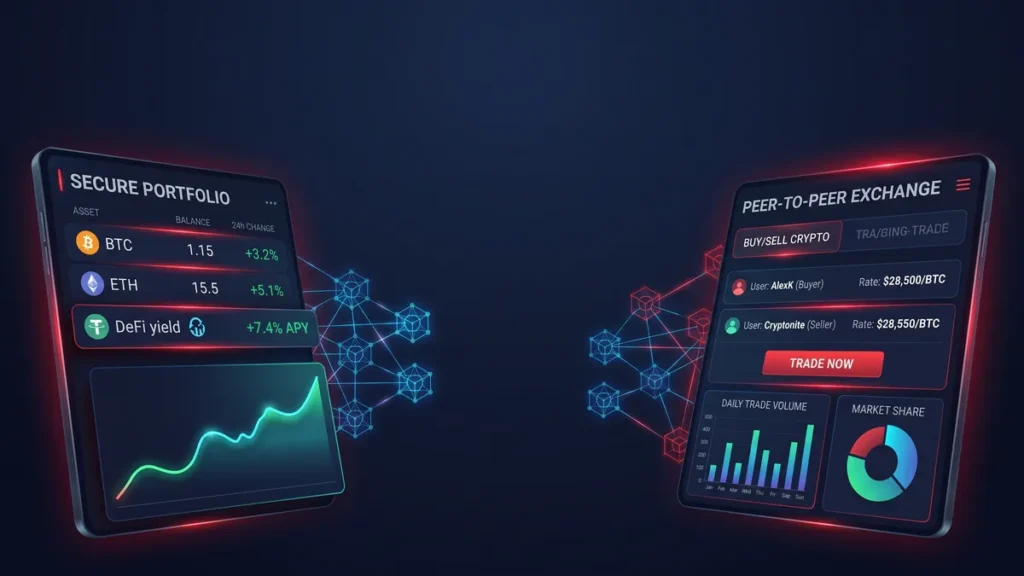
Utilizing a P2P Crypto Exchange with No KYC
The most common method to acquire digital assets privately is through a p2p crypto exchange with no KYC platform like Hodl Hodl or Bisq. These services do not hold your funds. Instead, they match individual buyers and sellers directly.
When you buy Bitcoin or stablecoins, the seller places the assets into a secure escrow smart contract. You then send the payment using an agreed method, such as a local bank transfer or a cash app. Once the seller confirms receipt, the escrow releases the tokens directly to your address.
Swapping Crypto via Instant Services
If you already own an asset like Bitcoin but want to trade it for a different utility token without an exchange account, instant non-custodial swap platforms like Changelly or ChangeNOW fulfill this need perfectly. You specify the trading pair, provide your receiving address, send the funds to the designated deposit wallet, and the platform delivers the converted asset back to you within minutes.
How to Set Up Your Wallet and Start Lending
Whether you are a complete beginner or a seasoned investor, managing your digital assets should not mean compromising your data privacy. IZAKA-YA streamlines the path to passive rewards by completely eliminating invasive identity checks.
Because it skips the exhausting KYC onboarding entirely, you can securely grow your portfolio while keeping your personal identification strictly to yourself.
Here is how to get your funds working for you in just a few minutes.
Step 1: Create Your Account in Under 5 Minutes
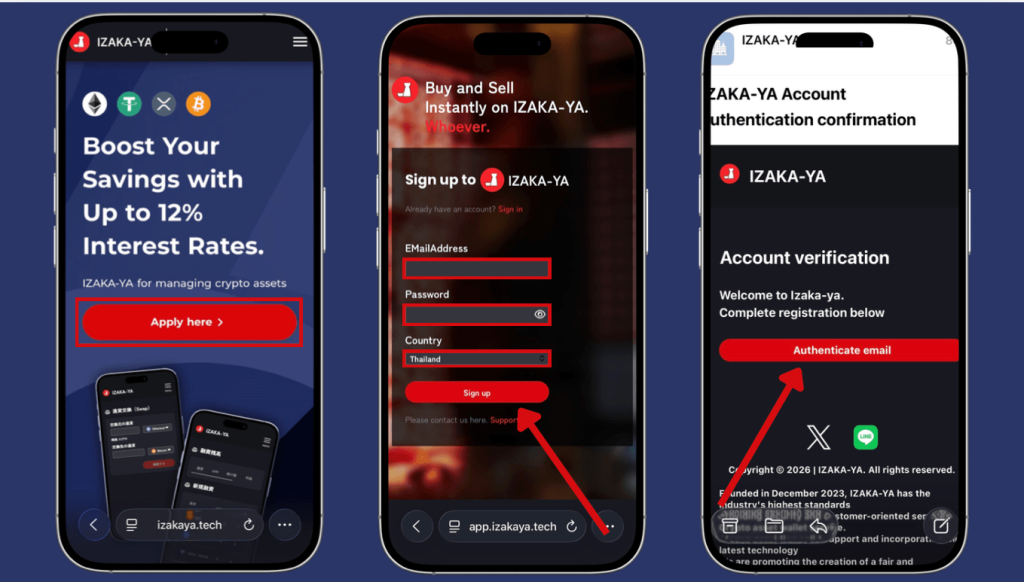
Getting started is fast and frictionless:
- Navigate to the official IZAKA-YA registration page.
- Enter your email address, create a password, select your country of residence, and click “Sign Up.”
- Verify your email address via the activation link sent to your inbox.
Your account is now fully active and ready to go: no passports, no selfies, and no invasive data collection required.
Step 2: Deposit Your Crypto Safely
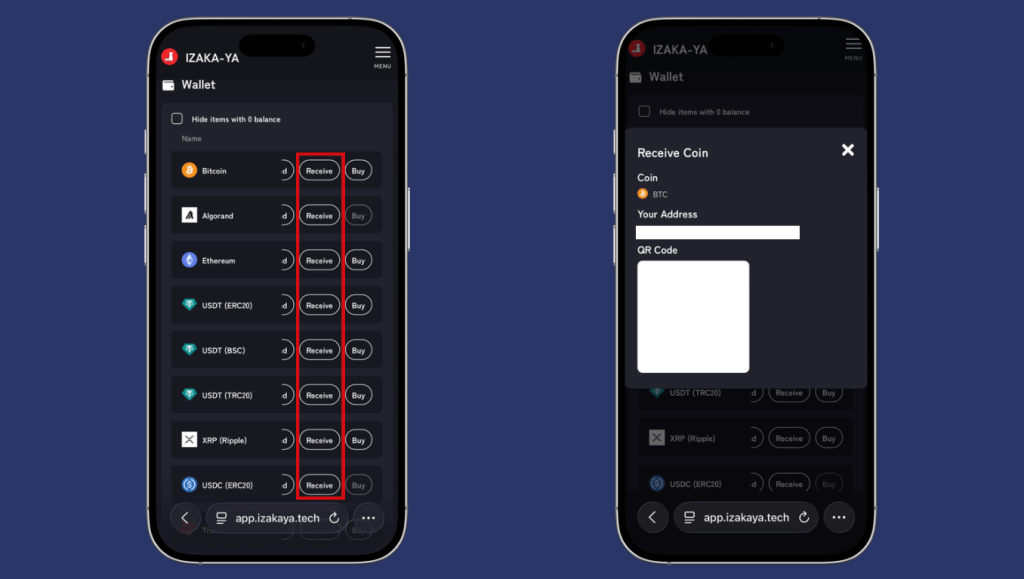
Once your dashboard is ready, you can fund your wallet with ease:
- Open your Wallet dashboard.
- Locate your preferred asset from the token list, and click “Receive” to generate your unique, private wallet address.
- A QR code and your wallet address will appear. Scan the secure QR code or copy the deposit address.
- Open the exchange or crypto wallet where you currently store your coin.
- Paste the copied address into the field and send your asset.
Step 3: Grow Your Portfolio with No-KYC Passive Lending
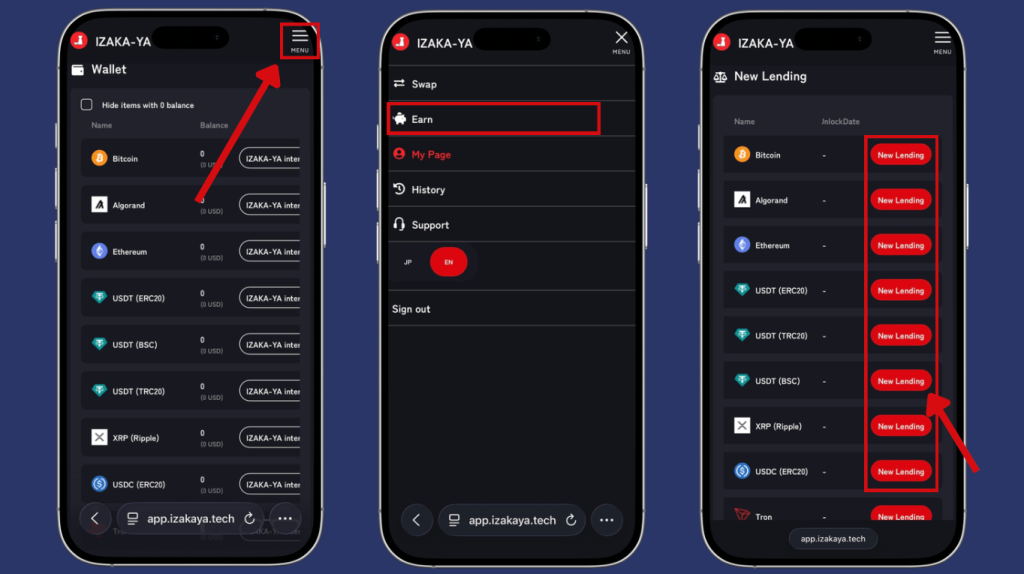
With your asset securely in your wallet, you can put your capital to work with IZAKA-YA’s Crypto Lending program to earn passive income from your holdings.
- Click the Menu icon in the top-right corner and select “Earn.”
- From the list of supported assets, find ur preferred asset and click the red “New Lending” button.
Your digital assets will instantly begin participating in the lending pools, allowing you to generate yield safely while keeping your real-world identity entirely off the grid.
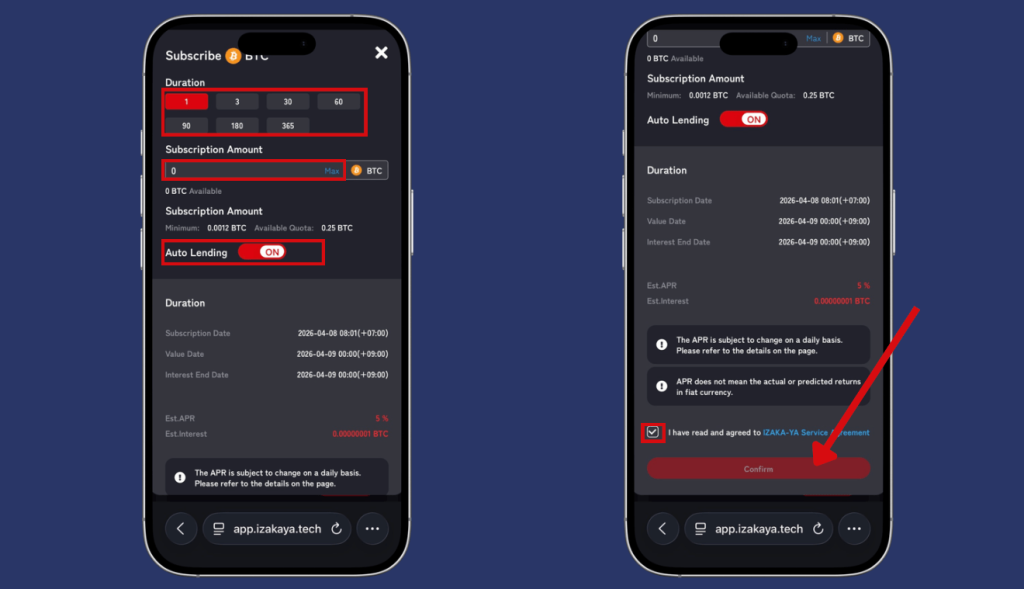
- Choose your preferred lending period (number of days).
- Enter the amount
- If you’d like your funds to be automatically re-lent when the term ends, enable “Auto-Renew Lending.
- Check the confirmation box and click the red “Confirm” button to start lending.
Register IZAKA-YAkeyboard_arrow_right
Interested in earning interest on your digital assets? Read our complete guide to crypto lending platforms to get started: Best Crypto Lending Platforms: Rates and Guide
Frequently Asked Questions (FAQ)
In most jurisdictions, using a non-KYC platform to trade crypto-to-crypto is completely legal. However, individual regional restrictions apply, and citizens of certain countries may be blocked from accessing specific centralized platforms due to local compliance frameworks.
No. Standard banking networks and payment processors require identity tracking by law. If you want to buy tokens using fiat currency without providing an ID, you must use peer-to-peer networks where you pay an individual directly.
The primary risk is user error, such as losing your wallet recovery phrase. Additionally, on centralized non-KYC exchanges, there is always a slight chance the platform could freeze an account or request verification unexpectedly if it detects anomalous transaction patterns.
Yes. Some peer-to-peer platforms allow buyers and sellers to trade directly without mandatory identity verification. Even so, it is important to verify the reputation of your trading partner and follow the platform’s security recommendations.
A no KYC exchange can be safe if it has a strong reputation, robust security measures, and a proven track record. Before depositing funds, research the platform, enable two-factor authentication, and avoid storing large amounts of cryptocurrency on any exchange for long periods.