



Opening your first cryptocurrency exchange account is a confusing experience. You are immediately confronted with flashing numbers, complex charts, and jargons that seem designed to confuse newcomers. Words like margin, perpetuals, options, and leverage dominate the screen. But before touching any of those advanced financial instruments, you need to understand the foundation of the crypto industry. That foundation is spot trading.
Every major cryptocurrency exchange is built around this core mechanic. If you want to actually own the digital assets you are investing in, you must learn how this specific market operates.
This guide will walk you through the real mechanics of the spot market, explain how prices are actually formed, and show you how to execute trades without losing money to hidden fees or poor execution.
What is Spot Trading?
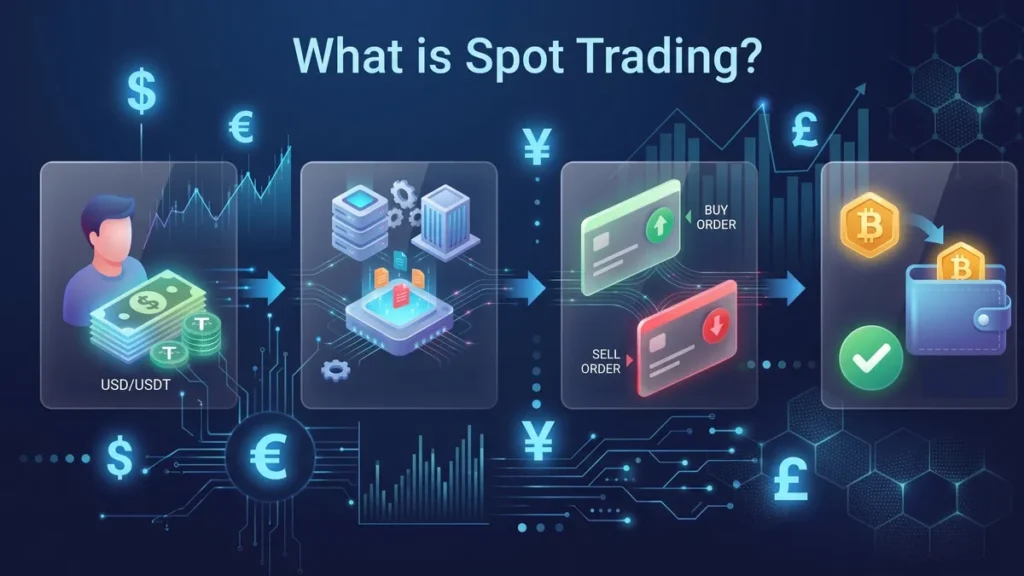
If you walk into a store, hand the cashier a twenty dollar bill, and walk out with a bag of coffee beans, you just completed a spot transaction. Money exchanged hands, and the physical asset was delivered immediately.
Crypto spot trading operates on the exact same logic. You are buying or selling a digital asset at the current market price for immediate delivery. If you swap US Dollars for Bitcoin on a spot platform, the trade settles on the spot. Your cash balance drops, your Bitcoin balance rises, and you take direct ownership of the coin. You hold the cryptographic rights, meaning you can leave it on the exchange, send it to a friend, or withdraw it to a private hardware wallet for long-term safekeeping.
In a futures or options market, you never actually touch the coin. You are simply trading contracts that track the price of Bitcoin. However, if your goal is to buy and hold the actual asset, the spot market is your perfect entry point.
How the Spot Market Actually Functions
A common misconception that many beginners have is that, when they buy crypto, they are buying it directly from the exchange company itself. The exchange is just a software platform playing matchmaker between buyers and sellers from all over the world.
The Order Book Engine
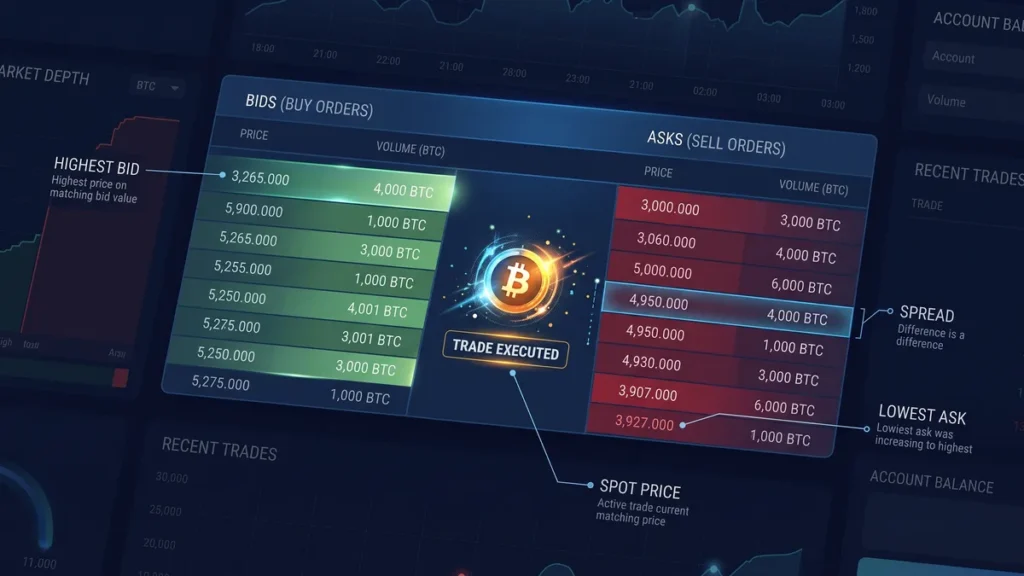
The heartbeat of any crypto exchange is the order book. This is a real time, public ledger displaying every single active buy and sell order for a specific trading pair.
A trading pair simply shows which two assets are being exchanged. If you are trading crypto like Ethereum against the US Dollar Tether stablecoin, you are looking at the ETH/USDT pair.
🚀 The order book is divided into two sides: The gap between the highest bid and the lowest ask is called the spread. When a buyer finally agrees to a seller’s asking price, or a seller accepts a buyer’s bid, a trade finally happens. That exact price becomes the new global spot price for that asset.
Liquidity and Market Depth
Understanding order books leads directly to understanding liquidity. Liquidity refers to how easily you can buy or sell an asset without causing the price to crash or spike.
If a market has deep liquidity, it means there are massive amounts of buy and sell orders waiting in the order book. A wealthy investor could buy a million dollars worth of spot Bitcoin without significantly altering the price. In a low liquidity market, that same million dollar purchase would eat through all the low priced sell orders, driving the price up violently in a matter of seconds. This phenomenon is called slippage.
The Psychology of the Spot Market

Understanding the technical mechanics of what is spot trading in crypto is only half the battle. Let’s dive into the other half, which is the psychology behind the spot market.
The crypto market operates 24 hours a day, 365 days a year. It never closes. This constant accessibility can lead to severe psychological fatigue.
Because spot trading does not involve leverage, your liquidation risk is essentially zero. This fact should provide peace of mind. However, the extreme volatility of digital assets still causes investors to panic. Seeing your portfolio drop 20 percent in a single afternoon is a common occurrence.
Successful spot traders operate with clear plans. They know their exact entry point, their target profit taking price, and their absolute maximum pain threshold for cutting losses. Instead of buying and selling impulsively, they rely on the limit orders they set when their minds are calm.
Mastering Order Types
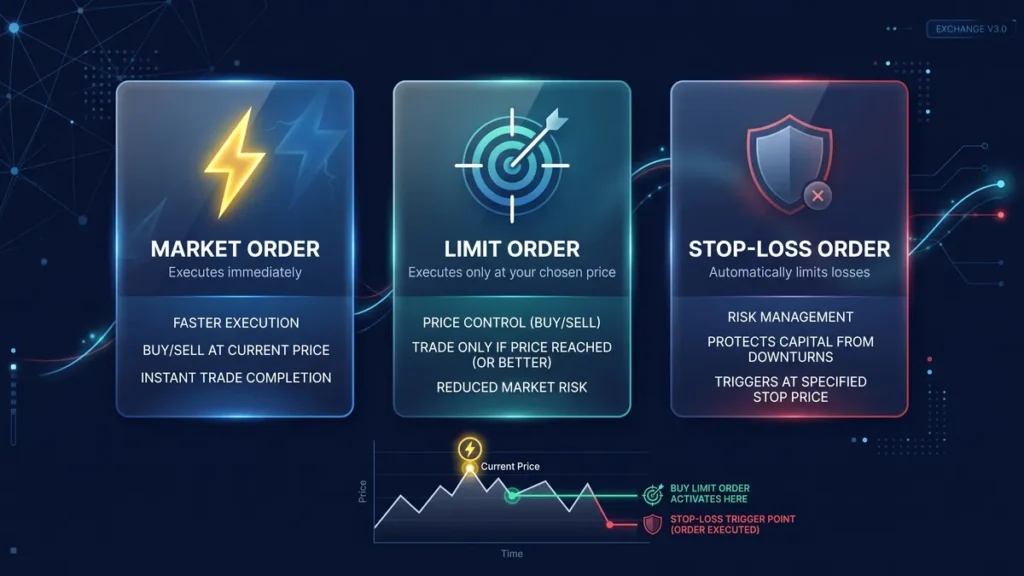
Now that you know how the engine works, you need to know how to drive. You do not just hit a “buy” button. You have to specify exactly how you want your trade to interact with the order book.
Market Orders
A market order tells the exchange software to buy or sell your asset immediately at the best available current price. You prioritize speed over price precision.
If you place a market order to buy 10 Ethereum, the exchange will instantly match you with the lowest available asks in the order book until your order is filled. Market orders are useful when you need to enter or exit a position urgently, but they can be dangerous in low liquidity markets due to the slippage mentioned earlier.
Limit Orders
A limit order gives you control over your entry or exit price. You tell the exchange the exact price at which you are willing to trade.
If Bitcoin is currently trading at $65,000, but you only want to buy if it drops to $62,000, you place a buy limit order at $62,000. Your order sits patiently in the order book. If the price never drops to your target, your order never executes. Limit orders protect you from bad pricing, but they offer no guarantee that your trade will actually happen.
Stop-Loss Orders
Risk management is the most important skill in crypto trading. A stop-loss order is designed to limit your potential losses if the market moves against you.
Imagine you buy an asset at $100. You decide you are not willing to lose more than 10 percent of your investment. You place a stop-loss order at $90. If the market price drops to $90, your stop-loss is triggered and automatically converted into a market order, selling your asset to prevent further losses.
Order Type
Execution Speed
Price Control
Guarantee of Fill
Best Used For
Market Order
Immediate
None
Very High ⭐️⭐️⭐️
Entering or exiting a position urgently.
Limit Order
Variable (waits for your target)
High
Low⭐️
Entering at a specific discount or taking profits.
Stop-Loss Order
Immediate (once triggered)
Sets a trigger to prevent further loss
Very High (once triggered) ⭐️⭐️⭐️
Risk management and protecting your capital from crashes.
The Reality of Trading Costs
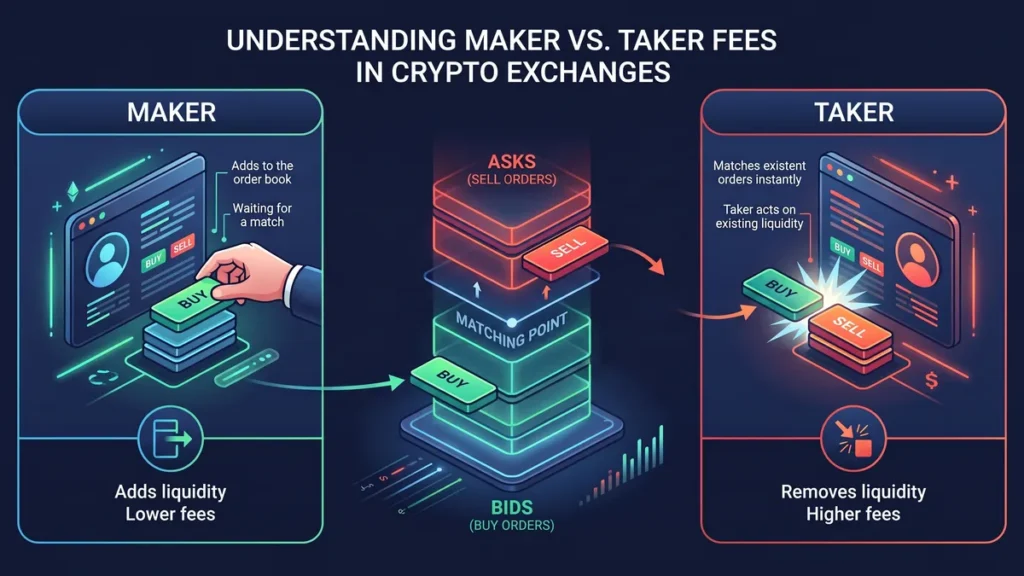
Exchanges provide the infrastructure, security, and matching engine, and they charge you for the privilege of using it. Most exchanges use a maker and taker fee model. This model incentivizes users to provide liquidity to the order book.
Maker vs. Taker Fees
- Maker Fee: You pay this fee when you place an order that does not execute immediately. For example, placing a limit order away from the current price adds an order to the book. You “make” liquidity. Exchanges reward this by charging a lower fee.
- Taker Fee: You pay this fee when you place an order that executes instantly against an existing order. Market orders always pay taker fees because they “take” liquidity away from the order book. Taker fees are almost always higher.
To put this into perspective, we can look at standard Binance spot trading fees. Binance charges a 0.1 percent fee for both makers and takers on regular spot trades. While 0.1 percent sounds tiny, it adds up incredibly fast if you are trading daily. Smart traders actively look for ways to reduce these costs, such as holding the exchange’s native platform token to secure fee discounts or using limit orders exclusively on platforms that offer maker rebates.
Understanding Binance Spot Trading Fees
Every exchange charges a toll for providing the infrastructure and matching your orders. Because Binance is the largest platform globally, understanding their specific fee structure provides an excellent baseline for how the entire industry handles transaction costs.
When you execute a trade on their platform, you are charged a baseline percentage. However, the exchange provides several built-in mechanisms that allow savvy users to reduce these costs significantly.
Here is a breakdown of how these charges work in practice:
- The Standard Base Rate: By default, Binance spot trading fees sit at 0.1 percent per trade. This applies to both makers and takers on regular spot pairs. If you buy $1,000 worth of crypto, the exchange takes a $1 cut.
- The Native Token Discount: Binance operates its own cryptocurrency called BNB. If you hold BNB in your account and toggle the setting to pay your trading fees with it, you receive an automatic 25 percent discount. This instantly drops your standard fee from 0.1 percent down to 0.075 percent.
- VIP Volume Tiers: The platform rewards high volume traders. If your 30 day trading volume crosses certain thresholds, your maker and taker fees drop progressively lower to encourage you to keep bringing liquidity to their market.
However, the exchange fee structures are not permanent. These prices can be adjusted by the platform based on market conditions, promotional periods, or changes to their tier requirements. Make sure to check the official fee schedule on the exchange right before you start trading to avoid any unexpected costs.
Best Practices for Successful Spot Trading
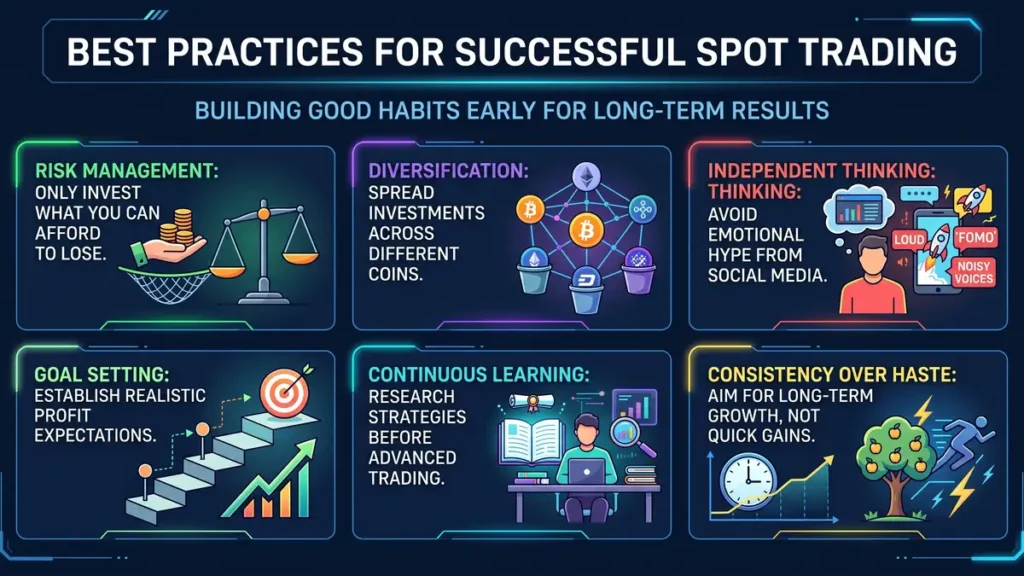
Building good habits early can improve your long-term results.
Consider following these practices:
- Invest only what you can afford to lose.
- Diversify across different cryptocurrencies.
- Avoid making decisions based solely on social media.
- Set realistic profit expectations.
- Continue learning before trying advanced trading strategies.
Consistency often produces better outcomes than chasing quick gains.
Managing Your Assets Post-Trade
Once you successfully execute a trade on the spot market, you face a critical decision regarding custody. Leaving your newly purchased crypto on a centralized exchange is convenient, but it introduces counterparty risk. If the exchange goes bankrupt or suffers a hack, you could lose your funds.
Crypto lending platforms allow eligible users to earn rewards by lending supported assets, while staking lets certain cryptocurrencies help secure their blockchain networks in exchange for rewards. Some investors also explore decentralized finance (DeFi) protocols to earn yield, although these typically involve higher complexity and additional smart contract risks.
If you are looking for a simple way to put your assets to work, IZAKA-YA is built specifically for newcomers. The platform focuses on keeping asset management as straightforward as possible, completely bypassing the confusing technical setups that typically frustrate new users.
Rather than just acting as a digital storage vault, it allows you to swap tokens and access earning features directly inside the application. This built-in functionality means you do not have to worry about bouncing your funds back and forth between different exchanges just to make a trade. With an incredibly fast setup process, anyone can jump in and start growing their portfolio immediately, regardless of their familiarity with complex blockchain jargon.
Register IZAKA-YAkeyboard_arrow_right
Frequently Asked Questions (FAQs)
Yes. Spot trading is the easiest form of crypto trading because there is no leverage or borrowing involved. Yes. Cryptocurrency prices fluctuate, so the value of your holdings can rise or fall after purchase. Spot trading gives you ownership of the cryptocurrency. Futures trading involves contracts that speculate on future prices without owning the asset itself. Yes. Most major cryptocurrency exchanges allow users to buy spot Bitcoin, meaning you purchase actual Bitcoin instead of a derivative contract. Binance generally offers competitive spot trading fees, with additional discounts available for eligible users. Always check the latest fee schedule before trading. Yes. Binance Wallet supports buying, storing, and managing supported cryptocurrencies. However, spot trading is available on cryptocurrency exchanges, where you can buy and sell digital assets at the current market price.