



Every time the market experiences a sharp downturn, a wave of panic spreads rapidly across the internet. The primary question on everyone’s mind is always the same: is Bitcoin dead? You have likely seen news anchors and financial commentators declaring that the era of digital currency has finally come to an end.
However, looking at the historical data paints a completely different picture. In this comprehensive guide, we will explore the reality behind these dramatic headlines.
The Big Question: Is Bitcoin Dead?

To understand why people constantly ask if the market is finished, we must look at how human psychology reacts to price volatility. Digital assets experience wild price swings that traditional stock market investors find shocking. When the price drops significantly, the immediate reaction is fear. Consequently, mainstream news outlets capitalize on this fear by publishing sensational articles claiming that the network is finished.
Despite these repetitive claims, the blockchain network continues to operate without a single interruption. Millions of computers around the world process transactions securely every single day. Not only that, the underlying protocol does not care about daily price action or negative news coverage. As long as the internet exists and people want a decentralized way to store value, the network remains fully alive.
A History of Premature Obituaries
The financial media has a long track record of calling the end of digital currencies. Various websites even track exactly how many times major publications have asked is Bitcoin dead? over the past decade. The number is well into the hundreds. In 2011, when the price crashed dramatically, commentators called it a failed experiment. Similar obituaries were written in 2014, 2018, and 2022.
Every single time the market enters a cooling period, the same narrative emerges. People assume that because the hype has faded, the technology has failed. Yet, after every major crash, the network slowly rebuilds its strength. Ultimately,this cycle of boom and bust is completely normal for a new asset class finding its place in the global financial system.
Why the Network Keeps Surviving
The resilience of the network comes down to its core design. Unlike a traditional company, there is no central headquarters to shut down and no CEO to arrest. The system is distributed across thousands of independent nodes globally. In addition, institutional adoption provides a massive safety net.
Major banks and investment funds now allocate billions of dollars into digital assets, recognizing that the underlying technology offers a superior alternative to outdated banking infrastructure.
Understanding Bitcoin Halving Cycles
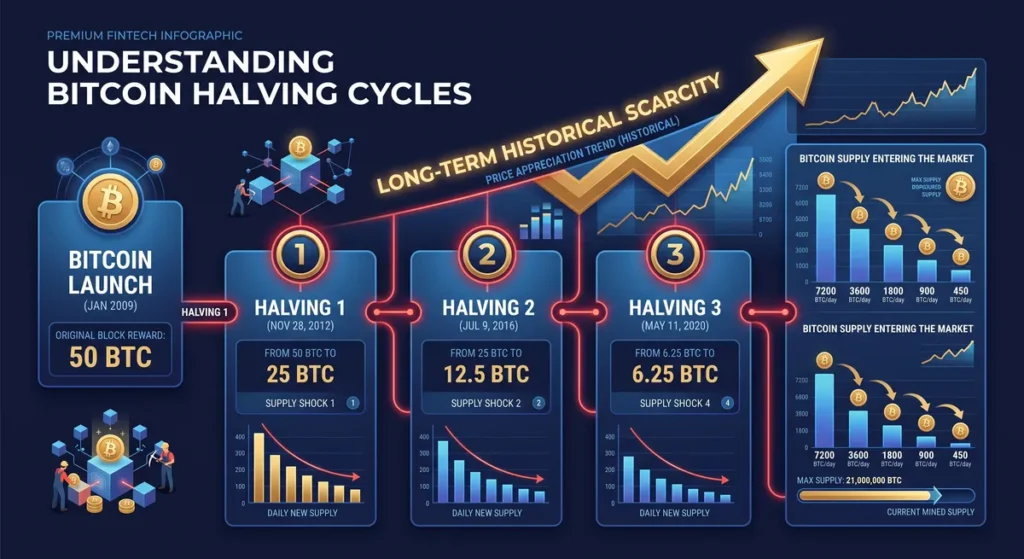
To grasp the long term value proposition of digital money, you must examine how new coins are created and distributed into the market. A key feature programmed directly into the code is the concept of Bitcoin halving cycles. Roughly every four years, the reward given to miners for securing the network gets cut exactly in half. Consequently, this mechanism completely alters the supply dynamics of the asset over time.
Traditional fiat currencies suffer from inflation because central banks can print an unlimited supply of money. Therefore, the creator of the blockchain wanted to build a system with absolute scarcity. By reducing the creation of new coins on a predictable schedule, the asset becomes increasingly rare.
The total supply is strictly capped at twenty-one million coins. Because millions of coins have already been lost forever due to forgotten passwords and destroyed hard drives, the actual available supply is much lower. This extreme scarcity means that even a tiny fraction of global wealth moving into the network is enough to sustain significant value. For the price to literally hit zero, millions of independent holders would have to collectively agree to give away their assets for free. Human greed and the basic principles of supply and demand prevent this scenario from ever playing out. Consequently, there will always be a buyer waiting at lower price levels. Miners use specialized computers to solve complex mathematical puzzles. When they solve a puzzle, they process a block of transactions and receive newly minted coins as a reward. During the first four years of the network, miners received fifty coins per block. After the first halving event, that reward dropped to twenty-five coins. Today, following the most recent event in 2024, the reward sits at just 3.125 coins per block. This dramatic reduction means fewer new coins enter the open market for sale. When the supply of a globally demanded asset shrinks, the natural economic result is a potential increase in long-term price.⚙️ The Mathematics of the Network
📉 How the Supply Gets Reduced
Past Halving Events and Price Trends
Historical data shows a correlation between these programmed supply cuts and major market rallies. While past performance never guarantees future results, the pattern is incredibly consistent.
Halving Event
Year
Reward Per Block
Market Cycle Phase
First
2012
25 BTC
Early Adoption
Second
2016
12.5 BTC
Retail Expansion
Third
2020
6.25 BTC
Institutional Entry
Fourth
2024
3.125 BTC
Mainstream Integration
Following each of the previous events, the market experienced a period of accumulation followed by an upward price movement. Ultimately, the reduction in available supply simply could not keep up with the steady global demand.
Can Bitcoin Go to Zero?

Fear is a powerful emotion that often causes investors to make irrational decisions during a market crash. The thought of a portfolio dropping to absolute nothingness is terrifying. Therefore, many newcomers eventually ask: can Bitcoin go to zero? In mathematical theory, any asset could drop to zero if every single person on earth decided it had no value simultaneously.
However, looking at the reality of the ecosystem makes a complete collapse virtually impossible. The sheer amount of infrastructure built around the network guarantees a permanent baseline of demand. Energy companies mine coins to monetize surplus power, and entire countries have adopted it as legal tender. Furthermore, large corporations hold it on their balance sheets as a hedge against inflation.
Why Do People Keep Asking “Is Bitcoin Dead?”
Whenever Bitcoin experiences a sharp price decline, negative sentiment spreads quickly. Investors panic, social media fills with fear, and mainstream news often declares the end of crypto.
Bitcoin has experienced several dramatic corrections throughout its history. Many of them exceeded 70%.
Some notable examples include:
Period
Approximate Decline
Main Cause
2011
Over 90%
Early market volatility
2014 to 2015
Around 85%
Mt. Gox collapse
2018
Around 84%
ICO bubble burst
2022
Around 77%
Inflation, rate hikes, major crypto failures
Each crash sparked countless articles claiming Bitcoin is dead.
However, history shows that Bitcoin eventually recovered from every previous bear market, although past performance never guarantees future results.
🚨 Fear, media attention, and market psychology Negative headlines naturally attract more attention than positive ones. During market downturns, investors also become more emotional, making dramatic predictions more common. This explains why is BTC dead becomes a trending search almost every bear market.
Institutional Adoption vs. Retail Fear
The main difference between today and the early days of the market is institutional involvement. During previous crashes, retail investors drove the panic selling. Today, large asset managers like BlackRock and Fidelity provide regulated investment vehicles for their clients. These massive financial entities do not panic sell during routine market corrections. Instead, they use the opportunity to accumulate more assets at a discount, providing a massive floor for the price.
Is Crypto Dead, or Just Maturing?
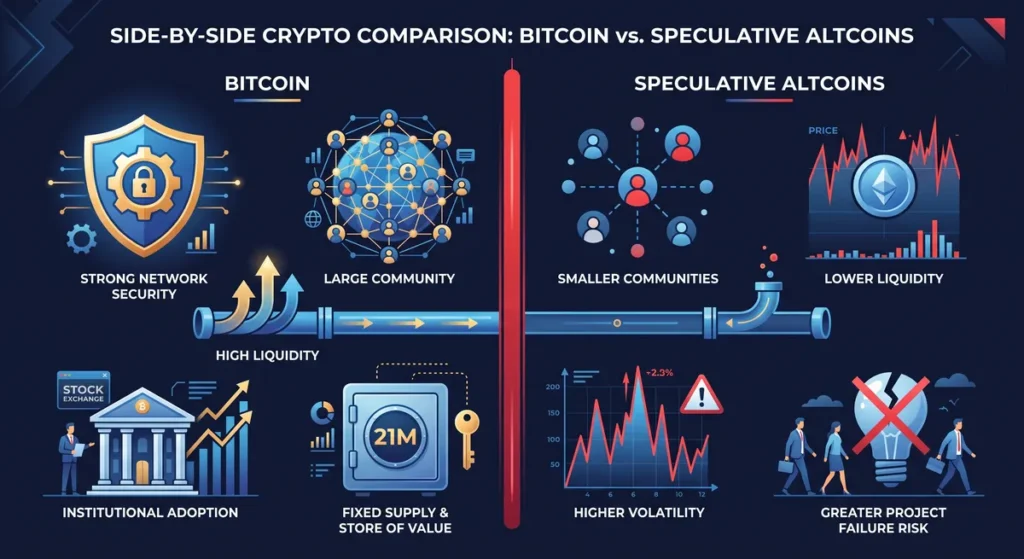
When smaller alternative coins lose massive amounts of value, the broader conversation shifts. Casual observers inevitably start asking: is crypto dead? The reality is that the broader industry is simply maturing and cleaning out the garbage. The market is incredibly saturated with useless tokens created entirely for speculation. Thus, when a bear market hits, these worthless projects naturally fade away and die.
This cleansing process is actually healthy for the long term growth of the technology. It forces capital and developer talent back into projects with real world utility and sustainable economic models.
The Evolution of Ethereum and Cardano (ADA)
While the original blockchain serves primarily as a digital store of value, other networks are building the foundation of decentralized finance. Ethereum remains the dominant platform for smart contracts and decentralized applications. Hundreds of billions of dollars flow through its decentralized exchanges and lending protocols.
Similarly, alternative networks like Cardano (ADA) continue to focus on academic research and peer reviewed development to build highly scalable infrastructure. Therefore, these ecosystems are definitely not dead. They are actively processing millions of complex transactions globally, completely bypassing traditional banks and financial gatekeepers.
The Rise of Stablecoins like USDC
One of the most important developments proving the industry is alive and well is the massive adoption of stablecoins. Assets like USDC bridge the gap between traditional fiat money and decentralized networks. People living in countries with severe inflation use USDC daily to protect their purchasing power. These digital dollars settle instantly across borders for fractions of a penny. Consequently, the daily trading volume of stablecoins alone proves that the core technology has achieved permanent product market fit.
What Should Crypto Holders Do During a Bear Market?
Bear markets can feel frustrating, especially for investors who bought near previous highs. Instead of making emotional decisions, it often helps to review your long-term investment goals.

For the lazy HOLDer
If you believe in Bitcoin’s long-term potential, staying patient and avoiding emotional trading may be a reasonable approach. Many experienced investors focus on secure storage and regular portfolio reviews rather than constantly watching price charts.
For the Altcoin Bagholder
If most of your portfolio consists of smaller cryptocurrencies, consider reviewing each project’s fundamentals. Not every token survives multiple market cycles, so diversification and risk management become increasingly important.
For the DeFi Refugee
If you previously chased high yields from decentralized finance platforms, today’s market may encourage a greater focus on security, transparency, and sustainable returns. Understanding where your assets are stored can be just as important as the yield itself.
Diversification and risk management
Holding digital assets requires a proactive approach to personal security and storage. Leaving your funds on a centralized exchange is risky because you do not truly own the assets until you control the private keys. To protect your wealth, using dedicated storage solutions and maintaining strong operational security is absolutely essential.
Regardless of market conditions:
- Never invest more than you can afford to lose.
- Diversify instead of relying on one asset.
- Store crypto securely.
- Continue learning before making major investment decisions.
Alternative Hardware Wallets and Security

Hardware wallets are physical devices that keep your private keys completely disconnected from the internet. The Ledger Nano series is a highly popular choice for beginners, offering a secure chip and a straightforward user interface. Trezor is another excellent hardware alternative that provides robust open source security for storing your long term investments safely. Meanwhile, for those who frequently interact with smart contracts, a software alternative like MetaMask is incredibly useful for navigating decentralized applications seamlessly.
In addition to using secure wallets, you should always route your connection through a reliable VPN when accessing your accounts on public networks. A VPN encrypts your internet traffic, preventing malicious actors from intercepting your sensitive financial data while you trade.
Maximizing Returns Safely With IZAKA-YA

Once you have your security under control, you might wonder what to do with your assets during boring market phases. Holding is a great strategy, but putting your capital to work can generate additional yield. For those looking to earn a steady passive return on their digital assets, you can seamlessly lend your funds out using the IZAKA-YA Crypto lending wallet. Generating a safe yield on your holdings is a smart way to accumulate more coins while waiting for the next major market expansion.
Register IZAKA-YAkeyboard_arrow_right
Frequently Asked Questions (FAQ)
Once the final coin is generated, which is estimated to occur around the year 2140, miners will no longer receive block rewards. Instead, they will be compensated entirely through transaction fees paid by users.
The fourth Bitcoin halving happened on April 19, 2024 (or April 20, 2024, depending on the time zone).
While historical data shows a strong correlation between supply reductions and price increases, past performance does not guarantee future results. Macroeconomic factors and overall market liquidity also play significant roles in determining asset value.
Many projects launch without a sustainable business model or fundamental utility. Consequently, when speculative hype dries up, the market naturally removes these weak projects, leaving only networks that provide real value.
The most secure method for long term storage is utilizing a cold storage hardware wallet, such as a Ledger or Trezor, which keeps your private keys completely offline and away from potential hackers.