



Imagine your local bank paying you a double digit interest rate just for keeping your money in a savings account. That sounds impossible in the world of traditional finance. However, in the decentralized finance ecosystem, this concept is an everyday reality for millions of users worldwide.
If you are wondering “what is yield farming?”, it is essentially a modern way to put your idle cryptocurrency to work. Instead of just holding your digital assets in a crypto wallet and hoping for the price to go up, you lend or stake in a decentralized application. In return for providing your assets to these platforms, you earn interest, transaction fees, or extra tokens. It works very much like earning a yield on a traditional bank deposit, but the potential returns are often much higher because there are no corporate middlemen taking a massive cut of the profits. This guide will break down everything you need to know to get started with crypto passive income safely and effectively.
What is Yield Farming?: Decoding the Mechanics
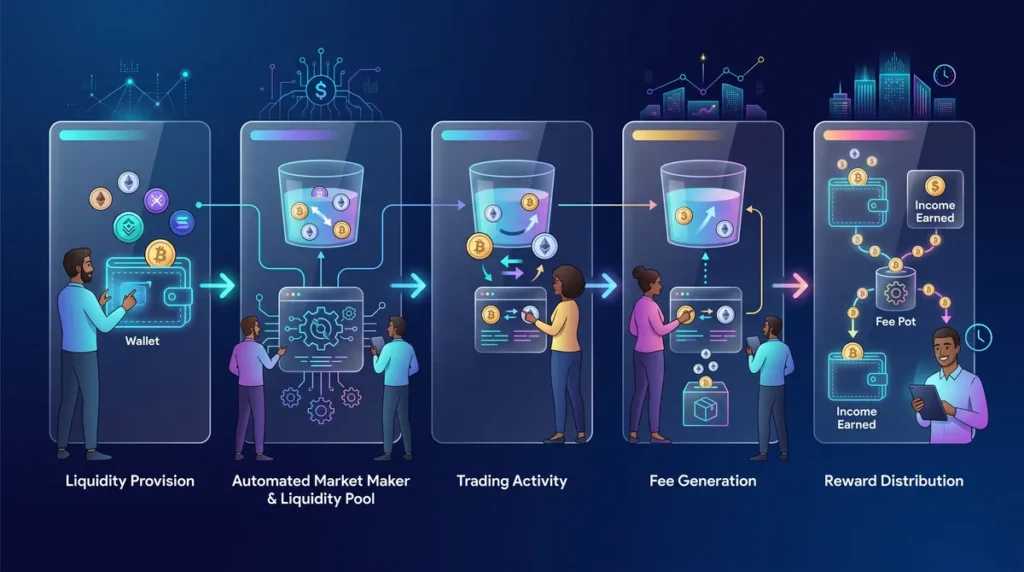
The technology behind these high returns might seem incredibly complex at first. In truth, the entire process relies on automated smart contracts and active community participation to function smoothly without human intervention.
When you engage in crypto farming, you are typically acting as a liquidity provider. Traditional stock markets and centralized crypto exchanges use an order book where buyers and sellers are matched up by a central authority. Decentralized exchanges do not have traditional buyers and sellers matching orders. Instead, they use something called an automated market maker and liquidity pools.
You deposit your tokens into these specialized pools, and other users trade directly against those pooled assets. Every time someone makes a trade, they are required to pay a small transaction fee. A portion of that fee goes directly back to you as a reward for providing the liquidity that made the trade possible. This means that as long as people are trading, you are constantly earning a steady stream of income.
A Quick Comparison: Holding vs. Crypto Farming
If you’re wondering whether yield farming is worth exploring, it helps to compare it with simply holding cryptocurrency. While both strategies can benefit from rising market prices, yield farming gives your assets an additional opportunity to generate rewards while you hold them.
The table below highlights the key differences between the two approaches.
Feature
Just Holding Crypto
Crypto Farming
Activity Level
Very passive
Active management and monitoring required
Primary Goal
Wait for long term price appreciation
Generate regular yield and compound growth
Risk Factor
Standard market volatility
Market volatility plus smart contract risks
Income Type
None until you sell
Continuous fee accumulation and token rewards
While holding crypto is the simpler approach, it leaves your assets sitting idle. Crypto farming requires more involvement, but it also offers the potential to earn passive income on top of any long-term price appreciation. Choosing between the two depends on your investment goals, risk tolerance, and how actively you want to manage your portfolio.
Strategies for Earning Crypto Passive Income
Building wealth while you sleep is the ultimate financial goal for many investors around the world. To execute this correctly, exploring the primary strategies behind “what is yield farming” offers a modern path to that dream by giving you multiple interconnected ways to earn a return on your digital capital.
When you deposit stablecoins like USDC or established assets like Ethereum into a DeFi protocol, you can generate crypto passive income in a few distinct ways. Understanding these methods is the first step toward building a profitable portfolio.
This is the most common form of farming. By supplying pairs of tokens to a decentralized exchange like Uniswap or Curve, you facilitate trading for other users. You earn a percentage of the trading fees proportional to your share of the total liquidity pool. Just like a traditional bank, decentralized lending platforms like Aave or Compound allow users to borrow funds. However, these platforms require borrowers to overcollateralize their loans. If you supply your tokens to these lending protocols, borrowers pay you interest. You receive the majority of those payments directly, creating a very steady and predictable stream of crypto passive income. Many platforms want to incentivize users to bring capital to their ecosystem. To do this, they reward users with their own native governance tokens on top of the standard trading fees. These bonus tokens can be held for future gains, used to vote on protocol updates, or sold immediately for profit to compound your initial investment.🚀 Providing Liquidity to Exchanges
🚀 Participating in Lending Protocols
🚀 Earning Governance Tokens
Why Do People Choose Crypto Farming?
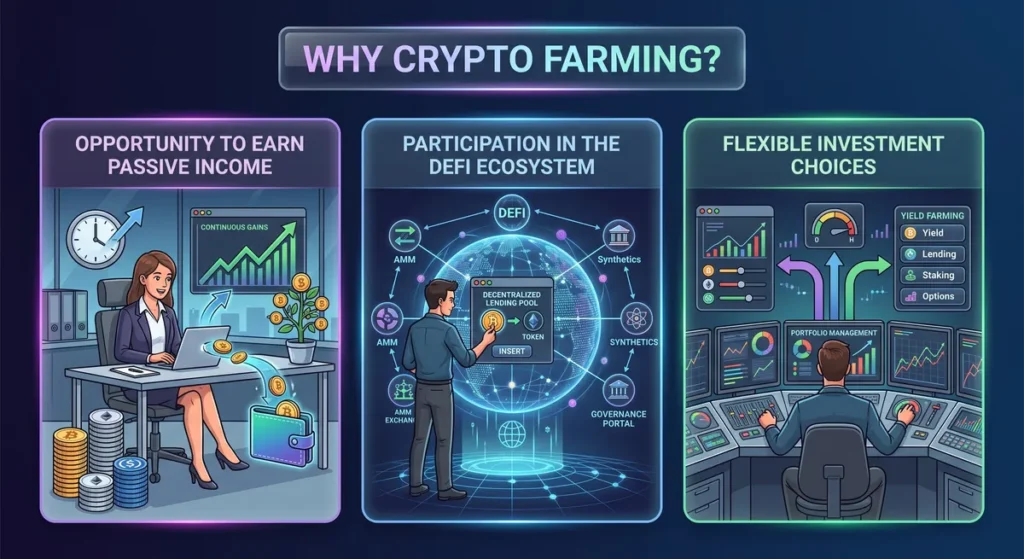
Many crypto investors already own digital assets but aren’t actively using them. Instead of simply waiting for prices to rise, yield farming offers another way to potentially increase the value of their holdings.
Several reasons explain why crypto farming has become popular.
Opportunity to Earn Passive Income
The biggest attraction is the ability to generate passive income.
Rather than leaving assets untouched in a wallet, investors can earn additional tokens over time. For long-term holders, this creates another potential source of returns without needing to trade frequently.
Participation in the DeFi Ecosystem
Yield farming also gives users direct access to decentralized finance.
By supplying liquidity or lending assets, participants help support decentralized applications while earning rewards in return. This creates a financial system that operates without relying on traditional banks.
Flexible Investment Choices
Different protocols offer different opportunities. Some investors prefer stablecoin lending for lower volatility, while others pursue higher returns by providing liquidity for newer blockchain projects.
This flexibility allows users to select strategies that better match their personal risk tolerance.
Key Metrics Every Farmer Must Know
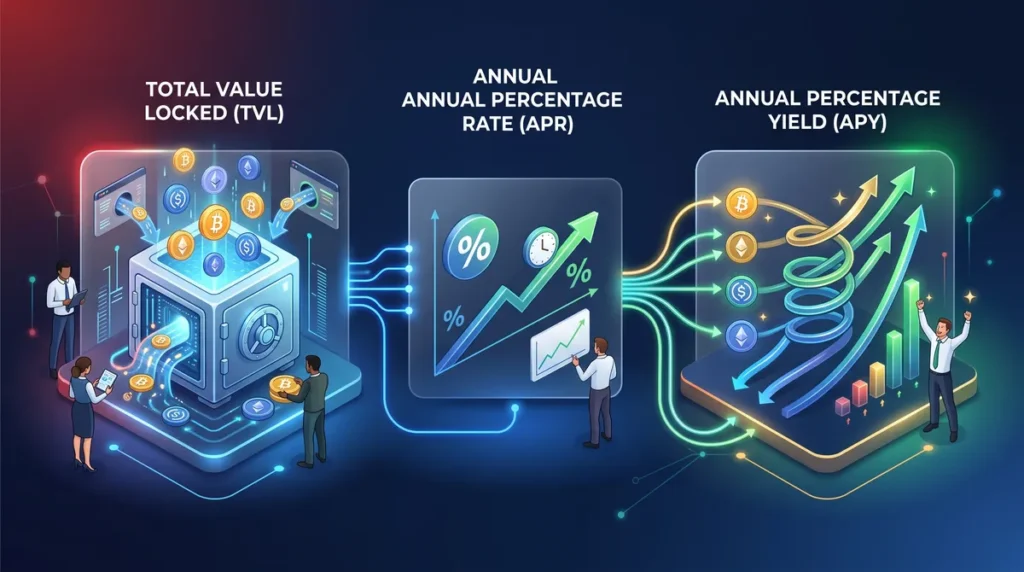
Once you understand why investors flock to crypto farming, the next step is learning how to spot the best opportunities, and avoid costly traps. Successfully navigating the decentralized finance space comes down to mastering a few crucial financial metrics
The first metric to look for is Total Value Locked. This number represents the total amount of user funds currently deposited inside a specific protocol. A high Total Value Locked generally indicates that the platform is trusted by the community and has deep liquidity. Conversely, a very low Total Value Locked might suggest a new, untested, or potentially risky platform.
You will also frequently see the terms APR and APY.
- Annual Percentage Rate (APR) calculates your simple interest over a year without taking compounding into account.
- Annual Percentage Yield (APY) is much more important because it factors in the effect of compounding your earned rewards back into your principal amount.
Always make sure you understand whether a platform is advertising its returns in APR or APY, as this significantly impacts your actual take home profit.
Yield Farming vs Crypto Staking
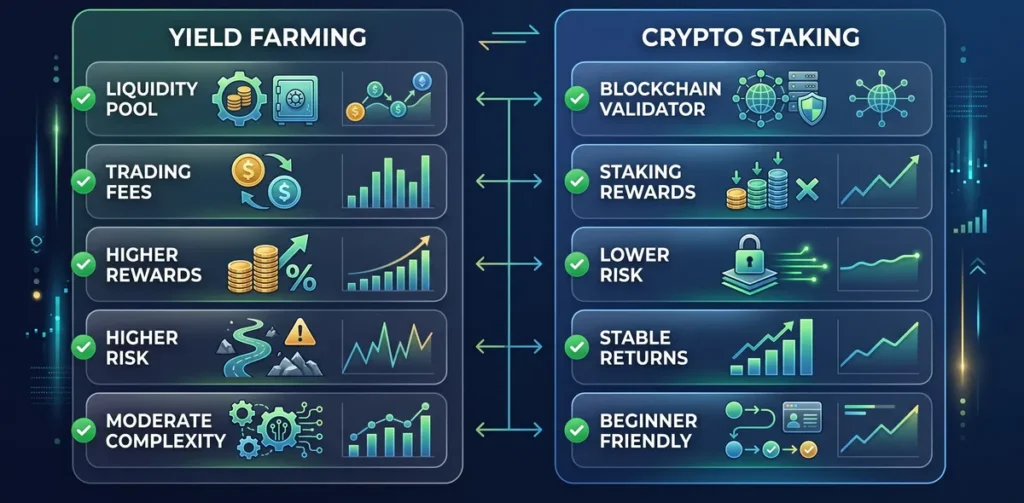
While yield farming and crypto staking are often grouped together as the premier ways to earn passive income, they operate on completely different mechanics. One turns you into a market maker, while the other turns you into a network validator. Understanding these differences is crucial for matching your investment strategy with your personal risk tolerance.
Feature
Yield Farming
Crypto Staking
Primary purpose
Provide liquidity or lend assets
Help secure a blockchain network
Reward source
Trading fees, lending interest, incentive tokens
Staking rewards from the blockchain
Risk level
Generally higher
Generally lower
Potential returns
Often higher but less predictable
Usually more stable
Complexity
Moderate to advanced
Beginner-friendly
For beginners, staking is often easier to understand. Yield farming may offer higher earning potential, but it usually requires a better understanding of DeFi and its associated risks.
The Risks of Crypto Farming
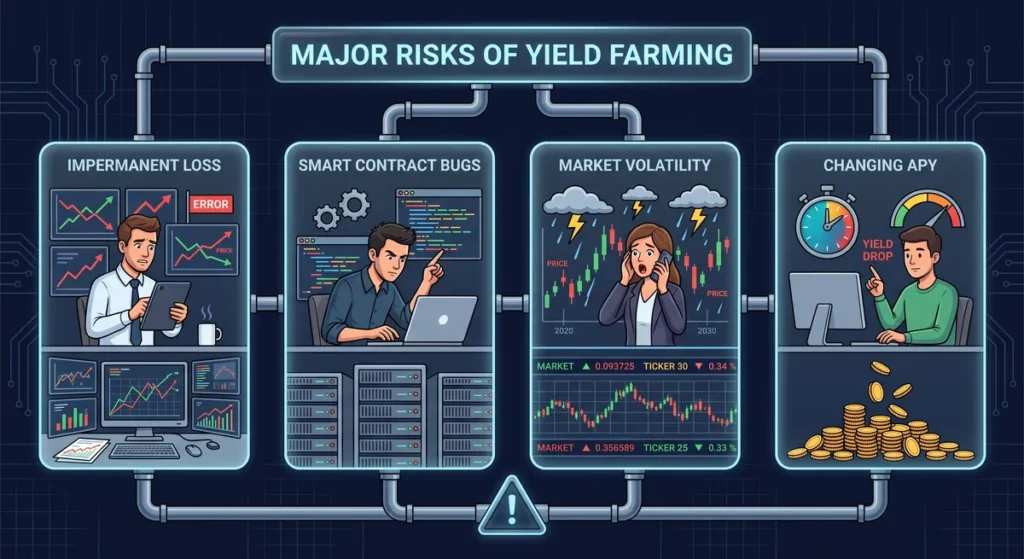
High financial rewards always come with certain trade offs. You must absolutely understand the potential downsides before locking up your hard earned funds in any experimental protocol. Education is your best defense against catastrophic losses in the fast moving world of decentralized finance.
The Danger of Impermanent Loss
This happens when the price of your deposited tokens changes significantly compared to when you first deposited them. The automated market maker constantly adjusts token ratios to maintain balance. This means if one token skyrockets in price, the pool will automatically sell some of it to buy the underperforming token. You might end up withdrawing less of a high performing asset than you originally put in, completely erasing your trading fee profits.
Smart Contract Bugs and Exploits
Since everything in decentralized finance runs on automated code, any hidden vulnerability can be exploited by malicious hackers. If a smart contract has a flaw, a hacker could potentially drain the entire liquidity pool in seconds, leaving investors with absolutely nothing. This is why you should always look for platforms that have been heavily audited by reputable third party security firms.
Scams and Rug Pulls
The crypto space is unfortunately filled with bad actors. Some new projects offer massive, unbelievable returns simply to attract large deposits from greedy investors. Once the liquidity pool is full, the developers will maliciously withdraw all the funds and abandon the project. This devastating scam is commonly known as a rug pull. Always stick to established, battle tested protocols if you want to protect your capital.
Maximize Your Returns with IZAKA-YA
Finding the perfect balance between high yields and robust security can be incredibly challenging for both newcomers and seasoned veterans. The learning curve for setting up self custody wallets, paying network gas fees, and managing multiple liquidity pools can be overwhelming. This is where specialized platforms come into play to simplify your investment journey.
IZAKA-YA is designed specifically for users who want to maximize their returns without dealing with the complex technical hurdles of traditional decentralized platforms. It bridges the gap between everyday crypto holders and lucrative lending opportunities. You can easily deposit your digital assets and start earning interest almost immediately, completely skipping the stressful process of manually managing liquidity pool pairs and calculating impermanent loss.
By using the IZAKA-YA, the platform automatically allocates your funds to safe, vetted lending protocols behind the scenes. This means you do not have to constantly monitor shifting interest rates or worry about approving countless complex smart contracts. Furthermore, IZAKA-YA prioritizes top tier security infrastructure to keep your digital assets completely protected while they generate consistent, reliable yield in the background.
Register IZAKA-YAkeyboard_arrow_right
Final Thoughts
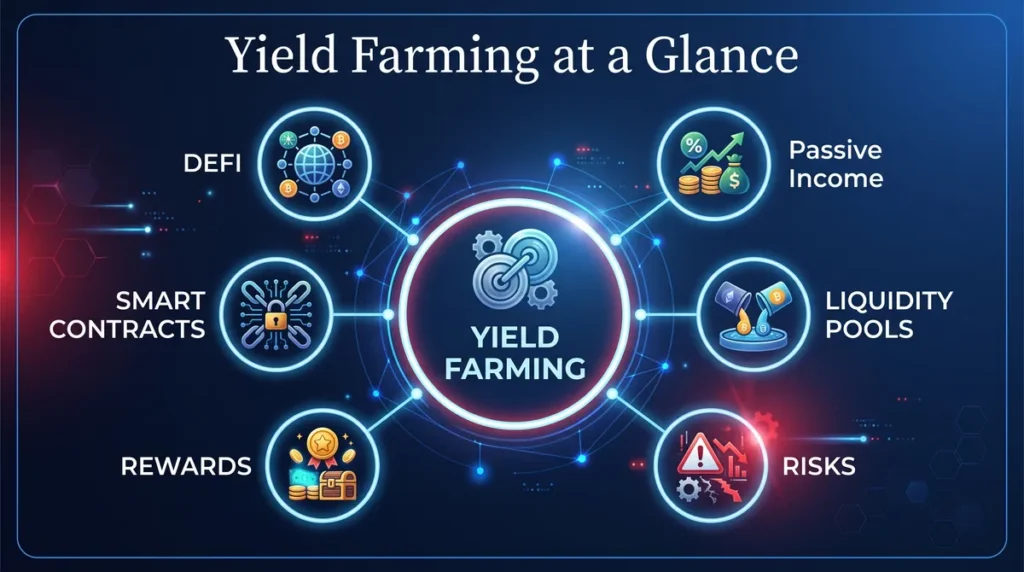
Yield farming has become one of the most popular ways to generate passive income while participating in the growing decentralized finance ecosystem.
Instead of letting your digital assets sit idle, you can use them to provide liquidity or lend them through DeFi protocols in exchange for rewards. While the earning potential can be attractive, it’s equally important to understand the risks involved, including market volatility, impermanent loss, and smart contract security.
If you’re new to crypto farming, begin with trusted platforms, invest only what you’re comfortable risking, and continue learning as you gain experience. A solid understanding of how yield farming works will help you make better decisions and build confidence as you explore new opportunities in the crypto space.
Frequently Asked Questions (FAQ)
Yes, it can be highly profitable, especially during bull markets. However, your profitability depends heavily on the platform you choose, the assets you provide, and your ability to manage associated risks.
Popular assets include Ethereum (ETH), USDC, USDT, DAI, Solana (SOL), and other cryptocurrencies supported by DeFi platforms.
You can start with just a few dollars. Keep in mind that network gas fees can eat into small profits, so starting with at least a few hundred dollars is usually the best way to make the transaction costs worthwhile.
It carries more risk than leaving money in a traditional bank. Using established protocols, keeping your assets in secure wallets, and sticking to stablecoins like USDC can significantly lower your overall risk profile.
Staking generally involves locking up a specific cryptocurrency to secure its blockchain network in exchange for rewards. Yield farming is a broader category that involves providing liquidity to trading pairs or lending out your tokens to generate income from decentralized applications.
