



Solana price prediction has become a major topic among crypto investors as SOL continues to rank among the largest blockchain assets by market value. In just a few years, Solana has evolved from a promising Layer-1 blockchain into one of the industry’s most active ecosystems, supporting decentralized finance (DeFi), meme coins, AI applications, stablecoin payments, and tokenized real-world assets.
As a result, many investors are asking an important question: How high could SOL realistically go in the coming years?
The answer depends on more than short-term price movements. Network adoption, developer activity, institutional demand, token economics, competition, and overall crypto market conditions will all play a role in determining SOL’s future value.
In this guide, we’ll examine the key factors behind SOL’s long-term outlook and provide our Solana price prediction for 2026 through 2035 based on different adoption scenarios and market trends rather than guaranteed outcomes.
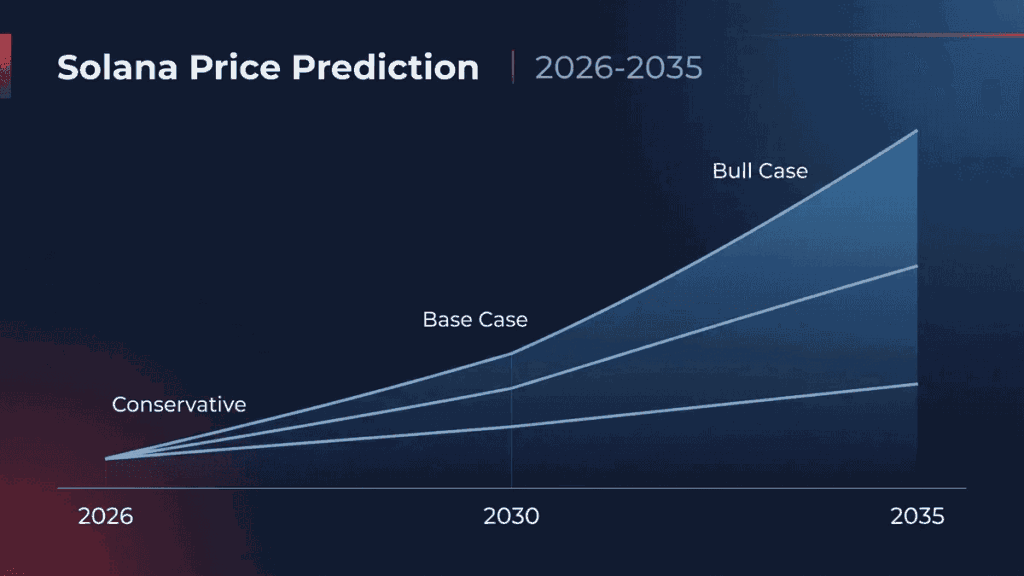
Solana Price Prediction 2026–2035 Summary
| Year | Conservative | Base Case | Bull Case |
| 2026 | $180–$250 | $250–$400 | $400–$600 |
| 2027 | $220–$320 | $350–$500 | $500–$700 |
| 2028 | $300–$450 | $500–$750 | $800–$1,100 |
| 2029 | $400–$600 | $700–$950 | $1,000–$1,400 |
| 2030 | $600–$900 | $900–$1,300 | $1,500–$2,500+ |
| 2035 | $900–$1,500 | $1,800–$3,000 | $3,500–$5,000+ |
These estimates represent possible scenarios based on Solana adoption, market conditions, and broader crypto industry growth. They should not be viewed as guaranteed price targets.
What Is Solana?
Before looking at our Solana price prediction, it’s important to understand what makes Solana one of the most closely watched blockchain networks in the industry.
Launched in 2020, Solana is a high-performance Layer-1 blockchain designed to process transactions quickly while keeping fees low. Unlike many networks that struggle with congestion during periods of high activity, Solana was built with scalability as a core priority.
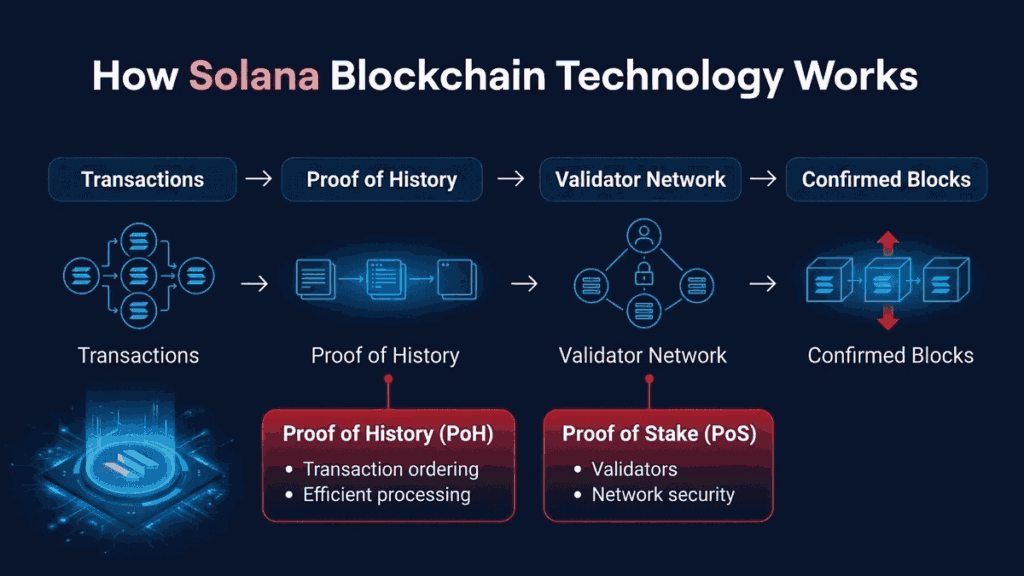
The blockchain uses a combination of Proof of Stake (PoS) and Proof of History (PoH) technology to improve transaction processing efficiency. This allows Solana to support applications that require speed, low costs, and high throughput.
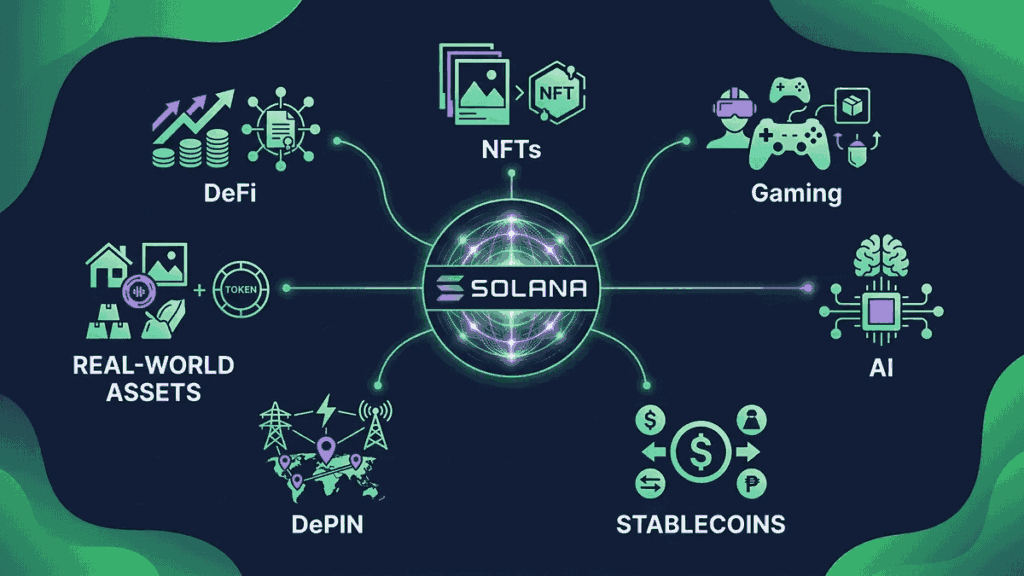
Today, the Solana ecosystem supports thousands of decentralized applications across multiple sectors, including:
- Decentralized Finance (DeFi), such as lending platforms, borrowing protocols, and decentralized exchanges
- NFT marketplaces and digital collectibles
- Blockchain gaming and Web3 entertainment
- AI-powered applications
- Stablecoin payments and financial infrastructure
- Decentralized Physical Infrastructure Networks (DePIN)
- Tokenized Real-World Assets (RWAs)
At the center of the ecosystem is SOL, Solana’s native cryptocurrency. SOL plays several important roles:
- Paying transaction fees across the network
- Staking to help secure the blockchain
- Interacting with decentralized applications
- Supporting the growth of the Solana ecosystem
As more users, developers, and businesses build on Solana, demand for SOL could increase alongside network activity. This is why any Solana price prediction should look beyond short-term market movements and focus on the network’s ability to create real-world utility.
Why Has Solana Grown So Quickly?
Speed is often the first thing people associate with Solana, but it’s far from the only reason the network has gained so much attention.
What has helped Solana stand out is its ability to combine fast transactions with low fees while continuing to attract developers and users across multiple market cycles. Even during periods when the broader crypto market slowed, new projects continued launching on the network, helping the ecosystem maintain strong momentum.
Several factors have contributed to that growth:
- Extremely low transaction fees
- Fast transaction confirmation times
- A vibrant developer ecosystem
- Expanding adoption across DeFi, gaming, AI, and payments
- Increasing institutional interest in the Solana ecosystem
None of these factors guarantees a higher SOL price. Together, however, they help explain why many analysts continue to view Solana as one of the strongest long-term blockchain projects.
How Does Solana Work?
Solana was designed with one objective: process more transactions without sacrificing speed or dramatically increasing fees.
To achieve that, the network combines Proof of Stake (PoS) with a technology called Proof of History (PoH). Rather than changing how transactions are validated, Proof of History helps organize them more efficiently, allowing validators to spend less time reaching consensus and more time processing new transactions.
The result is a blockchain capable of handling thousands of transactions per second while keeping costs remarkably low.
For most investors, the technical details aren’t the most important part. What matters is what this technology enables: a fast, scalable network that’s capable of supporting everything from everyday payments to complex decentralized applications. Those advantages continue to play a major role in shaping the long-term outlook for the Solana crypto price.
What Could Shape Solana’s Price in the Coming Years?
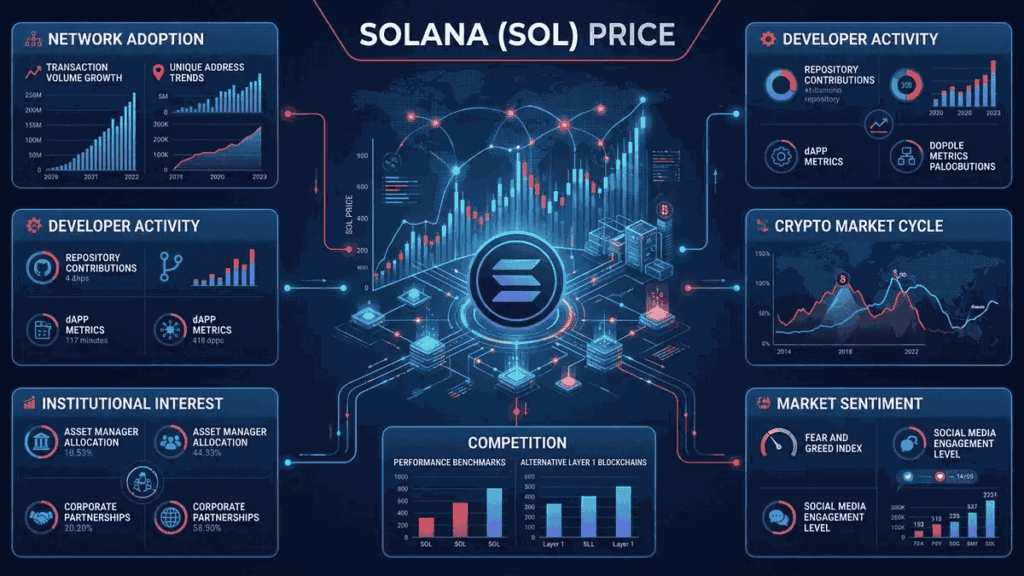
No one can predict where SOL will trade with complete certainty. Even so, some factors tend to have a much bigger influence than others. Understanding them helps put any Solana price prediction into context and explains why analysts can arrive at very different targets.
Network Adoption
The more people use Solana, the stronger its long-term fundamentals become. Growth in DeFi, stablecoins, payments, AI, and other on-chain applications increases network activity, which can strengthen demand for SOL over time.
Developer Activity
Healthy blockchain ecosystems are built by developers. A steady stream of new applications, protocol upgrades, and ecosystem projects signals that builders continue to see long-term potential in Solana. That often translates into greater user adoption and investor confidence.
Institutional Interest
Institutional participation has become an increasingly important driver of crypto markets. If more asset managers, companies, and regulated investment products gain exposure to Solana, demand for SOL could grow beyond the retail market.
The Broader Crypto Market
SOL doesn’t move independently of the rest of crypto. Bitcoin‘s market cycle, macroeconomic conditions, interest rates, and regulatory developments all influence investor sentiment and capital flows across digital assets.
Competition
Solana faces competition from other Layer-1 networks, including Ethereum, BNB Chain, Avalanche, Sui, and Aptos. To maintain its position, the ecosystem will need to keep attracting developers, users, and new projects as the industry evolves.
Market Sentiment
In the short term, sentiment can be just as influential as fundamentals. Major ecosystem announcements, product launches, regulatory news, or shifts in investor confidence can all trigger significant price movements, particularly during periods of high market volatility.
Solana Price History: A Quick Look Back
Understanding where Solana has been helps put its future potential into perspective. Like most major cryptocurrencies, SOL has experienced explosive rallies, sharp corrections, and remarkable recoveries—all within just a few years.
| Year | What Happened | Impact on SOL |
| 2020 | Solana launched with a focus on speed and low-cost transactions. | SOL traded below a few dollars and remained relatively unknown. |
| 2021 | The crypto bull market fueled rapid growth in DeFi and NFTs, driving heavy demand for the Solana ecosystem. | SOL surged to an all-time high of nearly $260. |
| 2022 | Rising interest rates, the broader crypto bear market, and the collapse of FTX weighed heavily on investor confidence. | SOL lost more than 90% of its value from its peak. |
| 2023–2024 | Developer activity remained strong despite the downturn, while new applications and ecosystem growth helped restore confidence. | SOL began a steady recovery as network usage increased. |
| 2025–2026 | Institutional interest grew, stablecoin activity accelerated, and Solana strengthened its position as one of the leading Layer-1 blockchains. | SOL re-established itself as one of the market’s largest cryptocurrencies. |
Overall, the biggest takeaway is that Solana has already been through both extremes. It has experienced one of the fastest rallies in crypto history, followed by one of its steepest declines. Even so, the network continued to grow during difficult market conditions.
While that doesn’t guarantee future gains, it does suggest that Solana’s long-term value depends on more than short-term price movements. With that in mind, as we look at the forecasts for 2026 through 2035, the key question isn’t whether SOL will remain volatile—it almost certainly will. Instead, the more important question is whether the ecosystem can continue attracting developers, users, and capital over the long run.
Important Note About Solana Price Predictions
Cryptocurrency price forecasts are based on assumptions about future adoption, market conditions, and ecosystem growth. Therefore, these estimates should not be considered guaranteed outcomes or financial advice.
Instead, the following Solana price predictions represent possible scenarios based on different levels of adoption, market performance, and industry development. Ultimately, actual SOL prices could be significantly higher or lower depending on factors such as regulation, competition, technological changes, and broader economic conditions.
Solana Price Prediction 2026
After several years of rapid expansion, 2026 could become a proving ground for Solana. Investors will be watching closely to see whether the ecosystem can convert strong momentum into sustainable long-term growth.
If activity across DeFi, payments, AI, and stablecoins continues to expand, demand for SOL could strengthen alongside the network itself. However, if the broader crypto market begins cooling after a strong rally, price growth may become more measured as investors shift their focus toward fundamentals rather than speculation.
2026 Price Prediction
| Scenario | Price Target |
| Conservative | $180–$250 |
| Base Case | $250–$400 |
| Bull Case | $400–$600 |
Overall, we believe the Base Case is the most realistic outcome, assuming the broader crypto market remains healthy and Solana continues expanding its ecosystem.
Solana Price Prediction 2027
Assuming Solana continues expanding through 2026, the conversation in 2027 is likely to shift. Instead of asking how quickly the network can grow, investors may begin asking whether that growth has become self-sustaining.
After all, a healthy ecosystem isn’t measured solely by price performance. Rather, continued developer activity, growing user engagement, and consistent on-chain demand will likely become the key indicators of Solana’s long-term strength. If these fundamentals continue improving, SOL could be well positioned for another year of steady growth.
2027 Price Prediction
| Scenario | Price Target |
| Conservative | $220–$320 |
| Base Case | $350–$500 |
| Bull Case | $500–$700 |
Our outlook remains cautiously optimistic, with the Base Case reflecting steady ecosystem growth rather than another speculative rally.
Solana Price Prediction 2028
Market cycles have shaped the cryptocurrency industry for more than a decade, and 2028 could mark the beginning of another important chapter. If historical patterns hold, renewed liquidity and stronger investor sentiment could once again benefit established cryptocurrencies like Solana.
Even so, market cycles alone won’t determine SOL’s future. Long-term success will depend just as much on continued innovation, ecosystem expansion, and real-world adoption as it does on favorable market conditions.
2028 Price Prediction
| Scenario | Price Target |
| Conservative | $300–$450 |
| Base Case | $500–$750 |
| Bull Case | $800–$1,100 |
While a move above $1,000 is possible under exceptionally favorable conditions, it would likely require both a strong crypto bull market and continued growth across the Solana ecosystem.
Solana Price Prediction 2029
If Solana reaches this stage of development, its valuation may become increasingly tied to real economic activity rather than speculation alone.
As a result, by 2029, investors are likely to pay closer attention to how widely Solana is being used across payments, decentralized finance, tokenized real-world assets, and consumer applications. Meanwhile, continued adoption in these areas could strengthen the long-term investment case for SOL while reducing its reliance on short-term market cycles.
2029 Price Prediction
| Scenario | Price Target |
| Conservative | $400–$600 |
| Base Case | $700–$950 |
| Bull Case | $1,000–$1,400 |
Our base case assumes Solana remains one of the leading Layer-1 blockchains, supported by steady ecosystem growth and increasing real-world adoption. A move above $1,000 is certainly possible, but it would likely require both favorable market conditions and continued expansion across the network.
Solana Price Prediction 2030
By 2030, Solana’s long-term success will likely depend less on speculation and more on whether the network can establish itself as essential blockchain infrastructure.
The key question is whether Solana can continue expanding beyond crypto-native users and become a widely used platform for decentralized finance, stablecoin payments, AI applications, consumer products, and tokenized real-world assets.
If the ecosystem continues attracting developers, users, and institutional capital, demand for SOL could increase significantly. However, competition among Layer-1 blockchains will remain intense, and Solana will need to maintain its technological advantages while proving that it can support sustainable real-world adoption.
2030 Price Prediction
| Scenario | Price Target |
| Conservative | $600–$900 |
| Base Case | $900–$1,300 |
| Bull Case | $1,500–$2,500+ |
Our base case estimates SOL could trade between $900 and $1,300 by 2030, assuming continued ecosystem growth and broader blockchain adoption.
A move above $2,000 is possible under a highly optimistic scenario, but it would likely require Solana to become one of the dominant blockchain networks globally, supported by strong user growth, institutional adoption, and significant economic activity on-chain.
Expert Forecasts for 2030
Long-term forecasts naturally vary because analysts use different assumptions about adoption, network activity, and future market conditions.
One of the most widely cited projections comes from VanEck, which published a valuation model suggesting SOL could exceed $3,000 by 2030 under an optimistic scenario. The firm’s analysis is based on expectations of significant growth in active users, network revenue, and Solana’s share of the smart contract platform market.
While that target is considerably higher than our base-case estimate, it highlights the upside that some analysts see if Solana becomes a dominant blockchain for decentralized applications and digital finance. As with any long-term forecast, however, the outcome will ultimately depend on real-world adoption rather than price momentum alone.
Solana Price Prediction 2035
Naturally, any forecast stretching to 2035 should be viewed as a long-term scenario rather than a precise prediction. After all, the blockchain industry is evolving rapidly, and today’s market leaders will need to keep innovating to remain competitive over the next decade.
If Solana continues attracting developers, expanding its ecosystem, and strengthening its position across decentralized finance, payments, AI, and tokenized real-world assets, SOL could benefit from years of sustained adoption. At the same time, investors should recognize that predicting cryptocurrency prices this far into the future involves considerable uncertainty. As a result, broad ranges are more realistic than exact targets.
2035 Price Prediction
| Scenario | Price Target |
| Conservative | $900–$1,500 |
| Base Case | $1,800–$3,000 |
| Bull Case | $3,500–$5,000+ |
Our long-term outlook remains optimistic but realistic. While a multi-thousand-dollar valuation is possible under favorable conditions, it’s important to remember that predicting prices this far ahead involves considerable uncertainty. Investors should treat these figures as potential scenarios rather than guaranteed outcomes.
Can Solana Reach $1,000?
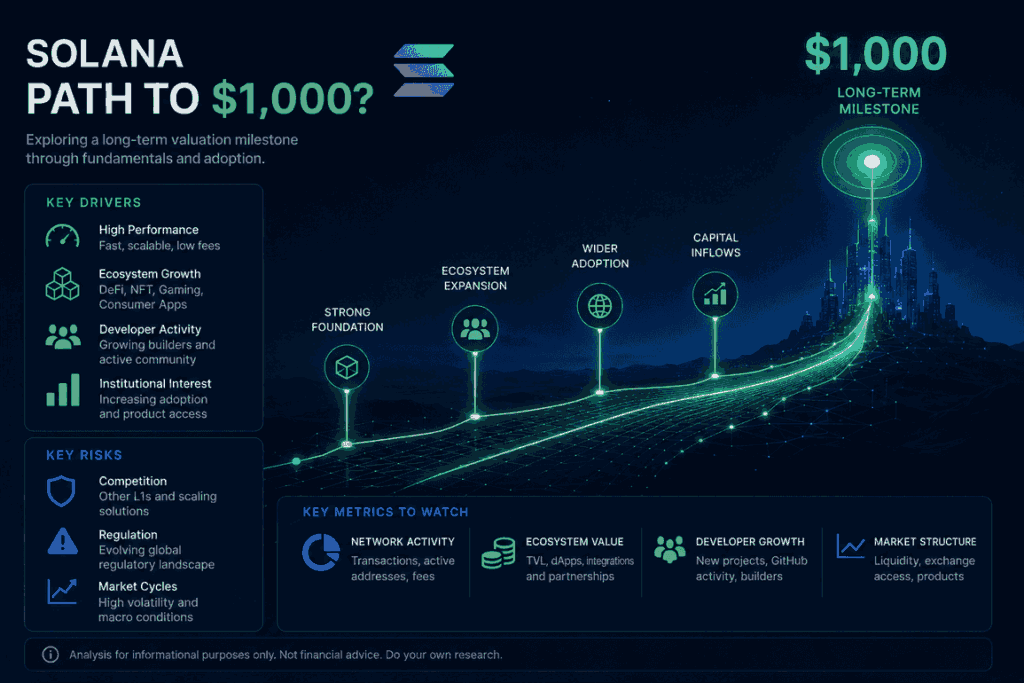
For many investors, $1,000 represents one of the most important long-term milestones for SOL. While that target may seem ambitious today, it’s not beyond the realm of possibility if both Solana and the broader cryptocurrency market continue expanding over the coming years.
Many Solana price prediction analyses suggest that reaching this level would require sustained ecosystem growth rather than a short-lived market rally.
Reaching and sustaining a four-digit valuation would likely require more than another crypto bull market. Solana would need to strengthen its position as one of the leading smart contract platforms while continuing to attract developers, users, liquidity, and institutional investment. Broader adoption of blockchain technology and favorable macroeconomic conditions would also play an important role.
Although there’s no guarantee SOL will reach $1,000, it’s a realistic long-term target under a strong growth scenario rather than an unrealistic best-case outcome.
Is Solana Still a Good Investment?
Solana is no longer viewed as an emerging blockchain project. Instead, it has developed into one of the largest Layer-1 ecosystems in the industry, supported by an active developer community, growing institutional interest, and an expanding range of decentralized applications.
However, that doesn’t mean investing in SOL is without risk. Cryptocurrency markets remain highly volatile, and future performance will continue to depend on factors such as regulation, technological innovation, competition from other blockchains, and overall market sentiment.
Therefore, any Solana price prediction should be considered alongside these risks rather than as a guarantee of future returns.
For long-term investors, the more important question isn’t whether SOL will experience another correction—it almost certainly will at some point. Instead, the focus should be on whether Solana can continue attracting developers, users, and real-world adoption over the next decade. If it can, SOL may remain one of the strongest-performing large-cap cryptocurrencies.
As always, investors should conduct their own research, diversify their portfolios, and only invest money they can afford to lose.
Final Thoughts
Few blockchain projects have experienced a journey quite like Solana’s. The network went from being one of the fastest-rising cryptocurrencies during the 2021 bull market to enduring a sharp downturn before rebuilding into one of the industry’s most active blockchain ecosystems.
That journey is one reason opinions on SOL remain divided today. Some investors point to its expanding ecosystem, active developer community, and growing institutional interest as signs of long-term strength. Others remain cautious, citing increasing competition and the volatility that continues to define the cryptocurrency market.
With that in mind, our Solana price prediction takes both viewpoints into account. We believe SOL has strong long-term potential, but its future performance will ultimately depend on continued adoption rather than speculation alone. Over time, investors who pay closer attention to network growth, developer activity, and real-world utility are likely to make more informed decisions than those focused only on short-term price swings.
Frequently Asked Questions
Based on different market scenarios, Solana could potentially trade between $600 and $2,500+ by 2030. The final outcome will depend on factors such as ecosystem growth, adoption, competition, and overall crypto market conditions.
Solana reaching $1,000 is possible under a strong growth scenario, but it would require significant expansion in network usage, institutional adoption, and the overall cryptocurrency market. While achievable, it should be viewed as a long-term possibility rather than a guaranteed outcome.
The biggest factors that could drive SOL higher include increased network adoption, developer growth, institutional investment, stablecoin activity, decentralized applications, and wider blockchain adoption. These are also some of the key drivers considered in any Solana price prediction.
Solana and Ethereum have different strengths. Solana focuses on high speed and low transaction costs, while Ethereum benefits from a larger ecosystem, strong developer community, and significant institutional adoption. The better option depends on how the blockchain industry develops in the future.
A $5,000 SOL price is possible only under an extremely optimistic scenario. It would likely require Solana to become one of the dominant global blockchain networks with massive adoption, strong economic activity, and continued growth in the crypto market.
Solana has strong long-term potential due to its technology, ecosystem growth, and developer activity. However, like all cryptocurrencies, SOL remains a highly volatile asset. Investors should consider their own risk tolerance and conduct independent research before making decisions.