



Wondering exactly what is ethereum and why it is rapidly changing the digital landscape? To put it simply, if Bitcoin is the digital equivalent of a basic mobile phone used strictly for secure financial transfers, Ethereum is the modern smartphone. It provides a foundational operating system where developers can build and install decentralized applications.
In this guide, we will explore the inner workings of the ethereum network, explain its underlying technology, and show you how to navigate this rapidly evolving ecosystem.
A Brief History: Ethereum Founder and Ethereum Launch Date
Every technological revolution begins with a single visionary idea. The story of this network traces back to a young programmer named Vitalik Buterin. In 2013, Buterin was actively involved in the Bitcoin community but grew frustrated with the network’s limitations. He recognized that blockchain technology possessed the potential to do much more than just transfer money. He envisioned a blockchain with a built-in programming language.
Buterin became the primary ethereum founder when he published a whitepaper detailing a new platform designed to execute complex programmable logic. The idea quickly gained traction among cryptographers and developers. Following a highly successful public crowdfunding campaign in 2014, the team worked tirelessly to bring the vision to life.
The official Ethereum launch date finally arrived on July 30, 2015, with the deployment of the first block, known as the Genesis block. Since that day, the platform has grown exponentially, attracting thousands of developers and billions of dollars in capital.
The Dawn of Web3: What is Ethereum?
The cryptocurrency landscape is vast, and while Bitcoin often dominates mainstream headlines, there is another technological giant that has fundamentally changed how the internet operates.
Ethereum is a decentralized, open-source blockchain software platform. However, reducing it to just a financial network misses the bigger picture entirely.
Imagine a massive, global computer that no single corporation or government controls. This computer operates continuously, powered by thousands of independent participants around the world.
Instead of simply processing financial transactions, this platform allows software developers to build, deploy, and run applications directly on it. These are known as decentralized applications (dApps).
Because these applications run on a decentralized network, they are highly resistant to censorship, downtime, and third-party interference. By providing this infrastructure, the network has become the foundational layer for Web3, the next iteration of the internet.
Decoding the Crypto Jargon: What is ETH vs. Ethereum?
One of the most common points of confusion for newcomers is the difference between Ethereum and ETH. Although people often use the terms interchangeably, they refer to two different things. Ethereum is the blockchain network itself, providing the infrastructure that supports smart contracts, decentralized applications, and digital asset transfers.
In contrast, Ether (ETH) is the native cryptocurrency of the Ethereum network. When people ask, “What is ETH?”, they are referring to the token that powers activity across the ecosystem. For example, users need ETH to pay transaction fees, execute smart contracts, and interact with decentralized applications. Without ETH, they cannot perform actions on the network.
A simple way to think about it is this: Ethereum is the platform, while ETH is the currency that keeps the platform running. Just as drivers need fuel to use a car, users need ETH to access and use Ethereum’s services.
To give you a clearer perspective, here is a breakdown of how the two biggest names in crypto compare:
Feature
Bitcoin (BTC)
Ethereum (ETH)
Primary Goal
Digital gold and decentralized payment system
A global operating system for decentralized applications
Scripting / Logic
Extremely limited by design for maximum security
Highly programmable using advanced smart contracts
Native Asset
BTC
ETH
Consensus Method
Proof of Work (Mining)
Proof of Stake (Staking)
Under The Hood: How the Ethereum Blockchain Actually Works
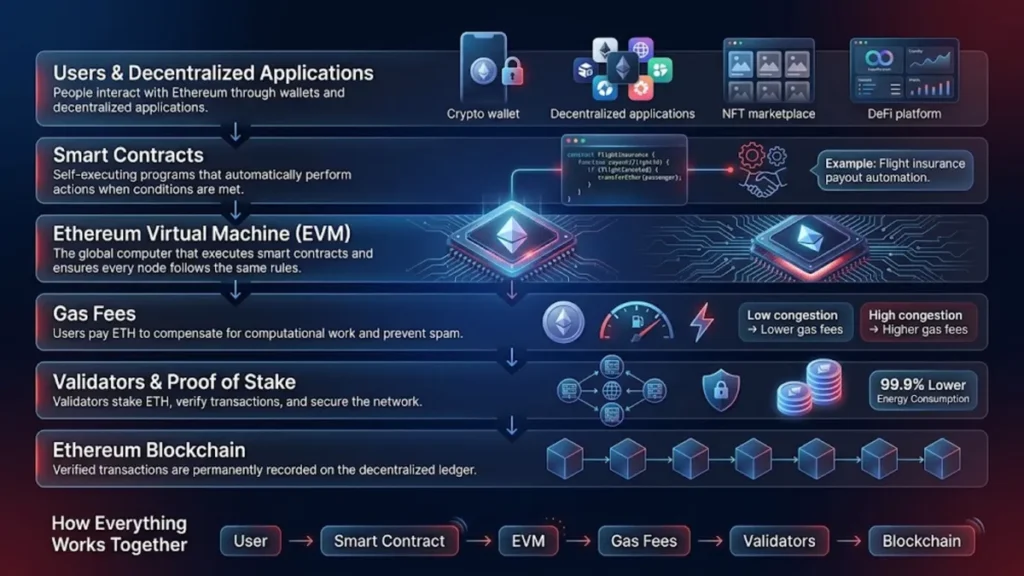
To truly appreciate the value of this ecosystem, we need to dive into the mechanics of the ethereum blockchain. While the technology is complex, the underlying principles can be understood without a computer science degree. The system relies on a few critical components working in perfect harmony.
Smart Contracts: The Heartbeat of the Network
One of the EVM’s most important functions is its ability to run smart contracts. A smart contract is a program that operates on the blockchain and automatically carries out specific actions when certain conditions are met. Because developers deploy these contracts on a public blockchain, anyone can inspect the code, and no one can secretly change the rules after deployment.
For example, consider a flight insurance application powered by a smart contract. A traveler pays a small premium in cryptocurrency, and the contract tracks flight data from approved sources. If the flight is delayed by more than two hours, the contract automatically sends the payout to the traveler’s wallet. As a result, users do not need to file claims, wait for manual reviews, or rely on a third party to approve the payment. Instead, the contract executes the predefined rules exactly as programmed.
The Ethereum Virtual Machine (EVM)
At the center of Ethereum is something called the Ethereum Virtual Machine (EVM). While traditional applications run on servers owned by companies such as Amazon or Google, applications on Ethereum operate across a decentralized network of computers around the world.
When developers create a decentralized application (dApp), they deploy its code to the EVM. From there, thousands of network participants work together to process transactions and maintain the blockchain. As a result, everyone on the network shares the same version of the data, helping ensure that transactions are executed consistently and according to the rules built into the protocol.
The Mechanics of Gas Fees
Every single action taken on the network requires computational power. To prevent malicious actors from spamming the network with infinite loops of useless code, the system requires a fee for every operation. This is known as “Gas.” Gas is paid in small fractions of Ether.
The cost of Gas is dynamic and fluctuates based on network demand. When the network is heavily congested with users trying to process transactions at the same time, the block space becomes highly valuable. Users must bid higher Gas fees to incentivize the network to process their transactions first. Conversely, during quiet periods, Gas fees drop significantly.
Proof of Stake (PoS) and Network Security
For the first several years of its existence, Ethereum relied on a Proof of Work (PoW) system, similar to the one used by Bitcoin. However, that changed in September 2022 with a major upgrade known as The Merge, which transitioned the network to a Proof of Stake (PoS) consensus mechanism.
Today, Ethereum is no longer secured by energy-intensive mining operations. Instead, the network relies on validators who stake their own Ether (ETH) to help verify transactions and maintain the blockchain. In return, honest validators can earn staking rewards. On the other hand, validators who attempt to break the rules or act maliciously risk losing a portion of their staked ETH through a process known as slashing.
As a result, Ethereum’s energy consumption dropped by more than 99.9% after The Merge, making the network significantly more energy efficient than before.
Since then, Ethereum has continued to evolve through a series of upgrades. For example, the Pectra upgrade introduced improvements aimed at enhancing staking efficiency, account functionality, and overall network performance. Consequently, these changes have helped strengthen Ethereum’s infrastructure while improving the experience for both users and validators.
Beyond Digital Money: What is Ethereum Used For?
Understanding the technical foundation is important, but practical utility is what drives real-world value. When beginners ask what is ethereum used for, they are often surprised by the sheer variety of industries being disrupted by smart contracts. The platform has evolved into a bustling digital economy.
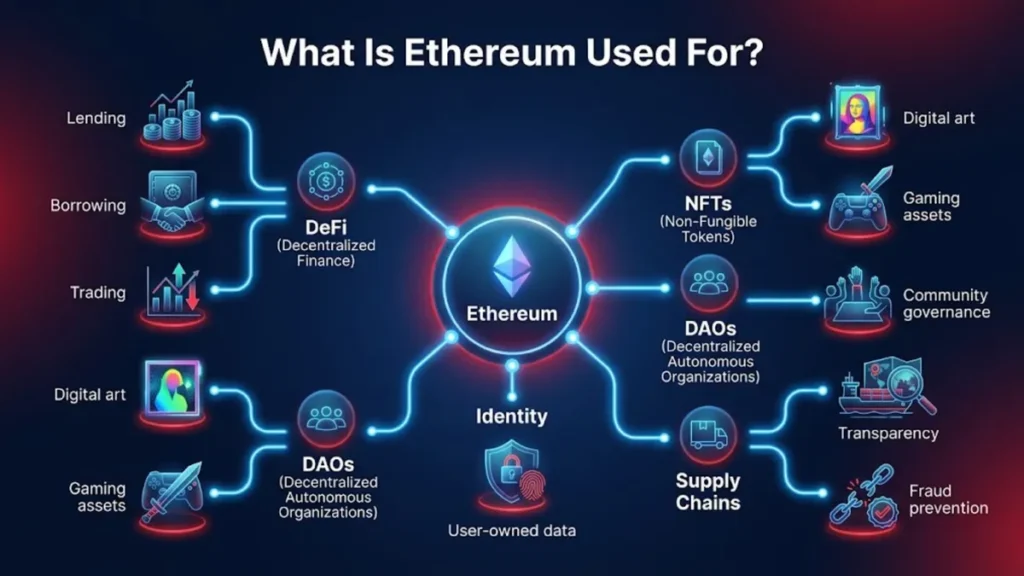
Here are the most prominent sectors thriving on the network:
Historical Price Performance: What is Ethereum All Time High?
Price movements naturally attract a great deal of attention in the crypto market, and Ethereum is no exception. Over the years, Ether (ETH) has gone through multiple cycles of rapid growth and significant corrections. Because ETH powers the Ethereum ecosystem, network activity, technological developments, investor sentiment, and broader economic conditions all play an important role in shaping its price.
During previous bull markets, rising interest in decentralized finance (DeFi), NFTs, and blockchain innovation helped drive demand for ETH. As a result, the asset reached its all-time high of approximately $4,946 in August 2025. Strong institutional participation, growing adoption of Ethereum-based applications, and positive sentiment toward the network’s future all contributed to the rally.
However, ETH remains highly volatile, just like other cryptocurrencies. Sharp price increases can quickly give way to significant pullbacks, and investors should never assume that past performance will repeat itself. Nevertheless, Ethereum’s ability to reach record valuations highlights the confidence that both retail and institutional investors have shown in the platform and its long-term potential.
Getting Started: How to Invest in Ethereum
Entering the digital asset market is much more intuitive today than it was during the industry’s infancy. If you are thoroughly researching how to invest in ethereum, the most straightforward path begins with a centralized cryptocurrency exchange. Platforms such as Coinbase, Kraken, or Binance provide highly regulated environments where you can easily create an account, verify your identity, and link your traditional bank account to purchase your first digital coins.
If you are looking to expand beyond these basics, Phantom has evolved from a Solana-only app into a highly polished, multi-chain wallet that supports Ethereum flawlessly. Additionally, Exodus offers a stunning desktop experience with built-in charts and seamless portfolio tracking for those who prefer managing their assets on a larger screen.
If you’re new to crypto, start with a small amount and take time to learn how buying, selling, and transferring assets works. Because the market can be highly volatile, a cautious approach often makes sense.
For beginners looking for a simple entry point, IZAKA-YA offers an all-in-one platform for storing, swapping, and lending crypto. Rather than requiring multiple apps or services, it brings these features together in a single interface.

For example, users can lend assets to earn returns or swap tokens directly on the platform. As a result, they can manage their holdings more efficiently and avoid the extra steps that often come with using separate wallets and exchanges.
In addition, IZAKA-YA keeps the user experience straightforward. The platform offers a clean interface and a simple onboarding process, making it a practical choice for people who are still learning about cryptocurrency and DeFi.
Register IZAKA-YAkeyboard_arrow_right
The Future Roadmap of the Ethereum Network
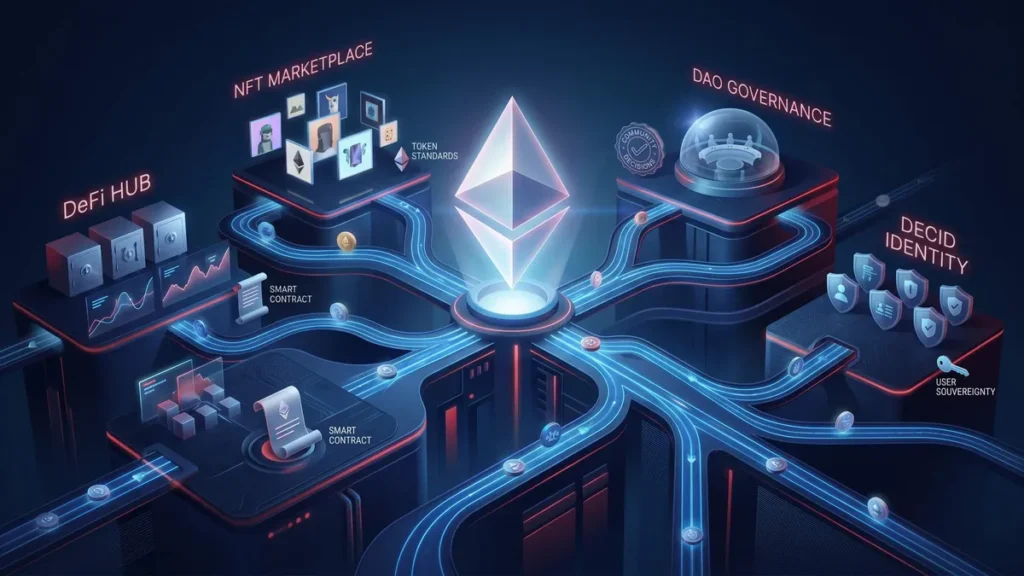
Ethereum continues to evolve through ongoing research and development. The network is supported by the Ethereum Foundation as well as a large global community of developers who work to improve scalability, security, and overall usability.
In recent years, Ethereum has introduced several major upgrades aimed at making the network more efficient and user-friendly. For example, improvements to account functionality have expanded what wallets can do, while other upgrades have focused on reducing costs and increasing the amount of data the network can process. As a result, the Ethereum ecosystem has become more accessible to both developers and everyday users.
Looking ahead, the Ethereum community remains focused on further scaling the network and improving the user experience. In particular, developers are exploring ways to increase transaction throughput, strengthen Layer 2 integrations, and make blockchain applications easier to use.
Ultimately, the goal is to create an ecosystem where users can interact with decentralized applications quickly and efficiently without needing to understand the technical details behind the technology.
Frequently Asked Questions
Think of Ethereum as a giant, global App Store that nobody owns. While Bitcoin is just used for sending digital money, Ethereum allows developers to build all kinds of apps, like games or online banks, that run automatically without a central company in charge.
Ethereum is the name of the entire network or system. ETH, which stands for Ether, is the actual digital coin that belongs to that system. You use the ETH coin to pay for transactions and actions inside the Ethereum network.
Unlike Bitcoin, which has a hard cap of 21 million coins, Ether does not have a fixed maximum supply. However, the network features a burning mechanism where a portion of every transaction fee is permanently destroyed. Depending on network activity, this can occasionally make the asset deflationary.
Investing in any cryptocurrency carries inherent risks due to price volatility. However, many investors view it as a foundational asset because it is the most actively utilized blockchain for developers and financial applications.
No, you cannot mine it anymore. The network used to use powerful computers for mining, but it changed to a new system called Proof of Stake. Now, people secure the network and earn rewards by locking up, or staking, their own ETH coins instead of using heavy computer hardware.


