



Ethereum price prediction involves much more than tracking short-term market swings. When people talk about cryptocurrencies with real-world utility beyond speculation, Ethereum (ETH) is usually one of the first projects mentioned. That’s because Ethereum is far more than just a digital asset—it powers a large portion of the blockchain economy.
Today, developers use the network to build everything from DeFi platforms and NFT marketplaces to Web3 games and payment systems. As a result, anyone researching the Ethereum price today should look beyond daily chart movements. Instead, it’s important to consider factors such as network activity, transaction fee generation, and the growing amount of ETH being used as collateral across decentralized applications. Together, these fundamentals provide valuable insight into Ethereum’s long-term growth potential and future price direction.
What Is Ethereum and Why Does It Matter in the Blockchain Ecosystem?
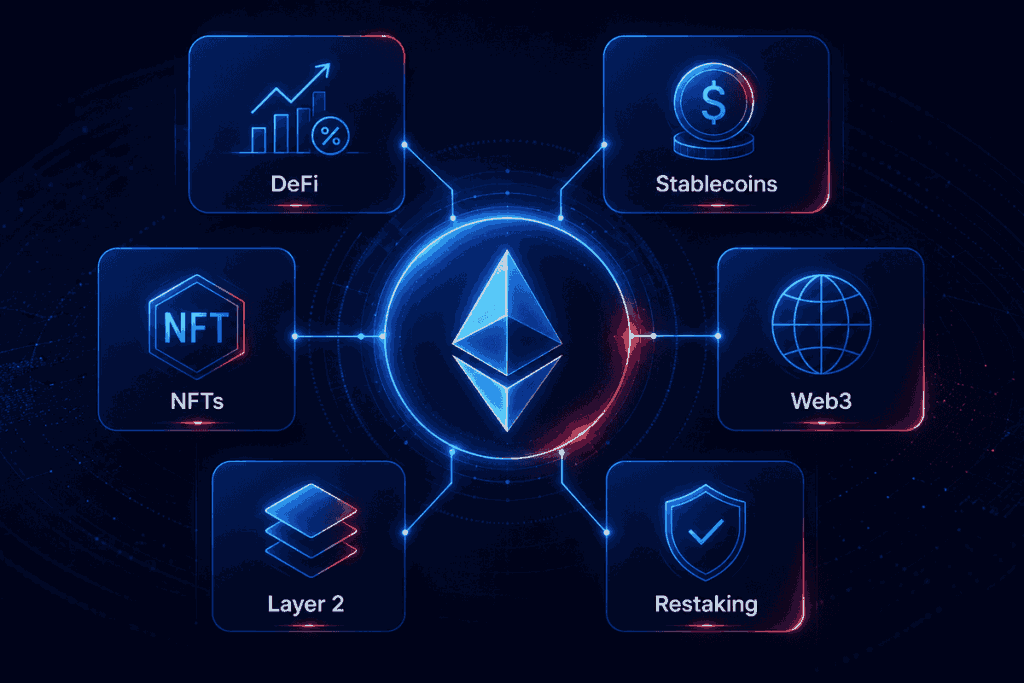
For newcomers, the simplest way to understand Ethereum is to think of it as the operating system of the crypto industry. Rather than serving only as a digital currency, Ethereum gives developers the tools they need to build decentralized applications and smart contracts that run directly on the blockchain.
Today, Ethereum supports a wide range of use cases, including:
- DeFi lending and borrowing
- NFT trading and marketplaces
- Web3 gaming
- International payments and money transfers
- Layer 2 scaling networks such as Arbitrum and Optimism
- Restaking protocols and blockchain security infrastructure
As more users interact with these services, demand for ETH naturally grows. In turn, higher network activity often increases the amount of value flowing through the ecosystem. This is why adoption remains one of the most important factors influencing the Ethereum price today and its long-term outlook.
Ethereum Price Today and Key Trends to Watch
From another perspective, Ethereum’s daily price movements reflect more than just buying and selling pressure. In many cases, they also provide a snapshot of the network’s overall health.
If you’re new to crypto and want a better understanding of the Ethereum price today, it’s worth looking beyond the chart and paying attention to the broader factors driving demand and activity across the ecosystem.
Ethereum News Today and Its Impact on Short-Term Prices
ETH often experiences sharp price movements in response to major news developments. In particular, announcements that affect network adoption, institutional investment, or ecosystem growth can have an immediate impact on market sentiment.
Some of the topics investors watch most closely include:
- Network upgrades
- Spot ETF developments
- Growth of Layer 2 ecosystems
- Restaking protocols and EigenLayer
- U.S. regulatory decisions
That’s why, when following Ethereum news today, it’s important not to focus solely on whether the headlines appear positive or negative. Instead, consider whether the news is likely to drive real usage and long-term demand for the network.
Network Activity, Layer 2 Growth, and Transaction Fees
At its core, Ethereum derives value from actual network usage. As more people use applications built on Ethereum, transaction activity increases, which in turn generates more fees across the ecosystem.
Some of the network’s key revenue sources include:
- Transaction fees
- Priority fees
- MEV (Maximal Extractable Value)
- Layer 2 settlement fees
- Security-as-a-Service revenue
A simple way to think about Ethereum is as the main highway of the crypto economy. The more applications, users, and transactions that flow through it, the more valuable the network becomes. As a result, adoption and network activity remain some of the most important factors behind any long-term Ethereum price prediction.
ETH Burn Mechanism and Supply Dynamics
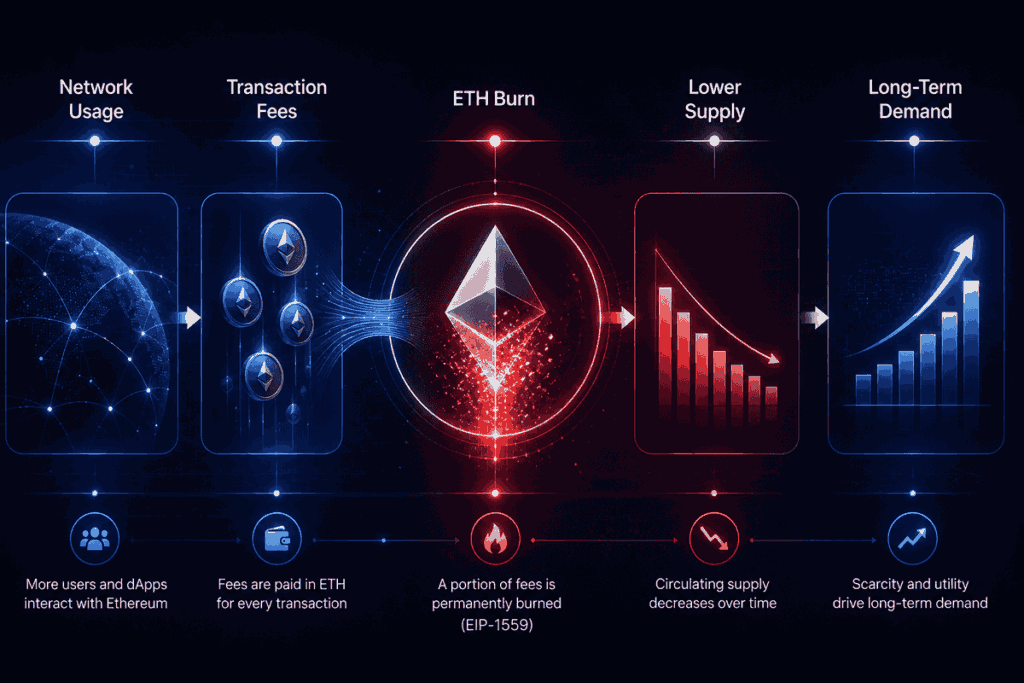
The ETH burn mechanism plays an important role in both the Ethereum price today and the broader Ethereum price prediction outlook.
One factor that many investors overlook is the token burn system introduced through EIP-1559. Since its implementation, a portion of transaction fees has been permanently removed from circulation whenever users interact with the network.
As network activity increases, more ETH gets burned. At the same time, demand for the asset continues to grow as developers, users, and institutions rely on Ethereum’s ecosystem. This combination gradually reduces the available supply while supporting long-term demand.
As a result, many investors view Ethereum’s burn mechanism as one of the network’s strongest economic advantages. Put simply, if usage continues to expand while the circulating supply becomes increasingly constrained, it could create favorable conditions for Ethereum’s long-term price growth.
Ethereum Price Prediction 2026–2040
When evaluating an Ethereum price prediction, it’s important to focus on the factors that could drive growth each year rather than looking only at a long-term target. While many investors are interested in where ETH could be by 2030, understanding the milestones along the way often provides a clearer picture.
Today, Ethereum benefits from several powerful growth drivers, including network upgrades, Layer 2 adoption, stablecoin settlement, token burns, real-world asset (RWA) tokenization, and increasing institutional participation.
The table below outlines a potential roadmap for Ethereum’s growth over the coming years.
| Year | Year-End Price Target | Key Growth Drivers |
|---|---|---|
| 2026 | $3,400 | ETF adoption, Layer 2 growth, RWAs |
| 2027 | $5,200 | Stablecoins, institutional demand |
| 2028 | $6,800 | Scaling upgrades, Bitcoin halving cycle |
| 2029 | $9,300 | Token burns, DeFi expansion |
| 2030 | $11,800 | Settlement layer dominance, tokenization |
| 2035 | $24,500 | Global tokenization, institutional adoption, restaking growth |
| 2040 | $42,000 | Blockchain-based financial infrastructure, mature on-chain economy |
Ethereum Price Prediction 2026
By 2026, Ethereum could benefit from a new wave of adoption as more users interact with Layer 2 networks, stablecoins, and tokenized assets. If institutional interest remains strong and on-chain activity continues to grow, ETH may start gaining momentum from utility rather than speculation alone.
Under this scenario, a year-end target of around $3,400 appears reasonable.
Ethereum Price Prediction 2027
In 2027, Ethereum’s position as the backbone of on-chain finance could become even stronger. As stablecoins and blockchain-based payment systems handle more value, demand for Ethereum’s infrastructure may continue to rise.
If adoption keeps moving in that direction, ETH could potentially reach $5,200 by the end of the year.
Ethereum Price Prediction 2028
By 2028, Ethereum may receive support from both internal and external catalysts. Continued scaling improvements could make the ecosystem more efficient, while the broader crypto market may benefit from the effects of the Bitcoin halving cycle.
Combined with steady network growth and ongoing ETH burns, these factors could help push ETH toward $6,800.
Ethereum Price Prediction 2029
If Ethereum continues expanding its role in DeFi, stablecoins, and tokenized assets, 2029 could be a year when investors place greater value on the network’s fundamentals.
Higher transaction volumes and stronger network revenue, paired with a gradually shrinking ETH supply, could support a move toward $9,300 by year-end.
Ethereum Price Prediction 2030
By 2030, Ethereum could be firmly established as a core layer of the digital asset economy. Stablecoins, tokenized securities, and Layer 2 ecosystems may all contribute to growing demand for the network.
If Ethereum maintains its leadership in smart contracts while adoption continues to expand, ETH could climb to around $11,800.
Ethereum Price Prediction 2035
Looking further ahead, Ethereum’s growth may increasingly depend on the adoption of tokenized real-world assets and blockchain-based financial infrastructure. If traditional finance continues moving on-chain, Ethereum could capture a meaningful share of that activity.
In that environment, ETH could potentially reach $24,500 by 2035.
Ethereum Price Prediction 2040
By 2040, Ethereum’s long-term success will likely depend on whether it remains a foundational platform for global digital finance. If businesses, institutions, and financial markets continue building on blockchain technology, Ethereum could benefit from sustained demand for its network and security.
While any forecast this far ahead is highly speculative, a price target of $42,000 remains possible if Ethereum continues strengthening its role in the digital economy.
VanEck Ethereum Price Prediction 2030
One of the most widely discussed long-term forecasts comes from VanEck. Rather than assigning a single price target, the firm outlines three possible scenarios based on how Ethereum’s ecosystem evolves and how much market share it captures within the smart contract sector.
| Scenario | Key Assumption | Market Share | 2030 Revenue | Price Target |
|---|---|---|---|---|
| Bear Case | Ethereum grows more slowly than expected and loses ground to competing networks | 15% | $2.56B | $343 |
| Base Case | Ethereum remains the leading smart contract platform and maintains a strong Layer 2 ecosystem | 70% | $50.9B | $11,849 |
| Bull Case | Ethereum becomes the dominant settlement layer for crypto and fully benefits from Layer 2 and restaking growth | 90% | $136.7B | $51,006 |
Bear Case
In VanEck’s bearish scenario, Ethereum struggles to maintain its competitive position as alternative blockchains gain traction. If networks such as Solana and other smart contract platforms capture a larger share of users, developers, and capital, Ethereum’s growth could fall short of expectations.
Under this scenario:
- Market share: 15%
- Estimated 2030 revenue: $2.56 billion
- Price target: $343
Base Case
The base-case scenario is generally viewed as the most realistic outcome. Here, Ethereum continues to lead the smart contract market while preserving its strong position within the Layer 2 ecosystem.
As network activity expands and Ethereum remains the preferred infrastructure layer for decentralized applications, revenue growth could accelerate significantly.
Under this scenario:
- Market share: 70%
- Estimated 2030 revenue: $50.9 billion
- Price target: $11,849
This forecast aligns closely with many long-term Ethereum price prediction models that assume continued adoption across DeFi, stablecoins, tokenized assets, and blockchain-based financial services.
Bull Case
The most optimistic scenario assumes Ethereum becomes the primary settlement layer for the global crypto economy. In this outcome, Layer 2 ecosystems mature, restaking adoption expands rapidly, and Ethereum captures a dominant share of blockchain activity.
As a result, network revenues could grow dramatically, creating a much stronger valuation framework for ETH.
Under this scenario:
- Market share: 90%
- Estimated 2030 revenue: $136.7 billion
- Price target: $51,006
While this outcome represents the upper end of expectations, it highlights the potential upside if Ethereum successfully strengthens its position as the foundational infrastructure of the digital asset ecosystem.
Is ETH Still a Good Investment for Beginners?

The Ethereum price today and the latest Ethereum news are two of the most important things new investors should keep an eye on.
Compared with many Altcoins, Ethereum is often easier to understand because its value comes from real network activity rather than hype alone. Developers, businesses, and users rely on Ethereum for a wide range of applications, giving the network a foundation that extends beyond short-term market sentiment.
Risks to Consider
Like any investment, Ethereum comes with risks. Before investing, beginners should be aware of several factors that could affect its future performance:
- High price volatility
- Growing competition from Solana and other blockchain networks
- Regulatory uncertainty
- The pace of Layer 2 adoption and growth
- Technical changes and network upgrades
While these risks don’t necessarily weaken Ethereum’s long-term potential, they remain important considerations for anyone building an investment strategy.
Long-Term Growth Potential
On the other hand, Ethereum continues to benefit from several powerful long-term trends. If it can maintain its position at the center of DeFi, tokenized real-world assets, stablecoins, and the Layer 2 ecosystem, the network could see significant growth in the years ahead.
For investors following Ethereum price prediction models, the key question is not where ETH will trade tomorrow or next week. Instead, it’s whether the network continues attracting users, generating revenue, and reducing supply through its burn mechanism.
If those core fundamentals remain strong, Ethereum’s long-term outlook could remain compelling regardless of short-term market fluctuations.
Conclusion: What Does the Ethereum Price Today Tell Us About the Future?
Ultimately, looking at the Ethereum price today is about much more than checking whether the chart is green or red. The bigger question is whether the network itself continues to grow.
Over time, Ethereum has evolved from a speculative cryptocurrency into a critical piece of blockchain infrastructure. Transaction fees, Layer 2 activity, MEV revenue, and ETH burns all contribute to the network’s economic value and play an important role in shaping the future Ethereum price outlook.
For beginners, understanding these fundamentals can make evaluating Ethereum much easier. Rather than relying solely on short-term price action, investors can focus on the factors that drive long-term adoption and value creation across the ecosystem.
Frequently Asked Questions
Ethereum’s price is largely driven by network usage, including DeFi, NFTs, Layer 2 activity, and stablecoin transactions. The EIP-1559 burn mechanism can also support long-term value by reducing ETH supply.
Forecasts vary, but some analysts, including VanEck, have projected ETH could reach around $11,000–$12,000 by 2030. Actual performance will depend on adoption, competition, regulation, and market conditions.
The burn mechanism permanently removes a portion of ETH from circulation. When network activity increases, more ETH is burned, which may help support prices over time by reducing supply.
Layer 2 networks make Ethereum faster and cheaper to use. Since most L2s still rely on Ethereum for settlement, their growth can help strengthen demand for the ecosystem.
Ethereum remains one of the most widely used blockchain networks and has strong long-term adoption potential. However, beginners should understand the risks and consider investing gradually through strategies such as DCA.


