



If you have spent any time in the crypto space, you have probably seen people talking about yields, smart contracts, and decentralized exchanges. For many people holding crypto, these terms sound like an alien language. Do not worry. We are going to break down the DeFi definition step by step. Whether you are holding Bitcoin for the long term or looking for new ways to grow your digital assets, understanding the basics of decentralized finance is your first step toward true financial control.
The following is an in-depth, comprehensive exploration of Decentralized Finance, designed to provide you with profound insights into how this technology is reshaping the future of money.
Defining Decentralized Finance (DeFi)
To provide the most accurate definition, DeFi refers to a decentralized financial system built upon blockchain technology. In the traditional financial world (TradFi), institutions act as the ultimate arbiters of trust, facilitating and approving every transaction.
DeFi, however, flips this model entirely. Instead of relying on a centralized bank to act as a middleman, the system utilizes immutable “code” and cryptographic “protocols” to govern all financial activities.
In this decentralized landscape, users are granted unprecedented financial autonomy. You have the ability to deposit your digital assets into liquidity pools to earn substantial interest yields, secure loans almost instantly without the need to submit exhaustive paperwork or credit checks, and exchange digital currencies directly with peers globally.
All of these actions are possible because the foundational architecture of DeFi is about a single, powerful philosophy: “Trust in code” rather than “Trust in people.” By removing human error, bias, and institutional bottlenecks, DeFi creates a frictionless financial environment.
Comparative Analysis: DeFi vs. Traditional Finance
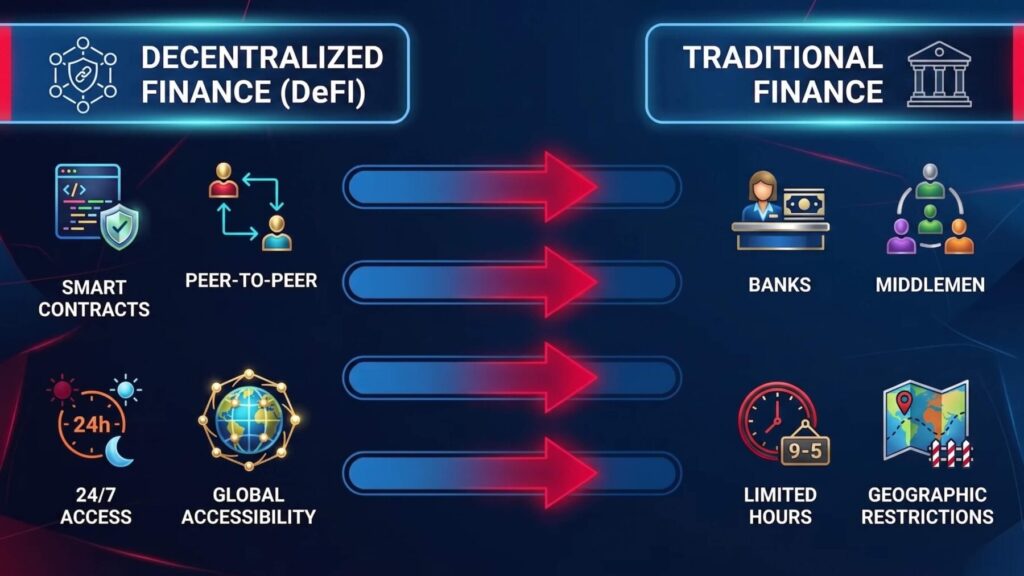
| Feature | Decentralized Finance (DeFi) | Traditional Finance (TradFi) |
| Intermediaries | None (Code-driven) | Centralized Institutions (Banks, Brokers) |
| Transparency | Extremely High (Publicly verifiable ledger) | Limited (Closed corporate databases) |
| Global Accessibility | Open to anyone with an internet connection | Restricted by geography, borders, and credit scores |
| Transaction Speed | Nearly instantaneous, 24/7/365 | Slower, limited by business hours and settlement days |
| Asset Custody & Control | Absolute User Sovereignty | Custodial (Institutions hold and manage your funds) |
The Engine of DeFi: How It Truly Works
Once the overarching concept is understood, the natural progression is to ask how this decentralized machinery actually functions beneath the surface. While the ecosystem may appear overwhelmingly complex to an outsider, the backend of DeFi relies on a few fundamental, yet revolutionary, technological pillars.
The Foundation: Code vs. Platform
These two concepts represent the underlying architecture of decentralized finance. One is the brick, and the other is the entire house.
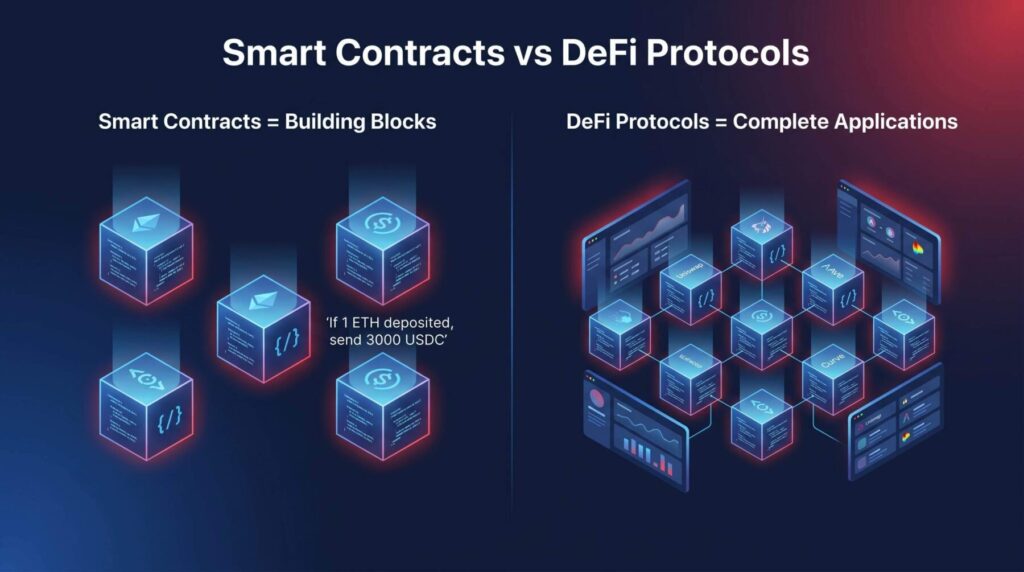
- Smart Contracts are the individual building blocks. A smart contract is a single, self-executing piece of code living on the blockchain. It is programmed to perform a specific action only when a strict condition is met. For example, the code might dictate: “If User A deposits 1 ETH, send User A 3,000 USDC.” It is the raw technology that enforces the rules without any human intervention.
- DeFi Protocols, on the other hand, represent the complete application. A protocol is the entire platform built by combining dozens or even hundreds of smart contracts together. Platforms like Uniswap, Aave, and Curve are all DeFi protocols. They provide the user interface, the overarching rules, and the complete financial service by relying on smart contracts to do the heavy lifting in the background.
The Trading Engine: Vaults, Math, and Incentives
When you move away from how the platforms are built and look at how people actually trade and generate profit, you run into these three highly interconnected terms. They rely on each other sequentially to function.
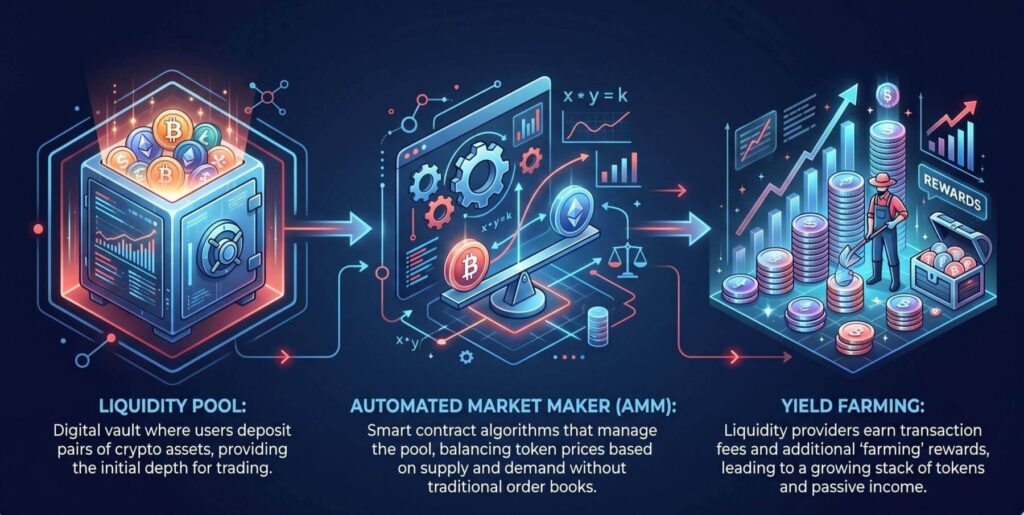
- Liquidity Pools act as the digital vaults. A liquidity pool is simply a massive pile of funds inside a smart contract. Because there is no centralized exchange sitting there with billions of dollars to facilitate trades, DeFi relies on everyday users to pool their money together. Without these pools, traders would have no assets to trade against.
- Automated Market Makers (AMMs) function as the mathematical brains managing those vaults. If the liquidity pool is the money, the AMM is the algorithm that determines what that money is worth. AMMs automatically calculate and adjust the price of the tokens in the pool based on real-time supply and demand. They completely replace the traditional order books and human market makers found on the stock market.
- Yield Farming is the investment strategy that brings it all together. Why would anyone risk putting their own money into a liquidity pool for strangers to trade against? They do it to earn a yield. Yield farming is the act of locking your assets into these liquidity pools specifically to earn high rewards. These rewards come from a combination of the trading fees paid by users and extra bonus tokens handed out by the protocol to incentivize more people to deposit funds.
The Symbiosis of DeFi and Cryptocurrency
Another frequent point of confusion is the relationship between DeFi and the broader cryptocurrency market. It is crucial to understand that Decentralized Finance simply could not exist without cryptocurrency. The two are intrinsically linked, operating in a symbiotic relationship where crypto provides the necessary fuel and DeFi provides the financial infrastructure.
Cryptocurrency serves multiple vital roles within this ecosystem. First and foremost, it acts as the primary medium of exchange, the native asset transferred between parties.
Furthermore, specific cryptocurrencies are required to pay network transaction fees, commonly referred to as “gas fees.” For example, the Ethereum network, which hosts the vast majority of DeFi applications, requires the ETH token to power the computational effort needed to execute smart contracts.
Within the DeFi space, users strategically utilize various types of digital assets:
- Utility and Gas Tokens: Users can fuel transactions and pay for network operations by using assets like ETH.
- Stablecoins: Users seeking to avoid the notorious volatility of the crypto markets while still participating in DeFi yields tend to use digital assets pegged to fiat currencies, such as USDT (Tether) or USDC (USD Coin)
- Governance Tokens: These represent voting power, allowing holders to propose and vote on future upgrades, fee structures, and protocol changes, ensuring the platform remains genuinely community-driven.
Ultimately, DeFi provides the architectural framework and the financial system, while Cryptocurrency serves as the essential tool and currency that flows through it.
The DeFi Wallet: Your Passport to Web3
To actively participate in Decentralized Finance, you must possess a thorough understanding of the DeFi Wallet, often referred to broadly as a crypto wallet or a non-custodial wallet. This is not merely an application for storing funds; it is your digital passport, your identity, and your interface for connecting with the decentralized web (Web3).
The most critical distinction of a DeFi wallet is that you, and only you, hold the “Private Keys.” Unlike a traditional bank account where the institution holds custody of your money, a non-custodial wallet ensures that no third party, government, or corporation has access to your funds. You do not need anyone’s permission to move your assets.
Through a DeFi wallet, individuals can seamlessly connect to various Decentralized Applications (dApps), execute complex financial transactions directly on the blockchain, and maintain total administrative control over their entire digital portfolio.
This absolute sovereignty over one’s wealth is the precise reason why advocates often declare that in the world of DeFi, “You become your own bank.”
Weighing the Scales: Advantages and Inherent Risks
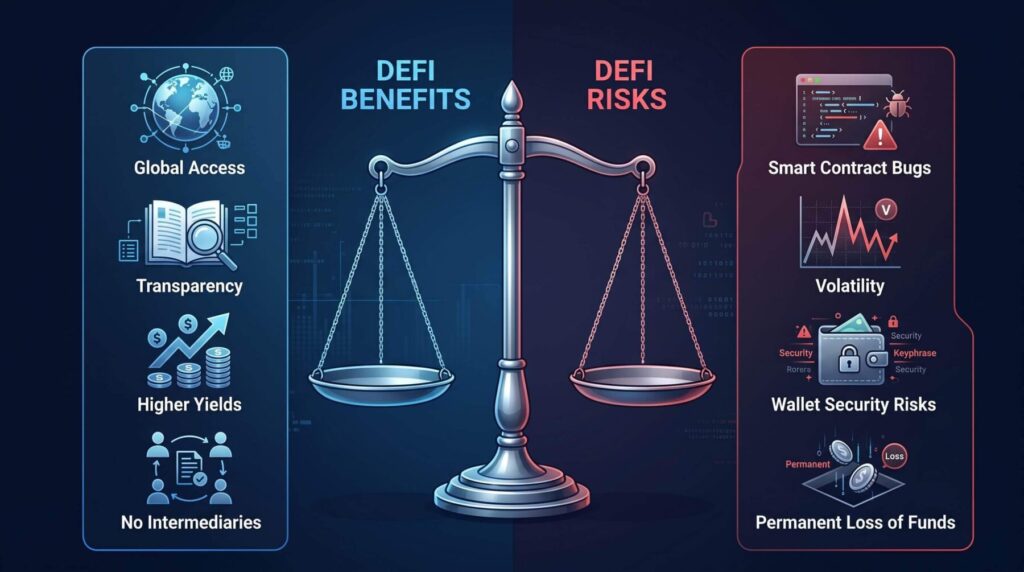
On the positive side, DeFi eliminates the need for trusted intermediaries, which reduces operational costs and censorship. Anyone with an internet connection, regardless of their geographic location or socioeconomic status, can access advanced financial tools. The open-source nature of blockchain ensures that every transaction and contract is transparent and verifiable, fostering an environment where systemic corruption is extremely difficult.
Furthermore, because there is no intermediaries, the financial yields and returns available to users are much higher than traditional savings accounts.
Conversely, the risks are substantial and demand caution. The most prominent danger lies in smart contract vulnerabilities. Because the system relies entirely on code, malicious actors can exploit any undiscovered bug, flaw in the programming to drain funds from the protocol.
Additionally, the extreme volatility of cryptocurrency prices can lead to fast liquidations for borrowers. The user experience is steep for beginners, requiring a deep understanding of network networks, gas fees, and wallet security.
Finally, the nature of the system means there is no customer support hotline; if a user makes a catastrophic error, such as sending funds to the wrong address or losing their private keys, those assets are permanently lost with no recourse for recovery.
Real-World Applications Redefining Finance
To move beyond the theoretical, it is essential to look at the practical applications of DeFi that millions of users are interacting with daily.
One of the most prominent use cases is lending and borrowing. Developers have found creative ways to bridge Bitcoin over to networks like Ethereum or build new layers directly on top of the Bitcoin network. This allows Bitcoin holders to finally earn interest on their holdings or use their coins as collateral for loans without having to sell them.
Individuals can deposit their idle digital assets into liquidity pools on platforms like IZAKA-YA to earn continuous interest, operating much like a high-yield savings account but with significantly better rates. Conversely, individuals needing capital can lock up their cryptocurrency as collateral and borrow stablecoins against it, without credit checks or negotiating with loan officers.
Decentralized Exchanges (DEXs) represent another massive sector. Utilizing Automated Market Maker (AMM) technology, DEXs allow users to swap one cryptocurrency for another directly from their wallets. There are no order books managed by centralized entities; instead, users trade against pooled liquidity provided by other users.
Across all these applications, the unifying thread remains consistent: sophisticated financial services are executed peer-to-peer, entirely devoid of traditional banking infrastructure.
Navigating the Ecosystem: Who is it for?
Decentralized Finance offers unprecedented opportunities, but it is not universally suitable for every individual at this current stage of its evolution. It is for those who already possess a foundational understanding of cryptocurrency mechanics, individuals with a high tolerance for financial risk, and those who deeply value absolute control and custody over their personal wealth.
For beginners wishing to enter the space, a methodical approach is paramount. The journey should begin with comprehensive education on fundamental blockchain concepts, smart contracts, and wallet security. Initial forays into DeFi should always be conducted with minimal capital, amounts that the user is prepared to lose. It is advisable to stick to established, heavily audited platforms with proven track records, avoiding the temptation to chase astronomically high yields on obscure, untested protocols simply due to market hype.
A Step-by-Step Guide to Entering DeFi
Bridging the Gap: Getting Started with IZAKA-YA
For those who find the theoretical concepts of DeFi difficult to grasp, looking at a practical gateway platform can demystify the process. IZAKA-YA serves as an excellent example of how users can seamlessly transition into the decentralized financial world utilizing a crypto wallet.
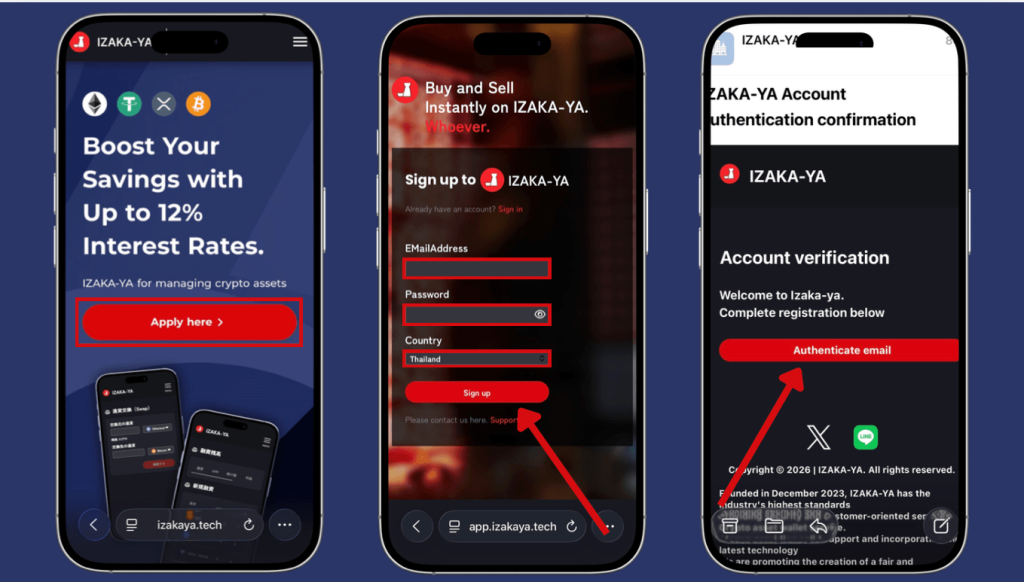
Platforms like this allow users to create an account, establish a secure wallet, and begin managing their digital wealth within a unified, intuitive interface. This greatly lowers the barrier to entry for newcomers trying to understand how Web3 connectivity functions.
Register IZAKA-YAkeyboard_arrow_right
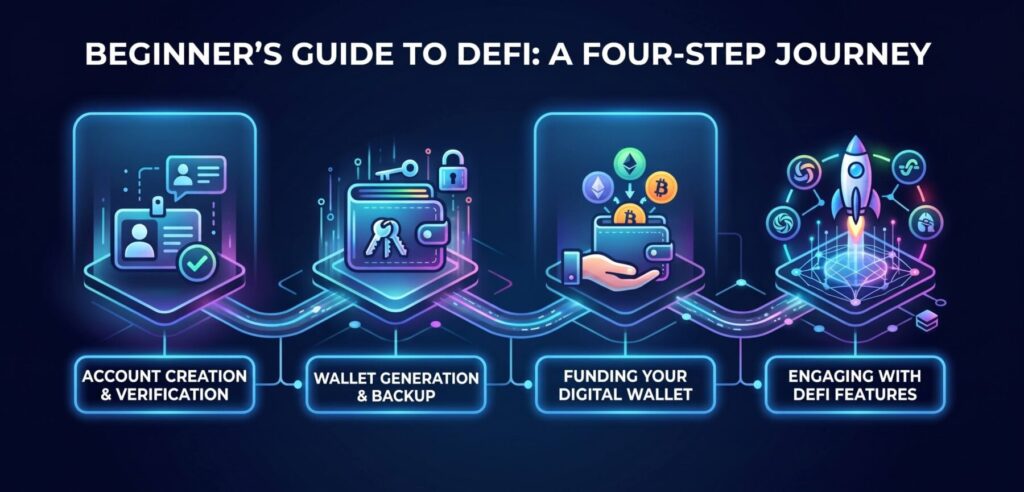
Step-by-Step Process for Beginners:
Step 1: Account Creation and Verification
Navigate to the platform’s official registration portal. You will need to initiate the creation of your account, which may involve standard verification protocols to ensure platform security and compliance, bridging the gap between traditional onboarding and decentralized access.
Step 2: Wallet Generation and Backup
Once inside the ecosystem, you will open or connect a decentralized Wallet. If generating a new wallet, the system will provide you with a seed phrase (a master password).
Crucial Step: Write this phrase down on physical paper and store it securely. Never share it with anyone, as it is the sole key to your assets.
Step 3: Funding Your Digital Wallet
To participate in DeFi, you require starting capital. You will need to deposit supported digital assets, such as the USDT stablecoin, into your newly created wallet address. You can do this by transferring funds from a centralized exchange where you purchased your initial crypto.
Step 4: Engaging with DeFi Features
With a funded wallet, you are now ready to explore. Navigate through the platform to access various DeFi services, such as depositing your stablecoins into earning pools to generate yield, or exploring trading mechanisms. You are now interacting directly with smart contracts.
The core advantage highlighted here is the direct, unmediated management of digital assets, which stands as the foundational pillar making DeFi a revolutionary force in modern finance.
Conclusion: Is DeFi the Future of Finance?
If one were to answer the question of what DeFi truly represents straightforwardly: It is a highly viable, revolutionary alternative to the modern financial architecture.
It is important to acknowledge that Decentralized Finance is not currently in a state of absolute perfection. It faces hurdles regarding scalability, regulatory scrutiny, and user experience. However, it has opened new doors, providing borderless, restriction-free financial services to a global audience.
Therefore, while DeFi may not entirely eradicate or replace traditional banks overnight, it is establishing itself as a parallel financial system that will become vital, integrated, and indispensable in the decades to come.
Frequently Asked Questions
DeFi is a blockchain-based financial system that lets people borrow, lend, and trade assets without relying on traditional banks.
DeFi refers to decentralized financial services, while cryptocurrency refers to the digital assets used within those services.
Users can pay transaction fees, vote on governance proposals, provide collateral for loans, or participate in decentralized applications.
A DeFi wallet stores your crypto and connects you to decentralized applications. In most cases, you need one to access DeFi services directly.
DeFi can offer strong security and transparency, but it still carries risks. Users should understand smart contract vulnerabilities, scams, and market volatility before participating.