



You have probably heard the word “crypto” thrown around on the news or social media, but you might still wonder what Bitcoin actually is.
Bitcoin is the first decentralized digital currency designed to allow people to transfer money directly to each other without going through a bank or middleman. All of this is driven by a technology called “Blockchain.”
To explain it simply, Bitcoin is “money on the internet” that no single organization controls.
A Quick Look at Bitcoin’s History
To truly understand why Bitcoin matters today, we need to look back at how it all started.
Bitcoin was born in 2008 when a mysterious person or group known as Satoshi Nakamoto published a whitepaper. This document proposed a financial system completely free from traditional banking control. By early 2009, the network went live with the creation of the very first block, known as the Genesis Block.
One of the most famous events in Bitcoin history happened in May 2010 when someone used 10,000 BTC to buy two pizzas. Back then, those coins were practically worthless. Today, that exact same amount is worth an absolute fortune.
The Growth of Bitcoin: Bitcoin’s History from Zero to Millions
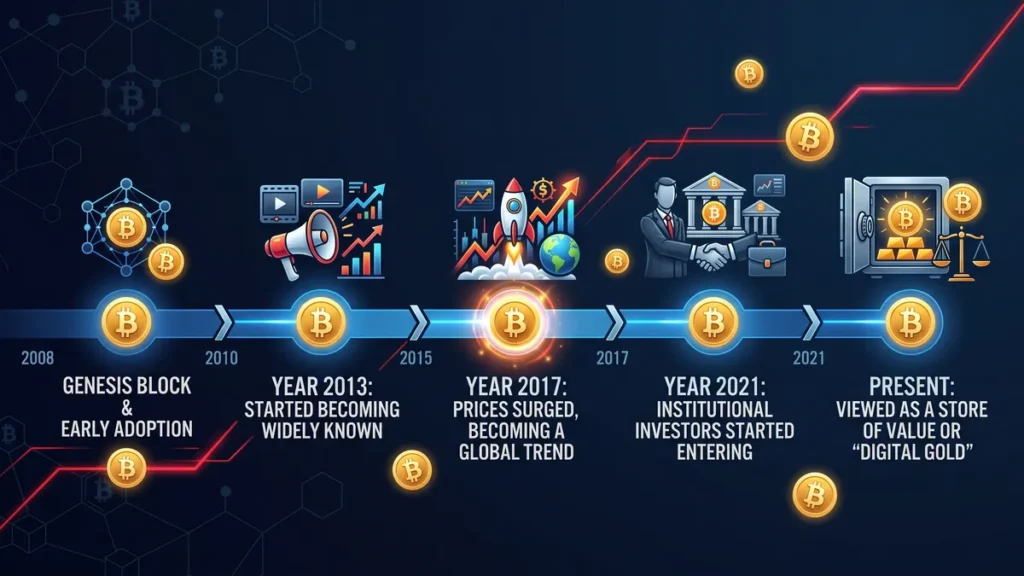
Looking back at the history of BTC, it is clear that Bitcoin has grown by leaps and bounds.
From a starting point where almost no one paid attention, it gradually became more talked about until it became an asset watched by the whole world. Key periods of growth include:
Year 2013: Started becoming widely known During this time, buying Bitcoin began to be mentioned more in the media, both in terms of new technology and as an alternative to traditional financial systems. Although it was still a small group, such as developers and tech enthusiasts, it was the starting point that made the general public more aware of Bitcoin.
Year 2017: Prices surged, creating a global trend This is the period when Bitcoin truly entered the mainstream. The price of Bitcoin rose rapidly, attracting many new investors into the market. The word “crypto” became familiar to the general public, and it was the turning point that made many people start wondering what Bitcoin is and how to invest in it.
Year 2021: Institutional investors started entering The entry of large companies and investment funds was a crucial turning point. For example, some listed companies began holding Bitcoin as an asset on their balance sheets, and financial institutions started offering crypto-related services. This greatly increased Bitcoin’s credibility from the perspective of long-term investors.
Present: Viewed as a store of value or “Digital Gold” Today, Bitcoin is no longer viewed just as a speculative asset but is starting to be used as a “hedging tool” in certain situations.
- A clear example is in some countries with highly volatile currencies; people are increasingly turning to Bitcoin to store value.
- Countries or groups facing financial sanctions might use Bitcoin as a channel for cross-border money transfers.
- Some investors view Bitcoin similarly to “gold” in the digital age because it has a limited supply and is not controlled by the state.
From a starting point of almost no value, today Bitcoin has become an asset watched globally, and its role continues to grow in line with the constantly changing context of the global economy.
What is Bitcoin Mining? Getting to Know the System Behind How Bitcoin Works
Before you invest, it helps to know how new coins are created and how transactions stay secure.
Bitcoin mining is the process where computers across the global network verify transactions and record them onto the blockchain. Everytime you send BTC, someone needs to confirm that the transfer is legitimate. This process works as follows:
- Many computers compete to solve mathematical equations.
- The machine that succeeds gets the right to record the transaction.
- And receives a reward in Bitcoin.
This mechanism allows the system to operate without an intermediary like a bank, and it also helps increase the security of the network. However, the mining process consumes a massive amount of electricity. This high energy demand remains one of the main criticisms of the network.
What is a Bitcoin ETF? A Turning Point for the Crypto Market
The way people invest in crypto changed forever in early 2024 with the approval of spot Bitcoin ETFs in the United States.
A Bitcoin ETF is an exchange-traded fund that tracks the real-time price of BTC. It allows traditional investors to buy shares through their regular stock brokerage accounts without actually holding the digital coins themselves.
- It makes investing incredibly easy for those unfamiliar with crypto exchanges.
- You do not have to worry about managing complex private keys.
- Large institutional investors can deploy capital with regulatory peace of mind.
The introduction of spot ETFs brought billions of dollars into the market and firmly cemented Bitcoin within the traditional financial system.
Deep Dive: How Bitcoin Actually Works
While the previous section explained what Bitcoin does (digital money), understanding how it does it requires looking under the hood at its fundamental components:
1. The Distributed Ledger (Blockchain)
Imagine a traditional bank’s database. It is a private spreadsheet stored on the bank’s servers, and only the bank can view or modify it.
Bitcoin uses a Blockchain, which is also a database, but with two crucial differences: it is public and distributed.
-
Public: Anyone in the world can view every transaction ever made on the network using a “block explorer.”
-
Distributed: Instead of being stored on one central server, a copy of the entire ledger is stored on thousands of independent computers worldwide, known as nodes. There is no “master copy.” If one node goes offline, the network continues unaffected.
2. Digital Signatures (Cryptography)
If the ledger is public, how do you prevent someone from spending your money? Bitcoin solves this using public-key cryptography.
Your Bitcoin wallet does not actually contain “coins.” Instead, it manages a pair of cryptographic keys:
-
Public Key: Like an email address or bank account number. This is what you share with others to receive Bitcoin.
-
Private Key: Like a secret password or your actual handwritten signature. You must never share this.
When you send Bitcoin, your wallet uses your private key to generate a unique digital signature for that specific transaction data. Other nodes on the network can use your public key to verify that the signature is legitimate, proving that you, the true owner, authorized the transfer. They can do this without ever seeing your private key.
Step-by-Step Guide: The Lifecycle of a Bitcoin Transaction
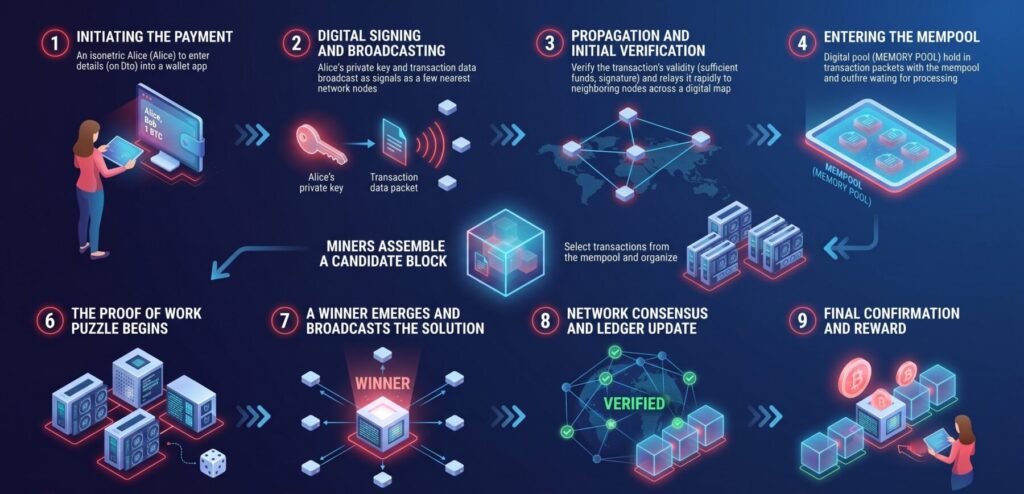
To fully grasp the “how,” let’s follow a single Bitcoin payment from start to finish.
Step 1: Initiating the Payment
Alice wants to send 1 BTC to Bob. In her wallet app, she enters Bob’s public address and the amount (1 BTC).
Step 2: Digital Signing and Broadcasting
Alice’s wallet uses her private key to sign the transaction. It then broadcasts this digital message “Alice sends 1 BTC to Bob” to the nearest Bitcoin nodes on the peer-to-peer network.
Step 3: Propagation and Initial Verification
Nodes that receive the transaction first check its validity. They verify that Alice has sufficient funds and that the digital signature is correct using her public key. If valid, they relay it to their neighboring nodes. Within seconds, the pending transaction has spread to thousands of nodes worldwide.
Step 4: Entering the Mempool
While waiting to be finalized, unconfirmed transactions reside in a temporary holding area on each node called the Mempool (memory pool).
Step 5: Miners Assemble a Candidate Block
Independent computers, known as miners, select a batch of pending transactions from the mempool, often prioritizing those with the highest transaction fees, to assemble into a “candidate block.” They include a special transaction that pays them the block reward if they win.
Step 6: The Proof of Work Puzzle Begins
This is where mining occurs. Miners must compete to solve an incredibly difficult mathematical puzzle based on the SHA-256 hashing algorithm.
The puzzle involves taking the entire block’s data, including a reference to the previous block’s unique identifier (hash),and adding a random number called a nonce. When the miner hashes this entire combined string, the resulting 64-character output must start with a specific number of zeros. This is known as finding a valid hash.
Analogy: Think of it like a global lottery. Miners make trillions of guesses per second and try to find the winning random number (the nonce).
Step 7: A Winner Emerges and Broadcasts the Solution
Eventually, one miner successfully finds a nonce that produces a hash meeting the difficulty target. They immediately stop working and broadcast their newly completed block, along with the winning solution, to the entire network.
Step 8: Network Consensus and Ledger Update
Other nodes receive the new block and stop their own puzzle-solving efforts. They independently verify the winner’s solution. Verification is instantaneous and requires almost no energy. Because the winner’s solution includes the reference to the previous block, all nodes now officially add this new block to their local copies of the chain, chronologically updating the global ledger.
Step 9: Final Confirmation and Reward
Alice’s transaction to Bob is now considered “confirmed” because it is permanently recorded in the immutable blockchain. Bob can now spend the 1 BTC. The winning miner receives newly created Bitcoin as a reward, incentivizing them to continue securing the network.
What are the Pros and Cons of Bitcoin?
Every financial asset has its strong points and drawbacks. Knowing these will help you make smarter decisions.
The balance between financial freedom and market volatility is something every investor must weigh. Let us look at a quick comparison.
Comparison Table: Pros vs. Cons of Bitcoin
| Pros of Bitcoin | Cons of Bitcoin |
| No middleman, controlled by a system | High price volatility |
| Limited supply of 21 million coins | High energy consumption for mining |
| Convenient cross-border transfers | Laws in some countries remain unclear |
| Transactions are verifiable | Risks from the users themselves |
In conclusion, the pros vs. cons of Bitcoin often lie in the balance between “freedom” and “risk,” which we will discuss in the next section.
Is Bitcoin Safe? What Investors Need to Know
Blockchain technology is incredibly secure and the Bitcoin network itself has never been hacked. The real danger usually comes from how users manage their funds, such as:
- Inadequate storage of private keys.
- Transferring to the wrong address.
- Being scammed into fraudulent investments.
Therefore, no matter how secure the system is, users must always remain cautious and this is why choosing the right wallet is absolutely critical.
If you plan to hold your assets long-term, hardware wallets like Ledger or Trezor offer top-tier offline security. For everyday use, software wallets like Atomic Wallet or My Cloud Wallet are great alternatives because they give you full control of your private keys while remaining user-friendly. If you are looking to earn passive income on your holdings, you should definitely check out the IZAKA-YA Crypto lending wallet to maximize your returns securely.
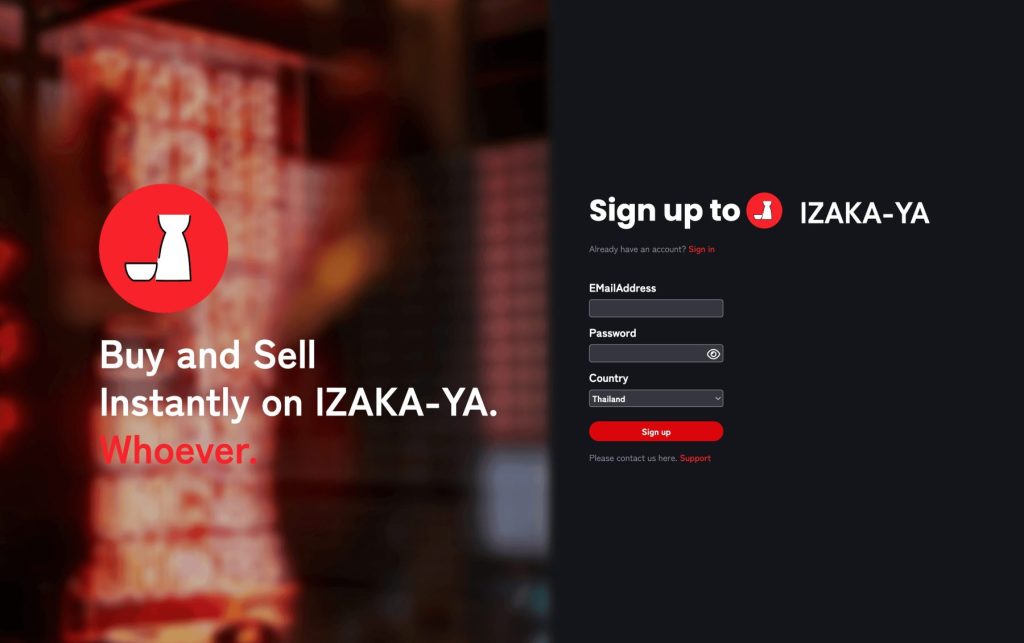
IZAKA-YA provides a streamlined onboarding experience for crypto beginners, removing the need to navigate complex technical systems. It distinguishes itself by offering immediate utility within a single interface, going beyond simple asset storage. Users can instantly engage in lending to generate returns or swap tokens directly on the platform, significantly cutting down the steps usually required to manage holdings across multiple exchanges.
We designed the user experience to be ready-to-use and intuitive from the start, making it especially suitable for those unfamiliar with DeFi jargon or frameworks.
Register IZAKA-YAkeyboard_arrow_right
Conclusion: Bitcoin Today and in the Future

Looking at the history of Bitcoin, it is evident that it is not just a new technology, but a complete shift in how we think about “money.”
Currently, Bitcoin is both a store of value and an alternative outside the traditional financial system. In the future, Bitcoin may play an even greater role, whether as an investment tool or as part of the global economic system. And this is exactly why Bitcoin continues to be something many people keep a close eye on.
Frequently Asked Questions
Bitcoin is a digital currency with no middlemen, like banks or governments. It differs from regular money, which is controlled by the state and can be printed in unlimited amounts, whereas Bitcoin has a limited supply.
The pros of Bitcoin are that there are no middlemen, transfers are easy, and it has a limited supply. The cons are high price volatility, high energy consumption, and risks from user error.
Bitcoin has high security at the Blockchain system level, but risks usually arise from the users, such as poor storage of private keys or falling for investment scams.
Bitcoin mining is the process of using computers to verify transactions and record them on the Blockchain. Those who help confirm transactions receive Bitcoin as a reward.
A Bitcoin ETF is a fund that tracks the price of Bitcoin, allowing investors to invest through the “stock market” without needing to hold the actual coins.


