



Imagine buying a house without paying a middleman, a lawyer, or a real estate agent. You simply send the required funds, and the digital deed instantly transfers to your name. There is no paperwork to sign, no business hours to wait for, and no human error to delay the process.
This level of frictionless exchange is exactly what digital automation brings to the financial world. At the heart of this revolution is a piece of technology that is reshaping how we think about trust and transactions on the internet.
What is a Smart Contract in Crypto?
If you are new to the digital asset space, you might be asking yourself what is a smart contract in crypto and why everyone keeps talking about it. To put it simply, a smart contract is a self-executing computer program that runs on a decentralized network. The terms of the agreement between the buyer and seller are written directly into lines of code.
When specific, predefined conditions are met, the code executes the agreement automatically. There is no need for a third party to verify or enforce the rules. Because these programs live on a public ledger, the transactions are transparent, trackable, and irreversible. You can think of them as digital promises that cannot be broken. Once deployed, the code acts as an impartial judge that perfectly follows the rules it was given.
A Brief History of Smart Contracts
Although blockchain popularized the concept, the idea itself is older than Bitcoin.
Computer scientist Nick Szabo introduced the concept of smart contracts in the 1990s. His vision involved digital agreements that could automatically enforce themselves.
Years later, Ethereum transformed that vision into reality by introducing programmable blockchain functionality.
Today, smart contracts power billions of dollars worth of assets across decentralized finance, gaming, NFTs, and tokenized real-world assets.
Key Characteristics of Smart Contracts
Smart contracts are designed to be:
- Transparent
- Automated
- Immutable after deployment
- Decentralized
- Resistant to tampering
How Do Smart Contracts Work in Blockchain?
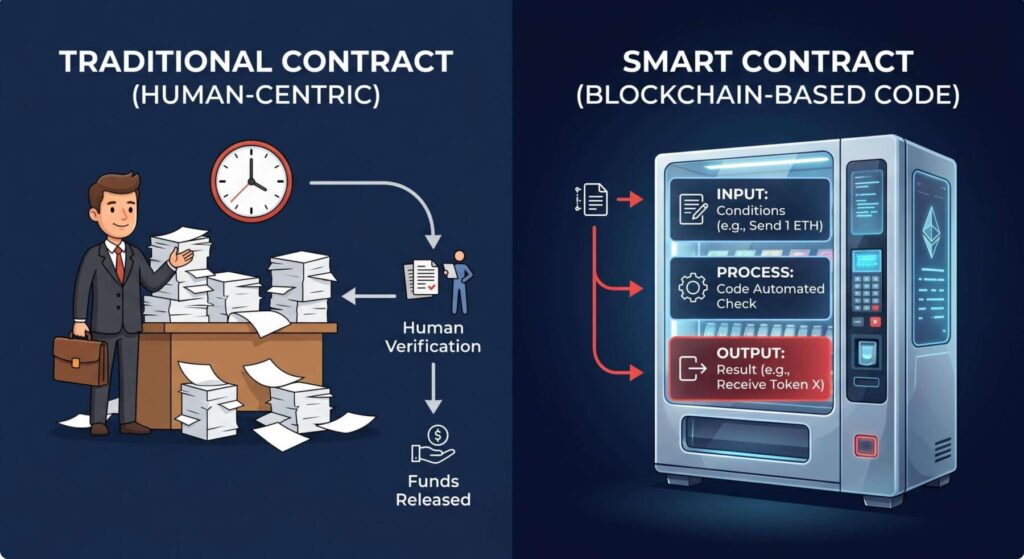
To truly grasp the mechanics, we have to look at decentralized networks to see how smart contracts work in blockchain environments. Traditional contracts require a human to read the terms, verify that both parties have done their part, and manually release the funds or assets. Blockchain technology entirely removes the human element from this equation.
A smart contract refers to blockchain-based code that automatically handles financial activities and digital asset transfers without requiring a central authority.
These contracts can:
- Transfer cryptocurrencies
- Manage staking rewards
- Facilitate lending and borrowing
- Execute token swaps
- Create NFTs
- Power decentralized exchanges
For example, when users swap tokens on a decentralized exchange like Uniswap, a smart contract automatically processes the trade. No bank or broker needs to approve the transaction. This automation helps reduce costs and allows users to interact directly with decentralized protocols.
Think about a vending machine. You select a drink, insert the correct amount of money, and the machine automatically dispenses your beverage. If you insert the wrong amount, the machine will not release the item and will refund your money. The vending machine has a hardcoded set of rules, and it executes those rules without needing a cashier to oversee the transaction. This is essentially a basic, mechanical version of a smart contract.
The Step-by-Step Process
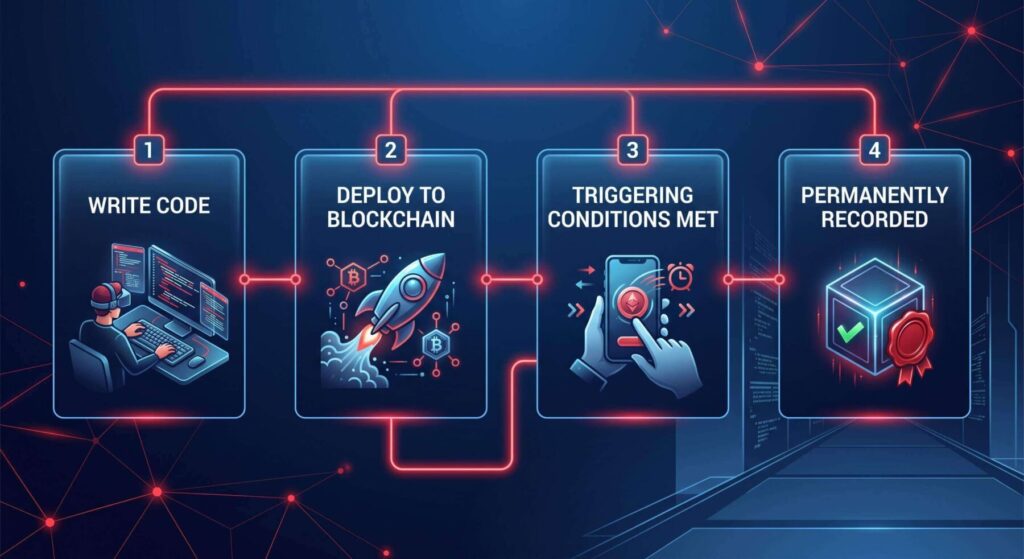
In the digital realm, the process happens across thousands of computers simultaneously. Here is the typical flow of operations:
Step 1: Writing the Code
Developers define the rules and conditions inside the contract. For example: “If User A sends 1 ETH, transfer Token X to User B.”
These instructions are written using programming languages such as Solidity.
Step 2: Deployment to the Blockchain
Once completed, the code is uploaded to a blockchain network. After deployment, the contract receives its own blockchain address and becomes publicly accessible.
Step 3: Triggering Conditions
Users interact with the contract through wallets and applications. Whenever a required condition is satisfied, the contract automatically executes.
Step 4: Recording the Results
The outcome is permanently recorded on the blockchain, creating a transparent history that anyone can verify.
Imagine a decentralized lending protocol. Everything happens through code, which minimizes manual intervention and allows the platform to operate continuously.
The Ethereum Smart Contract: Pioneering Programmable Money
If Bitcoin introduced the world to decentralized digital money, Ethereum introduced the world to decentralized applications. The Ethereum smart contract changed the landscape of the internet forever by turning a simple ledger into a massive, global computer.
Before Ethereum, blockchains were mostly used to track who owned which coin. The developers behind Ethereum realized that if you could track money on a secure ledger, you could also track logic and rules. They created a network where anyone could upload their own self-executing code.
Today, the vast majority of decentralized finance projects, digital art collections, and new crypto tokens are built directly on top of the Ethereum network. It remains the absolute gold standard for developers who want to build secure and complex decentralized applications.
Best Smart Contract Platform: Comparing the Heavyweights
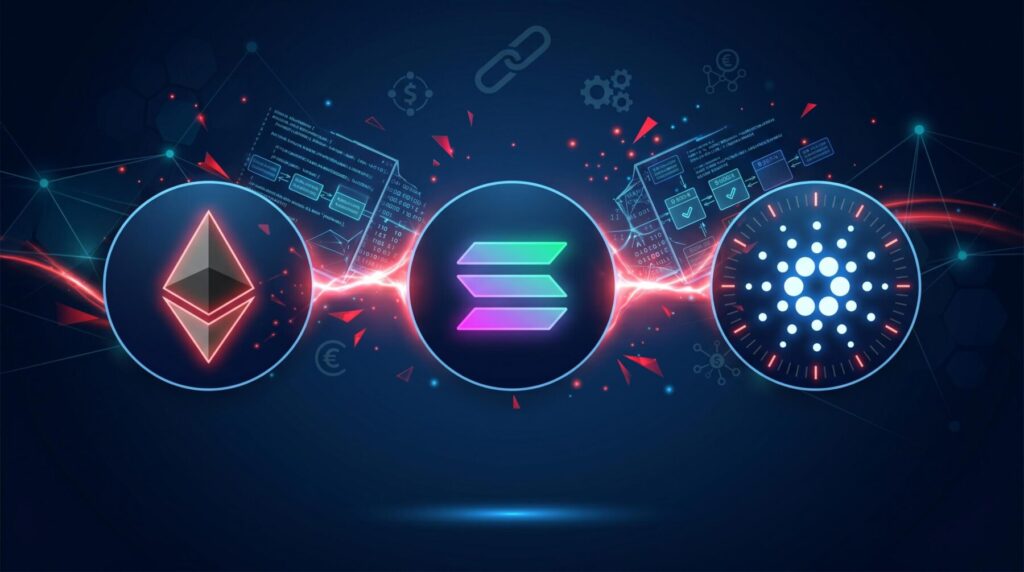
While Ethereum holds the crown as the most famous network, it is certainly not the only option available today. Developers and investors constantly debate the best smart contract platform based on speed, transaction costs, and security. Here is a look at how the top contenders stack up.
Platform
Key Focus
Average Transaction Fee
Transaction Speed
Ethereum
Maximum security and highest adoption
High
Moderate
Solana
Extremely high speed and low costs
Very Low
Very Fast
Cardano (ADA)
Peer-reviewed research and stability
Low
Moderate
Each network has its own unique advantages. Ethereum has the most established ecosystem and developer tools. Solana focuses heavily on scalability to handle thousands of transactions per second. Cardano relies on a highly academic, research-driven approach to ensure its code is perfectly secure before launching new features. The choice of platform usually depends on the specific needs of the project being built.
What Can Smart Contracts Be Used For?
The potential applications for this technology go far beyond simply moving digital coins from one wallet to another. Smart contracts touch almost every major industry in the modern world.
- Decentralized Finance (DeFi): Users can lend, borrow, and trade assets without ever using a traditional bank. The code automatically calculates interest rates and manages collateral.
- Supply Chain Management: Companies can track the journey of a physical product from the factory floor to the retail shelf. As the product reaches specific checkpoints, the blockchain updates automatically, ensuring absolute transparency.
- Real Estate: Property ownership can be tokenized and transferred instantly, removing the need for lengthy title searches and expensive legal fees.
- Automated Insurance: Imagine a flight delay insurance policy that automatically pays out to your wallet the exact minute your flight is officially delayed by the airline database.
Smart Contract Security: Keeping Your Digital Assets Safe
One of the most common phrases in the crypto world is “code is law.” However, what happens when the law has a loophole? Because humans write these programs, they can contain bugs. Smart contract security is one of the most critical topics in the industry today.
Once a contract is deployed to the blockchain, it usually cannot be changed. If a hacker finds a flaw in the code, they can potentially drain the funds locked inside the contract. To prevent this, serious projects hire independent cybersecurity firms to conduct extensive code audits before launching.
As a user, it is incredibly crucial to only interact with well-known, heavily audited applications to protect your assets.
Interacting with the Blockchain: Wallets and Yields
To actually use these digital agreements, you need a secure way to access the blockchain. This is where crypto wallets come into play. Hardware wallets like Ledger wallet provide excellent offline security for your long-term holdings, keeping your private keys completely isolated from internet connections. On the other hand, software wallets like MetaMask wallet are incredibly popular because they allow you to connect directly to web browsers and interact with decentralized applications instantly.
If you are currently holding assets and want to do more than just wait for prices to go up, you can explore the IZAKA-YA to securely earn yields on your digital funds.
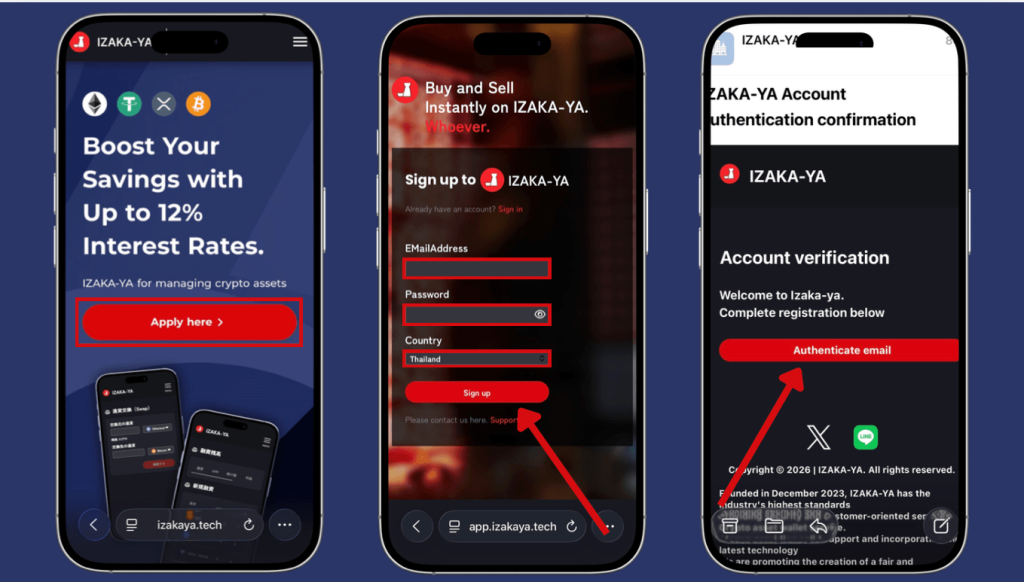
IZAKA-YA operates by managing and safeguarding the private keys on behalf of the user. This centralized approach to security heavily prioritizes convenience, meaning beginners do not carry the burden of securing their own recovery phrases.
Register IZAKA-YAkeyboard_arrow_rightChoosing the right tool depends entirely on your personal goals and how actively you plan to engage with the decentralized web.
Frequently Asked Questions
The concept existed long before Bitcoin. A computer scientist and cryptographer named Nick Szabo first proposed the idea in 1994. However, it was not until the creation of Ethereum in 2015 that the technology was successfully brought to life on a global scale.
Because blockchain transactions are permanent and irreversible, sending funds to an incorrect address usually means those assets are lost forever. There is no customer service department to call to reverse the transaction. This is why it is incredibly important to double check every address before you hit the send button.
Not at all. While they are famous in the crypto world, almost anything that requires a secure, automated agreement can leverage the underlying technology.
Generally, no. The vast majority are immutable, meaning you cannot change them once deployed. This ensures no one can alter the rules halfway through an agreement.
Absolutely not. You interact with them through simple, user-friendly websites and mobile apps. The complex code runs completely in the background, much like you do not need to know HTML to use a web browser.


