



What is leverage trading? It is a trading method that allows you to control a larger position with a smaller amount of capital by using funds provided by a broker or trading platform. This means even small market movements can have a much bigger impact on your results, increasing both potential gains and potential losses.
Leverage is widely used in markets such as stocks, forex, commodities, and cryptocurrencies. In the crypto market especially, where prices can change rapidly, leveraged trading has become popular among traders looking to increase their market exposure without committing large amounts of capital upfront.
While leverage can increase potential returns, it also comes with greater risk. A trade that moves against you can quickly result in larger losses or even liquidation if your position no longer meets the required margin level. This is why understanding both the benefits and risks of leverage is essential before using it.
In this guide, you’ll learn how leverage works, why traders use it, and what makes crypto leverage trading different from traditional markets. We’ll also explore the benefits, risks, and key strategies beginners should know before using leverage.
What Is Leverage Trading?
What is leverage trading in simple terms? It is a way of trading that lets you control a larger position than the amount of money you actually invest. Instead of paying the full value of a trade upfront, you can increase your market exposure by using funds provided by a broker or trading platform.
One of the main reasons traders use leverage is the ability to increase their market exposure without committing the full value of a position upfront. While this can create opportunities for larger gains, it also means losses can grow faster when the market moves against you.
You’ll find leverage trading across a wide range of financial markets, including:
- Cryptocurrencies (Bitcoin, Ethereum, Solana, XRP, Dogecoin, Shiba Inu and more)
- Forex (currency pairs such as EUR/USD and GBP/USD)
- Stocks and ETFs
- Commodities (gold, oil, silver, and others)
- Market indices (such as the S&P 500 and Nasdaq 100)
Although the concept is the same across all of these markets, it’s especially popular in crypto because prices can move sharply within a short period. That creates more trading opportunities—but also increases the risk of large losses.
Leverage can be a powerful tool when used carefully, but it’s not a shortcut to guaranteed profits. Before opening your first leveraged trade, it’s worth understanding how leverage works, how much risk it adds, and when it makes sense to use it.
Understanding Leverage in Trading
Now that you understand the basics of leverage trading, it’s important to look at how leverage actually works. In simple terms, leverage is a multiplier that increases your buying power compared to the amount of capital you provide.
For example, if you have $1,000 and use 10× leverage, you can open a position worth $10,000. The higher the leverage, the larger the position you can control without increasing your initial investment.
Here’s how different leverage ratios compare:
| Leverage | Your Investment | Position Size |
| 2× | $1,000 | $2,000 |
| 5× | $1,000 | $5,000 |
| 10× | $1,000 | $10,000 |
| 20× | $1,000 | $20,000 |
| 50× | $1,000 | $50,000 |
At first glance, higher leverage might seem like the obvious choice because it gives you greater market exposure. However, there’s a trade-off: both profits and losses are magnified by the same amount. A trade that moves in your favor can generate larger returns, but a small move in the opposite direction can quickly eat into your capital.
Leverage vs. Margin: What’s the Difference?
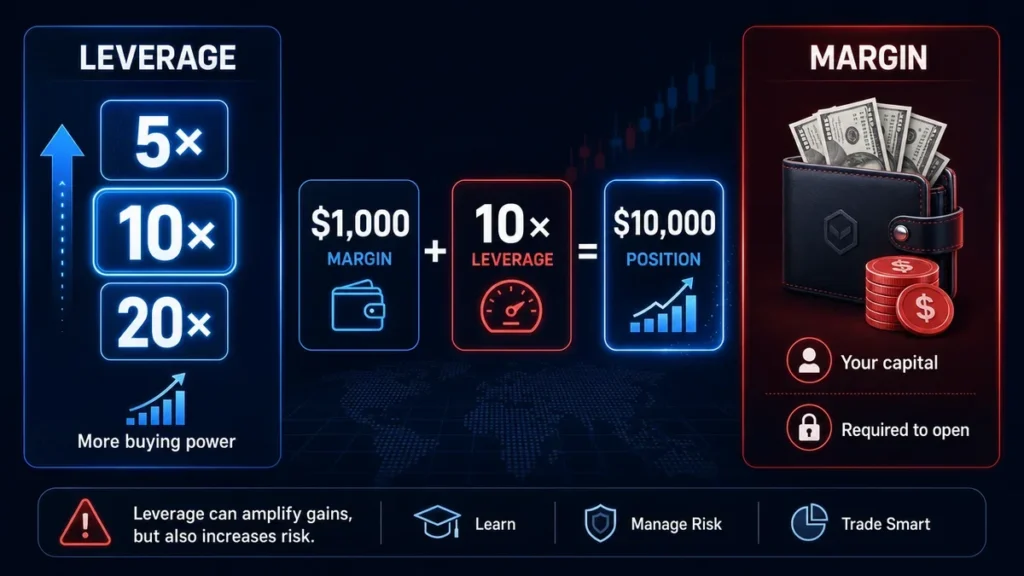
Leverage and margin are closely related, but they aren’t the same thing.
- Leverage is the ratio that increases your buying power, such as 5×, 10×, or 20×.
- Margin is the amount of your own money required to open and maintain a leveraged position.
A simple way to remember the difference is:
Leverage is how much you can borrow. Margin is how much you need to put up.
For example, if you want to open a $10,000 trade using 10× leverage, you only need to provide $1,000 as margin. The remaining value is effectively financed through the leverage offered by the trading platform.
Understanding this relationship makes it easier to see how leveraged trades are structured and why even relatively small price movements can have a significant impact on your account balance.
How Does Leverage Trading Work?
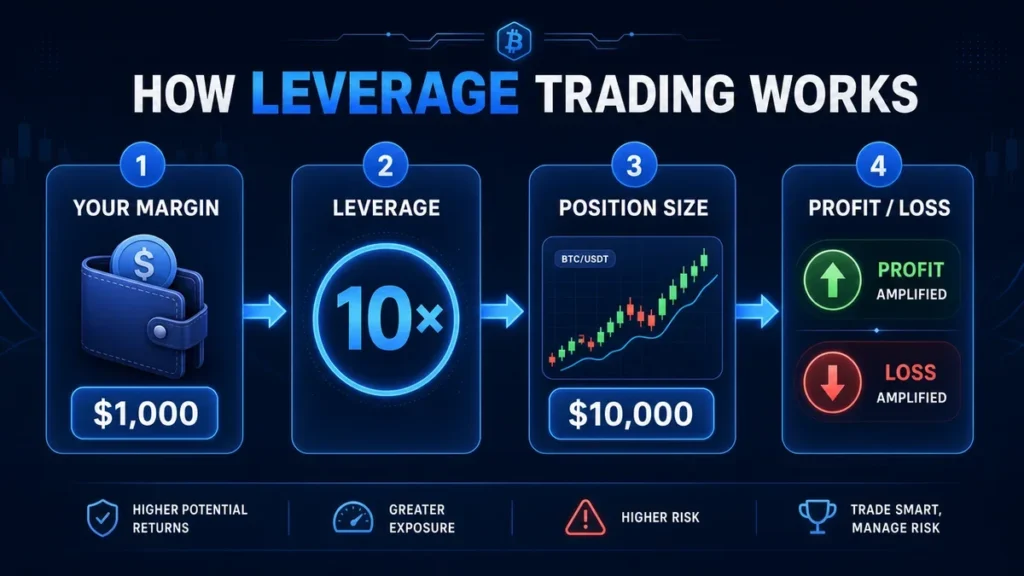
Understanding how does leverage trading work is easier when you see how a leveraged trade plays out in practice. While each platform may have slightly different features, the basic steps are generally the same. Whether you’re trading on a traditional exchange or a No KYC crypto exchange, the overall process of opening and managing a leveraged position follows a similar structure.
Here’s what typically happens when you open a leveraged trade:
- Choose an asset to trade.
Select the market you want to trade, such as Bitcoin, Ethereum, Dogecoin, a stock, or a forex pair. - Decide how much margin to invest.
This is the amount of your own money you’ll use to open the position. - Select a leverage ratio.
Depending on the platform, you may be able to choose leverage ranging from 2× to 100× or more. Higher leverage increases both your potential returns and your risk. - Open your position.
Once the trade is placed, your position size is based on your margin multiplied by your chosen leverage. - Close the trade.
Your profit or loss is calculated based on the total position value, not just the margin you invested.
A Simple Example
Let’s say you have $1,000 and decide to use 5× leverage to buy Bitcoin.
| Your Margin | Leverage | Total Position Value |
| $1,000 | 5× | $5,000 |
Now imagine Bitcoin’s price rises by 10%.
- Without leverage, your $1,000 investment would grow to $1,100, giving you a $100 profit.
- With 5× leverage, your $5,000 position gains 10%, resulting in a $500 profit (before fees and funding costs).
Of course, leverage works both ways. If Bitcoin’s price falls by 10% instead, your leveraged position would lose $500, compared with just $100 without leverage.
What Happens If the Market Moves Against You?
If your losses become too large, your account may no longer have enough margin to support the position. When this happens, the trading platform can automatically close your trade to prevent further losses. This process is known as liquidation.
The higher the leverage you use, the less room your trade has to move against you before liquidation becomes a possibility. That’s why many experienced traders prefer using lower leverage, even when much higher ratios are available.
Understanding this balance between risk and reward is one of the most important lessons in leverage trading. While higher leverage can increase your potential returns, it also means that even small market movements can have a much bigger impact on your account.
Why Is Leverage Trading So Popular in Crypto?
Crypto leverage trading works in the same way as leveraged trading in traditional markets, but the major difference is volatility. Cryptocurrency prices can move much faster and more dramatically than many traditional assets, creating both greater opportunities and higher risks for traders.
Most crypto exchanges offer leverage through margin trading and futures trading. While both allow traders to increase their market exposure, they work differently and are suited to different trading strategies.
Margin Trading
Margin trading involves borrowing funds to buy or sell cryptocurrencies. Because you’re trading the actual asset, it’s generally considered the simpler of the two methods and often comes with lower maximum leverage.
This type of trading is commonly used by investors who want a bit more buying power while maintaining exposure to the underlying cryptocurrency.
Futures Trading
Futures trading doesn’t require you to own the cryptocurrency itself. Instead, you trade a contract that tracks the asset’s price, allowing you to speculate on whether it will rise or fall.
Many crypto exchanges also offer perpetual futures, which have no expiration date. Rather than settling on a fixed day, these contracts remain open until you close the position or it’s liquidated. To keep perpetual futures prices aligned with the spot market, exchanges use funding fees—small periodic payments exchanged between traders holding long and short positions.
Long vs. Short Positions
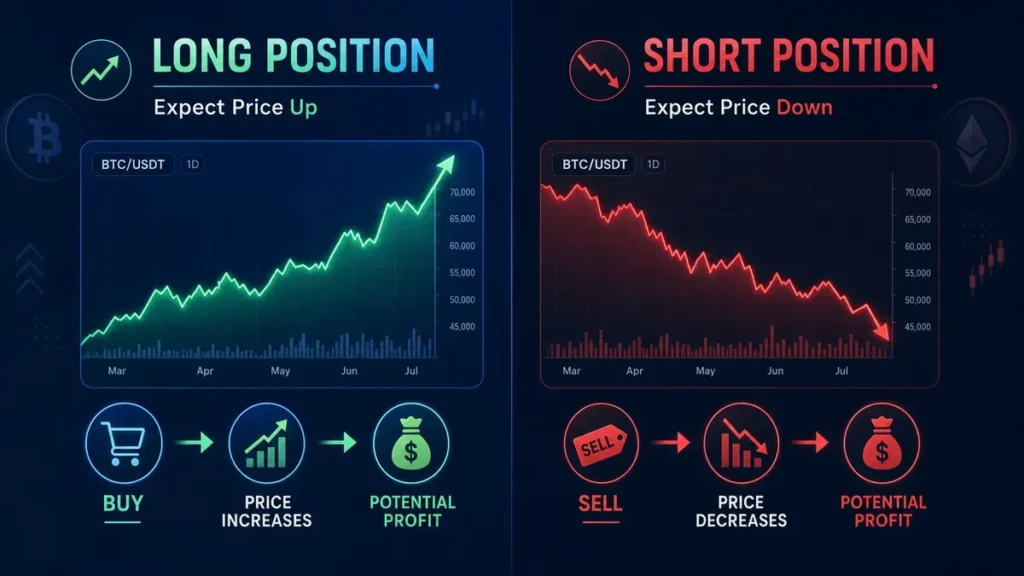
One advantage of crypto leverage trading is that traders can look for opportunities in both rising and falling markets.
- Long position: You expect the price to rise, so you buy with the aim of selling later at a higher price.
- Short position: You expect the price to fall, allowing you to potentially profit from a decline in value.
This flexibility means traders can look for opportunities in both bull and bear markets. However, because cryptocurrency prices can change rapidly, losses can build just as quickly—especially when using high leverage.
For beginners, it’s generally a good idea to start with lower leverage and focus on understanding how the market behaves before increasing risk. Experience and disciplined risk management matter far more than using the highest leverage available.
Choosing the Right Leverage
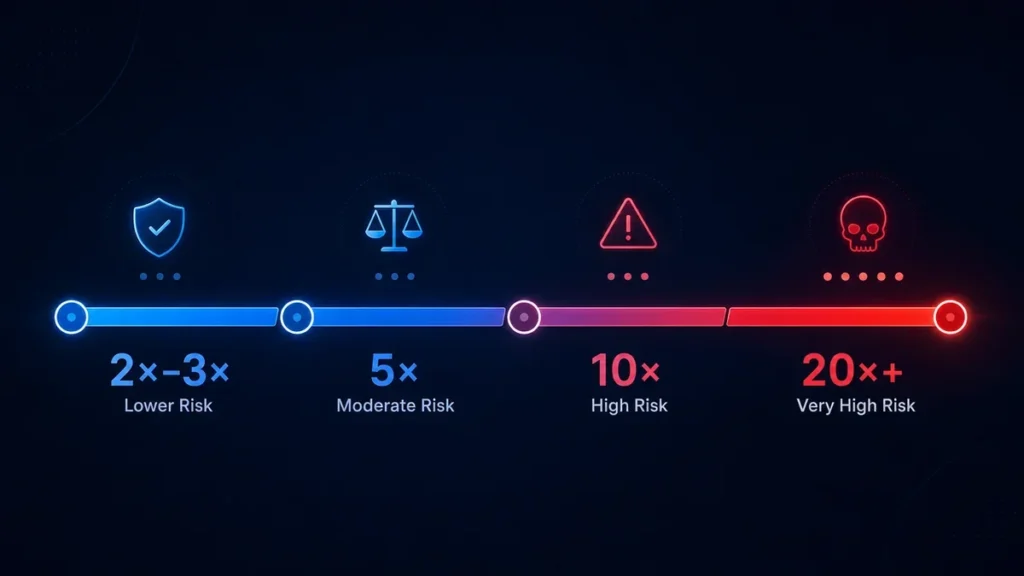
A common mistake among new traders is assuming that higher leverage always means bigger profits. In reality, the right leverage depends on your experience, trading strategy, and how much risk you are comfortable taking.
As a general rule, lower leverage gives your trade more room to withstand normal market fluctuations, while higher leverage increases the likelihood of liquidation if the market moves against you.
Here’s a general comparison of common leverage ratios:
| Leverage | Commonly Used By | Risk Level |
|---|---|---|
| 2×–3× | Beginners learning leverage and conservative traders | Lower |
| 5× | Traders with some experience and clear risk management | Moderate |
| 10× | Active traders with higher risk tolerance | High |
| 20×–50× | Advanced traders using short-term strategies | Very High |
| 50×–100×+ | Highly speculative trading strategies | Extremely High |
Keep in mind that these aren’t strict rules. Some experienced traders rarely use more than 3× or 5× leverage, while beginners often make the mistake of choosing the highest leverage available in hopes of earning bigger profits. In many cases, that simply increases the chance of being liquidated before the market has time to recover.
If you’re just getting started, using lower leverage and smaller position sizes is usually the safer approach. As you gain experience and develop a consistent trading strategy, you can decide whether higher leverage fits your trading style.
Advantages of Leverage Trading
When used properly, leverage can help traders increase their market exposure without needing to provide the full value of a position upfront. This flexibility is one reason why leverage is commonly used across different financial markets.
Some of the main benefits of leverage trading include:
- Greater market exposure with less capital. You can control a larger position without paying its full value upfront, leaving more of your capital available for other trades or investments.
- Potential for higher returns. Because profits are calculated based on the total position size, successful trades can generate significantly larger returns than non-leveraged trades.
- Opportunity to profit in both rising and falling markets. Through long and short positions, leverage allows traders to potentially benefit whether prices move up or down.
- More efficient use of capital. Instead of allocating all your funds to a single trade, you can spread your capital across multiple positions, helping to diversify your trading strategy.
- Access to more advanced trading strategies. Many experienced traders use leverage alongside hedging, arbitrage, or short-term trading strategies that would be difficult to execute using only their own capital.
While these advantages can make leverage an attractive trading tool, they’re only part of the picture. Every potential benefit comes with additional risk, and using leverage without a clear trading plan can quickly lead to significant losses. That’s why understanding the risks is just as important as understanding the rewards.
Risks of Leverage Trading
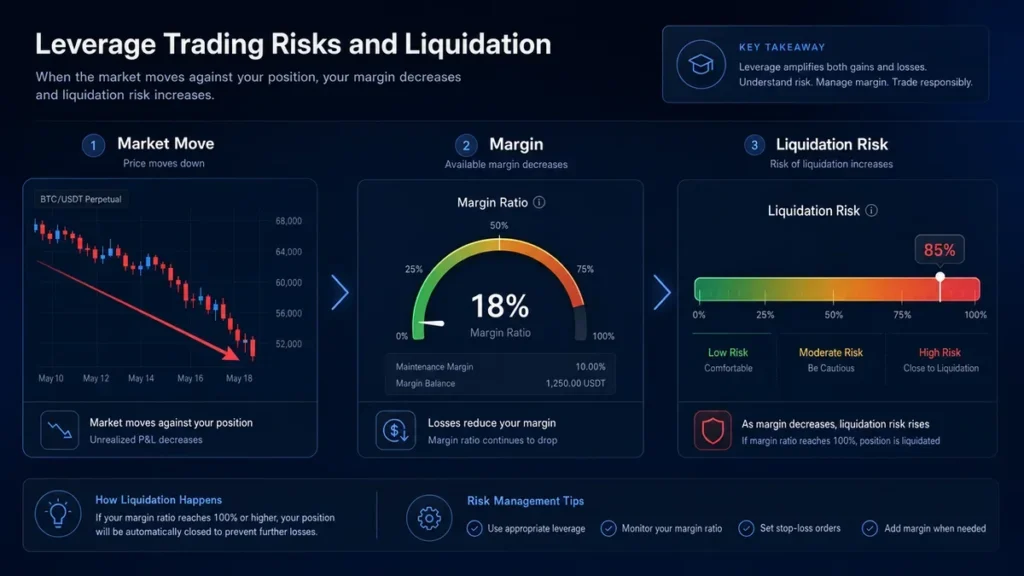
Leverage can increase your earning potential, but it also increases your exposure to risk. Even experienced traders can suffer significant losses if they use too much leverage or fail to manage their positions carefully.
Here are some of the biggest risks to keep in mind:
- Losses are magnified. Just as leverage can boost your profits, it can also amplify your losses. A relatively small price movement can result in a much larger percentage loss than if you were trading without leverage.
- Liquidation can happen quickly. If your account no longer has enough margin to support an open position, the trading platform may automatically close it. This can happen much sooner when using high leverage.
- Market volatility can work against you. Cryptocurrency prices can change rapidly, sometimes within minutes. Sudden price swings can trigger stop-loss orders or liquidations before the market has a chance to recover.
- Emotional decision-making. Watching profits and losses fluctuate more dramatically can lead to fear, greed, or impulsive trading. These emotions often cause traders to abandon their strategy and make costly mistakes.
- Additional trading costs. Depending on the platform and the type of leveraged product you use, you may need to pay interest on borrowed funds, funding fees, or higher trading fees. These costs can reduce your overall returns, especially if you hold positions for an extended period.
These risks don’t mean leverage should always be avoided. Instead, they highlight why careful planning, proper position sizing, and risk management are important when using leveraged positions. Experienced traders usually focus more on protecting their capital than simply maximizing their leverage.
Tips for Using Leverage More Safely
Leverage trading always involves risk, but having a clear strategy can help beginners avoid common mistakes. The goal is not to eliminate risk completely, but to manage it in a way that limits unnecessary losses and protects your capital over time.
Here are some practical ways to use leverage more responsibly:
- Start with lower leverage.
Higher leverage may look attractive because it increases potential returns, but it also leaves less room for mistakes. Beginners often start with lower ratios, such as 2× or 5×, while learning how the market moves. - Never risk more than you can afford to lose.
Avoid putting a large portion of your trading capital into a single leveraged position. Proper position sizing can help prevent one bad trade from significantly damaging your account. - Use stop-loss orders.
A stop-loss automatically closes your position when the price reaches a certain level. It can help limit losses and prevent emotions from influencing your decisions during sudden market movements. - Understand liquidation levels before entering a trade.
Before opening a leveraged position, know how far the market can move against you before liquidation occurs. This helps you choose a leverage level that matches your risk tolerance. - Avoid trading based on emotions.
Fear of missing out (FOMO) and the desire to recover losses quickly are common reasons traders take unnecessary risks. A clear trading plan is often more valuable than chasing short-term opportunities. - Keep learning and testing your strategy.
Before using significant amounts of money, consider practicing with a demo account or smaller positions. Understanding how different market conditions affect your trades can help you make better decisions.
Leverage is a tool, and like any tool, the outcome depends on how you use it. Traders who focus on risk management often have a better chance of staying consistent than those who simply chase the highest possible returns.
Is Leverage Trading Right for Beginners?
For beginners, leverage trading can be both exciting and overwhelming. The ability to control larger positions with less capital may seem appealing, but it also requires a strong understanding of risk management and market behavior.
In most cases, beginners should avoid using high leverage until they have gained enough trading experience. Many new traders focus on the potential profits without fully understanding how quickly losses can accumulate when leverage is involved.
Before trying leverage trading, it’s worth asking yourself:
- Do you understand how margin and liquidation work?
Knowing when and why a position can be closed automatically is essential before using borrowed funds. - Do you have a clear trading strategy?
Entering leveraged trades without a plan often leads to emotional decisions and unnecessary risks. - Can you manage losses calmly?
Leverage can make price movements feel much more intense. Being able to follow your strategy during periods of volatility is an important skill.
For those who are still learning, starting with lower leverage—or practicing with a demo account—can be a more sensible approach. The goal should be to understand the mechanics of leverage trading first, rather than focusing only on maximizing potential returns.
Ultimately, leverage trading is not inherently good or bad. It is simply a tool that can work in your favor when used carefully or work against you when used without proper preparation. Building knowledge, managing risk, and staying disciplined are what separate thoughtful traders from those who rely on luck.
Final Thoughts: What Is Leverage Trading?
Leverage trading gives traders the ability to access larger positions with less upfront capital, but that extra buying power comes with additional risk. A small market movement can have a much greater impact when leverage is involved.
Understanding what is leverage trading, how margin works, and how liquidation happens is essential before entering any leveraged position. While leverage can be a useful tool for experienced traders, it should always be approached carefully, especially in highly volatile markets like crypto.
For beginners, the focus should not be on using the highest leverage available or chasing quick profits. Building a solid understanding of risk management, starting with smaller positions, and developing a consistent trading strategy are far more important for long-term success.
When used responsibly, leverage can be a powerful addition to a trader’s toolkit. But without proper knowledge and discipline, it can quickly turn a small mistake into a significant loss.
Frequently Asked Questions
It depends on the platform and trading product. In many cases, your position is automatically liquidated before losses exceed your available margin, but it’s important to understand the rules of the exchange you use.
Regular trading uses only your own capital, while leverage trading uses borrowed funds to open a larger position. This increases both potential profits and potential losses.
No. Leverage trading availability depends on local regulations and the rules of each trading platform. Some regions limit or restrict access to leveraged products.
Beginners often start with lower leverage because it gives trades more room to move before liquidation becomes a risk. The right leverage depends on your experience and risk management strategy.
Leverage trading allows traders to control larger positions using borrowed funds. It can increase potential profits, but it also increases potential losses, so proper risk management is essential.