



Bitcoin Halving is a programmed event that cuts the number of new BTC entering circulation by half. It happens roughly every four years and is one of the most important features of Bitcoin’s monetary system.
Every Bitcoin halving reduces the reward paid to miners for adding new blocks to the network. This gradually slows the creation of new BTC and helps maintain Bitcoin’s maximum supply of 21 million coins.
If you are looking for Bitcoin halving dates, the Bitcoin halving schedule, or the next Bitcoin halving date, the key thing to understand is that the event is based on the number of blocks mined rather than a fixed date on the calendar. That is why the timing can be estimated years in advance but only confirmed as the network approaches the relevant block height.
What Is Bitcoin Halving?
So, what is Bitcoin halving in practical terms? It is an automatic reduction in the number of new BTC awarded to miners when they successfully add a block to the Bitcoin blockchain.
Bitcoin miners use computing power to process transactions and secure the network. In return, the winning miner receives a block reward that includes newly created BTC. Every 210,000 blocks, the protocol cuts this reward in half.
The result is simple: fewer new bitcoins are created over time. The process does not reduce the BTC already held by investors or remove coins from circulation. It only reduces the rate at which new ones are issued.
Here is how the reward has changed after each halving:
- 50 BTC per block before the first halving.
- 25 BTC after the first halving.
- 12.5 BTC after the second halving.
- 6.25 BTC after the third halving.
- 3.125 BTC after the fourth halving.
The next Bitcoin halving will reduce the reward again to 1.5625 BTC per block.
This predictable issuance schedule is one of Bitcoin’s defining features. Unlike traditional currencies, where the money supply can be changed by central banks or governments, Bitcoin’s supply rules are built into its protocol.
How Does Bitcoin Halving Work?
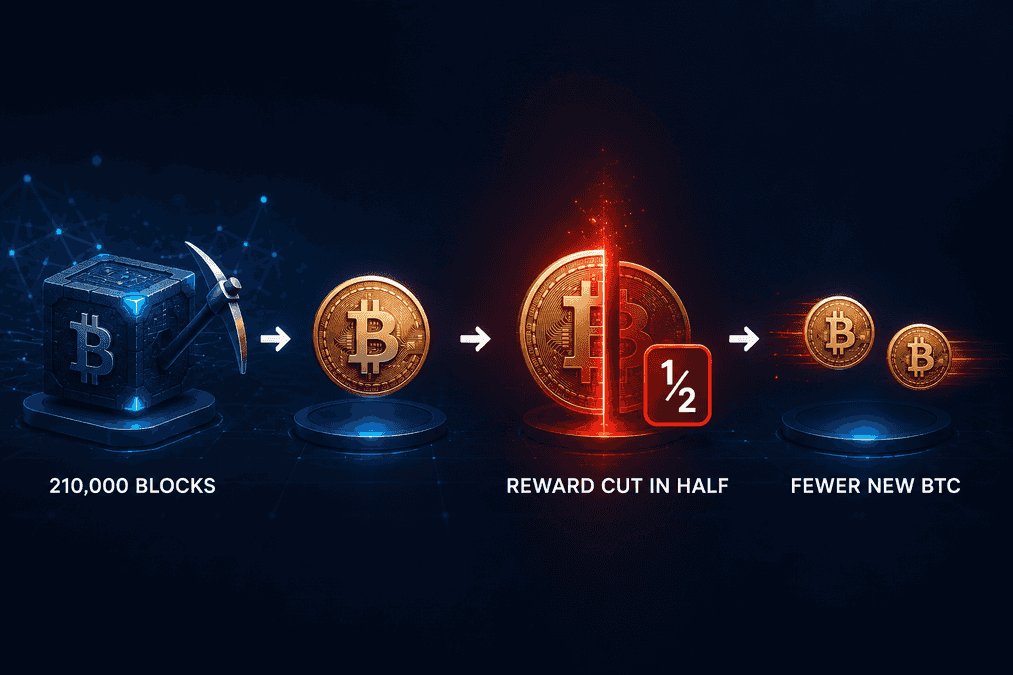
The easiest way to understand Bitcoin halving is to look at how new BTC enters the market in the first place.
Why Does Bitcoin Halve Every 210,000 Blocks?
Bitcoin does not halve on a specific date chosen in advance. Instead, each halving happens after another 210,000 blocks have been mined.
Bitcoin aims to produce a new block roughly every 10 minutes. At that pace, reaching 210,000 blocks takes about four years. In reality, the exact timing can vary because blocks are not mined at perfectly regular intervals.
This is why Bitcoin halving dates are usually estimates until the network gets closer to the target block height. The block number ultimately determines when the halving happens, not the date on the calendar.
How Much Bitcoin Is Created After Each Halving?
The Bitcoin block reward has fallen significantly since the network launched.
| Bitcoin Halving | Block Height | Reward Before | Reward After |
| First | 210,000 | 50 BTC | 25 BTC |
| Second | 420,000 | 25 BTC | 12.5 BTC |
| Third | 630,000 | 12.5 BTC | 6.25 BTC |
| Fourth | 840,000 | 6.25 BTC | 3.125 BTC |
| Fifth | 1,050,000 | 3.125 BTC | 1.5625 BTC |
The reduction may look simple, but its long-term effect is significant. The amount of new Bitcoin entering the market gradually becomes smaller, reducing the rate of new supply growth.
Bitcoin Halving Dates and Schedule
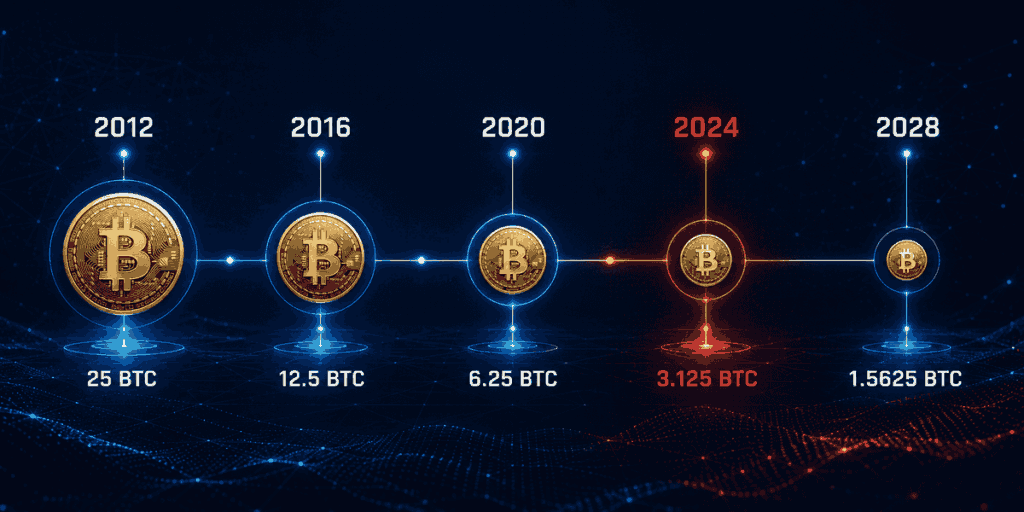
The Bitcoin halving schedule follows a simple rule: a new halving occurs every 210,000 blocks.
That makes the broader timeline fairly easy to estimate, but it does not give Bitcoin a fixed four-year calendar schedule. The exact date depends on how quickly miners produce the blocks leading up to the next milestone.
Bitcoin Halving History
The main Bitcoin halving dates so far are:
| Halving | Date | Block Height | Block Reward After Halving |
| First | November 28, 2012 | 210,000 | 25 BTC |
| Second | July 9, 2016 | 420,000 | 12.5 BTC |
| Third | May 11, 2020 | 630,000 | 6.25 BTC |
| Fourth | April 20, 2024 | 840,000 | 3.125 BTC |
| Fifth | Expected in April 2028 | 1,050,000 | 1.5625 BTC |
The dates above show why people often describe Bitcoin halvings as four-year events. However, the schedule is based on block production rather than a specific date on the calendar.
When Was the Last Bitcoin Halving?
The last Bitcoin halving took place on April 20, 2024, when the network reached block height 840,000.
The event cut the block reward from 6.25 BTC to 3.125 BTC. In practical terms, miners began receiving half as much newly created Bitcoin for each block they mined.
It was the fourth halving since Bitcoin launched in 2009.
What Is the Next Bitcoin Halving Date?
The next Bitcoin halving date is currently expected to fall around April 2028, when the network reaches block height 1,050,000.
At that point, the block reward will drop from 3.125 BTC to 1.5625 BTC. The reduction will happen automatically under Bitcoin’s protocol rules.
The exact calendar date is not yet fixed, however. It can move slightly depending on how quickly the network reaches the target block height. For that reason, the block height is more important than any estimated date.
Why Does Bitcoin Halving Matter?
Bitcoin halving matters because it changes Bitcoin’s supply dynamics at the protocol level.
The immediate impact is on miners, whose block reward is cut in half. As new BTC becomes scarcer over time, the event is closely monitored by retail investors, institutions, and those following the Bitcoin ETF market.
Lower Bitcoin Supply Growth
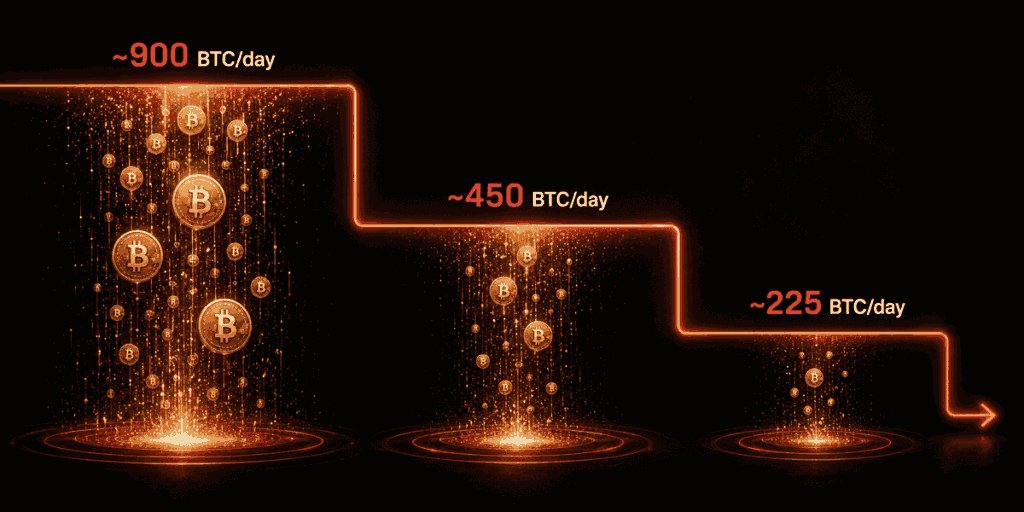
The most obvious effect of a halving is that fewer new bitcoins are created.
Before the 2024 halving, miners received 6.25 BTC for each block. That figure fell to 3.125 BTC after the event, cutting the theoretical daily issuance from roughly 900 BTC to around 450 BTC based on an average of 144 blocks per day.
The next halving is expected to reduce new issuance again to approximately 225 BTC per day, assuming a similar block production rate.
That does not mean Bitcoin’s price must rise. Markets are influenced by many factors, including demand, liquidity, interest rates, regulation, institutional activity, and investor sentiment.
The supply change is simply one part of the equation. The key difference is that miners have fewer newly created BTC to sell into the market than they did before the halving.
Impact on Bitcoin Miners
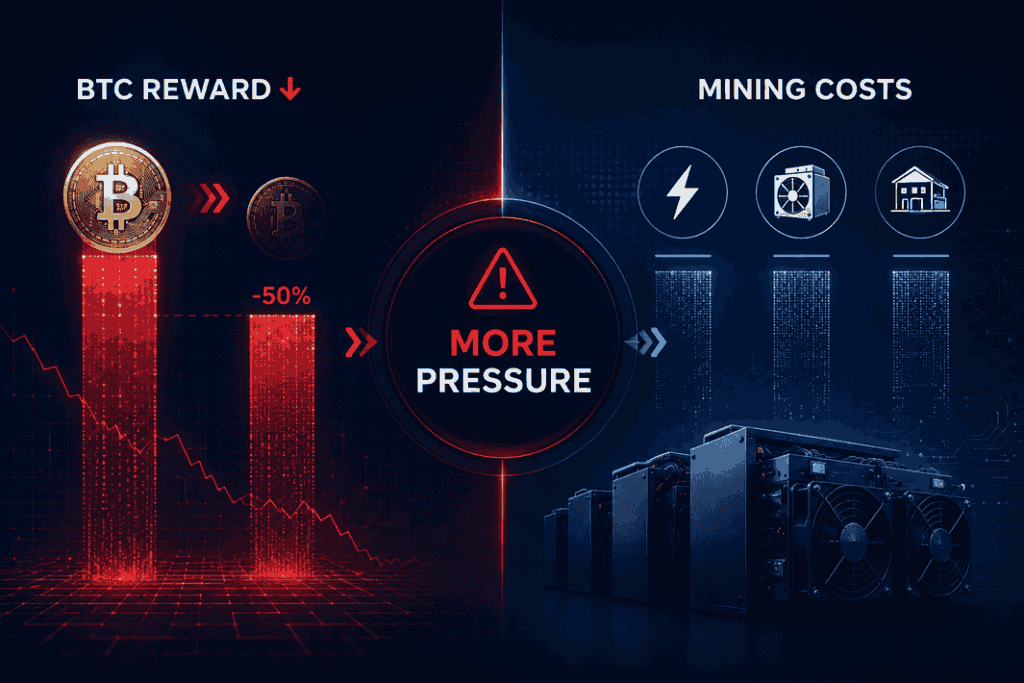
Miners feel the impact of a Bitcoin halving immediately.
Their biggest source of revenue is cut in half, but their main expenses, such as electricity, hardware, and infrastructure, do not automatically fall with it. That can put less efficient mining operations under significant financial pressure.
After a halving, miners may respond by:
- Improving energy efficiency.
- Upgrading to more efficient mining hardware.
- Moving to locations with cheaper electricity.
- Selling more of their Bitcoin reserves.
- Reducing or shutting down unprofitable operations.
The mining industry can therefore become more competitive after a halving. Efficient miners may be better positioned to continue operating, while less efficient miners can face greater financial pressure.
Transaction fees also form part of miner revenue. Over time, as the block subsidy becomes smaller, fees are expected to become increasingly important to Bitcoin’s long-term security model.
Possible Effect on Bitcoin Price
Bitcoin halvings have historically been followed by major market cycles, which is why investors often pay close attention to them.
The logic behind the potential impact is relatively simple. If the amount of new BTC entering the market falls while demand stays the same or increases, the change in supply could support higher prices over time.
But the halving itself is not a guaranteed price catalyst. Bitcoin’s market is also shaped by liquidity, interest rates, institutional demand, regulation, investor sentiment, and the broader economy.
There is also a timing issue. Because the halving is known in advance, some investors may buy ahead of the event, meaning part of its expected impact could already be reflected in the price. During this period, many traders also watch technical indicators, such as a bull flag or bear flag, to help assess potential market momentum.
For that reason, the halving is best viewed as an important change to Bitcoin’s supply dynamics rather than a guaranteed signal to buy or sell.
Does Bitcoin Halving Always Make Bitcoin Go Up?
No. Bitcoin halving does not guarantee that the price of BTC will rise.
Although previous halving cycles have been followed by significant long-term price increases, each market environment is different. Past performance does not guarantee similar results in the future.
There can also be a difference between the short-term and long-term effects of a halving.
In the short term, the event may already be priced into the market because investors know when it is expected to happen. The price can also be affected by unrelated events, such as changes in interest rates, economic uncertainty, regulation, or large movements in institutional capital.
Over a longer period, the reduced rate of new Bitcoin issuance can become more important if demand continues to grow.
This is why the halving is better understood as a change to Bitcoin’s supply dynamics rather than a simple “buy signal.”
Bitcoin Halving and the 21 Million BTC Supply Cap
Bitcoin’s supply is limited to 21 million BTC.
The halving mechanism helps distribute this supply gradually over a long period instead of creating most of the coins in the early years of the network.
The block reward started at 50 BTC in 2009. It has since been reduced several times and will continue to fall through future Bitcoin halving events.
Eventually, the block reward will become so small that the creation of new BTC will effectively stop. The final Bitcoin is generally expected to be mined around the year 2140, although the exact timing can vary based on how the network operates over the coming decades.
Once new Bitcoin issuance ends, miners will need to rely on transaction fees as their primary source of network rewards.
What Happens After the Final Bitcoin Halving?
The final Bitcoin halving will not happen in the same way as the earlier events.
Bitcoin’s block reward is repeatedly divided by half until the amount of newly created BTC becomes extremely small. Eventually, the subsidy will reach zero.
At that point, miners will no longer receive newly created Bitcoin as a block subsidy. Instead, their main source of revenue will be transaction fees paid by users.
This raises important questions about the long-term economics of Bitcoin mining and network security. However, that transition is still more than a century away, giving the Bitcoin ecosystem significant time to evolve.
For now, the more immediate focus is on the next Bitcoin halving expected in 2028 and how the market responds to another reduction in new BTC issuance.
Final Thoughts on Bitcoin Halving
Bitcoin Halving is a core part of the cryptocurrency’s monetary system.
By reducing the mining reward every 210,000 blocks, Bitcoin gradually slows the creation of new coins while maintaining its maximum supply of 21 million BTC.
The next Bitcoin halving date is expected to be in April 2028, although the exact day will depend on when the network reaches block height 1,050,000.
For investors, the halving is worth understanding because it affects Bitcoin’s supply dynamics, mining economics, and potentially market sentiment. Understanding how these changes may influence your investment strategy is just as important as choosing a secure Bitcoin Wallet, such as Electrum Wallet, to store your BTC.
The most important takeaway is simple: Bitcoin halving reduces the rate at which new BTC enters circulation, and this programmed scarcity is one of the defining features of Bitcoin.
Frequently Asked Questions
Bitcoin halving does not directly change Bitcoin’s transaction fee rules. However, changes in network activity can affect demand for block space, which may cause fees to rise or fall independently of the halving itself.
A Bitcoin halving is part of the network’s consensus rules and is not controlled by a central authority. The timing can shift because block production varies, but the reward reduction is expected to occur when the network reaches the required block height.
No. A halving does not reduce the amount of BTC held in your wallet. It changes how much new Bitcoin can be created as a mining reward.
The exact number depends on how the remaining block subsidy is calculated over time, but many more halvings are expected before the mining reward eventually reaches zero. The process is designed to continue until the full Bitcoin supply is distributed.
The 21 million limit is part of Bitcoin’s original protocol design. It creates a predictable supply ceiling and means that no central authority can simply increase the maximum supply under the existing rules.
It can, but its impact is debated. Reduced new supply may support prices over time, but demand, market conditions, and investor sentiment can have a much greater influence.
A Bitcoin halving does not require you to move your BTC. Whether you store your coins in a good personal wallet or on the best Bitcoin Exchange, the halving occurs automatically on the Bitcoin network.