


Stepping into the cryptocurrency space often feels like learning a brand new language. People constantly throw around terms like blockchain, private keys, and liquidity pools. Everyone has to start somewhere, and for the vast majority of investors, that starting point is a Bitcoin exchange. This platform serves as your digital gateway where traditional money turns into cryptocurrency.
Whether you want to buy a fraction of a Bitcoin or explore hundreds of different digital assets, understanding how these platforms work is your first critical step. This guide will walk you through exactly how exchanges operate, what features to look for, and how to protect your investment once you make a purchase.
What is a Bitcoin Exchange?
Before you can trade, you need to understand the mechanics of the marketplace. A Bitcoin exchange operates much like a traditional stock brokerage. It provides a digital environment where buyers and sellers meet to trade Bitcoin and other cryptocurrencies. You can use standard fiat money like US Dollars, or Euros to purchase digital coins directly.
Behind the scenes, the exchange uses an “order book” to match people who want to buy with people who want to sell. When you place an order to buy Bitcoin at a specific price, the exchange software scans the order book to find a seller willing to part with their Bitcoin at that exact price. The platform facilitates the trade instantly and takes a small fee for providing the service.
Exchanges handle all the heavy lifting regarding security, matching algorithms, and user interfaces. They make the complex world of blockchain technology accessible to everyday users who simply want to invest without learning computer programming.
What Makes the Best Bitcoin Exchange?
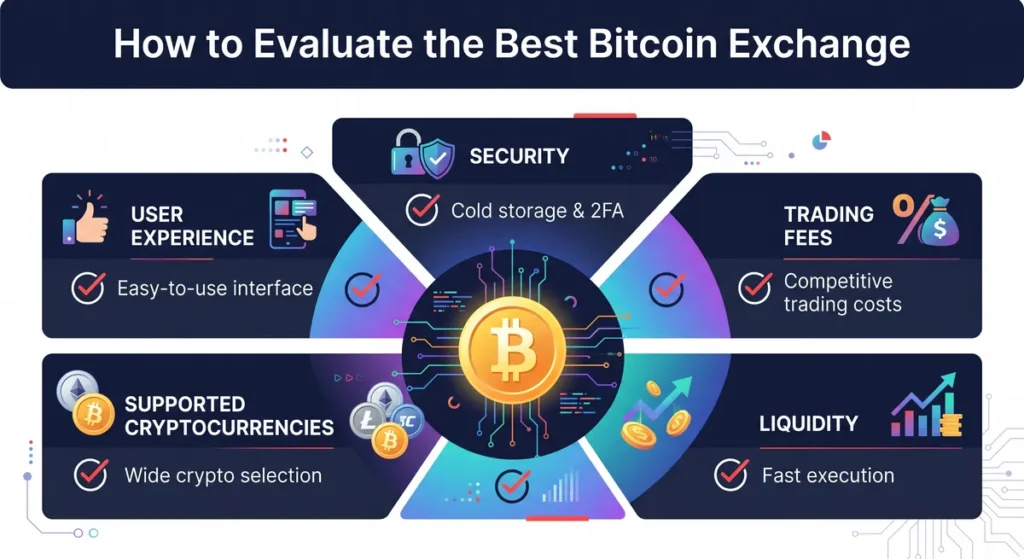
People constantly ask crypto experts to name the best Bitcoin exchange available today. The truth is that the right choice depends entirely on what you want to achieve. A professional day trader needs advanced charting tools and lightning-fast execution speeds. A beginner just wants a clear interface and a simple button to buy their first coin.
When evaluating your options, you should weigh several key factors carefully:
- Security Measures: The platform must offer Two-Factor Authentication (2FA) and hold the majority of user funds in offline cold storage. You want a platform with a clean history and strong financial backing.
- Trading Fees: Every time you buy or sell, the exchange takes a cut. Some platforms charge a flat fee, while others charge a percentage of your total trade. Always review the fee schedule before depositing money.
- Asset Selection: Some exchanges only list major coins like Bitcoin and Ethereum. If you want to explore smaller, emerging projects, you will need a platform that lists a wide variety of digital assets.
- Geographic Restrictions: Regulatory rules vary wildly by country. Ensure the exchange legally operates in your region and accepts your local currency for deposits.
- Customer Support: When money is on the line, you need reliable help. Look for platforms that offer live chat support or rapid email response times.
The Core Types of Crypto Exchanges
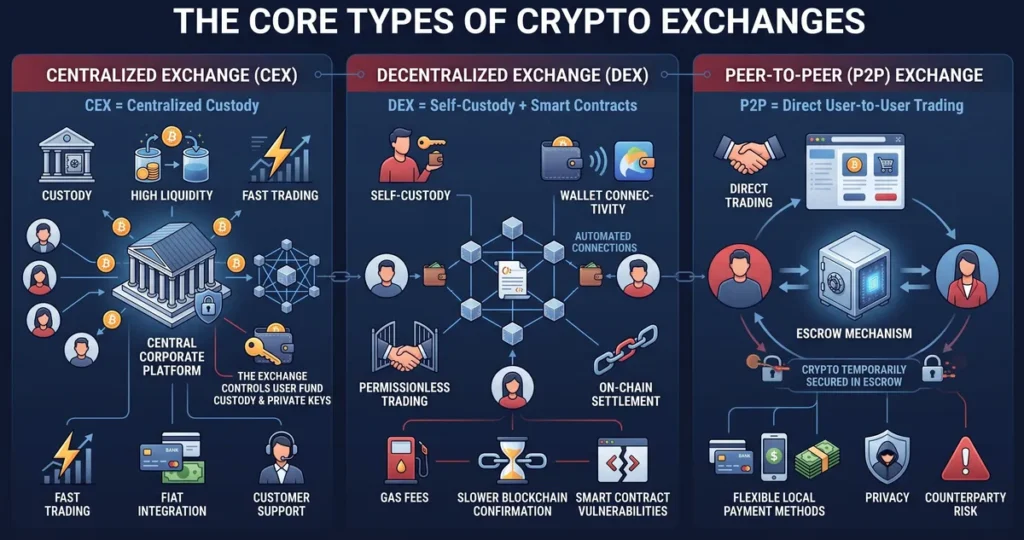
1. Centralized Exchanges (CEX)
Centralized exchanges are platforms owned and operated by a single corporate entity. They act as a trusted intermediary or custodian, holding your funds in their corporate wallets while you trade on their platform. Many also offer advanced features such as leverage trading, futures, and margin products for more experienced users.
- How they work: When you deposit money into a CEX, the exchange updates an internal database showing your balance. Trades occur instantly off-chain within the exchange’s private ledger rather than directly on the blockchain.
- Examples: Coinbase, Binance, Kraken.
- Key Advantage: They offer high liquidity, fast transaction processing, fiat currency integration (buying with a bank card), and customer support.
- Key Drawback: You do not control your private keys (“not your keys, not your coins”), making your assets vulnerable if the exchange undergoes bankruptcy or suffers a massive security breach.
2. Decentralized Exchanges (DEX)
Decentralized exchanges completely remove the middleman. Instead of relying on a corporation to hold assets and match orders, a DEX relies on self-executing smart contracts directly on the blockchain.
- How they work: Users connect their non-custodial wallets or hardware wallets directly to the platform. Trades are executed peer-to-smart-contract (using Automated Market Makers, or AMMs) and settled directly on the blockchain.
- Examples: Uniswap, PancakeSwap, Curve Finance.
- Key Advantage: You maintain absolute custody of your private keys throughout the entire trading process. There is no sign-up process, and no personal documentation is required.
- Key Drawback: Higher transaction fees (gas fees), slower trade execution tied to blockchain confirmation times, and the risk of smart contract bugs or vulnerabilities.
3. Peer-to-Peer (P2P) Exchanges
P2P exchanges act as decentralized marketplaces or bulletin boards where individual buyers and sellers connect directly with one another to trade.
- How they work: The platform provides an escrow service. The seller deposits their crypto into the escrow contract, the buyer pays the seller directly via an agreed method (like a bank transfer, cash, or PayPal), and once the seller confirms receipt, the platform releases the crypto to the buyer.
- Examples: Bisq, Hodl Hodl, Paxful.
- Key Advantage: Exceptional flexibility with local payment methods and increased privacy compared to major corporate platforms.
- Key Drawback: Higher risk of counterparty fraud or disputes, lower liquidity, and generally higher price spreads.
Crypto Exchange Comparison
To help you choose the right venue for your trading style, this side-by-side table outlines the fundamental operational differences:
• High-Volume Day Traders requiring split-second execution speeds and advanced order types. • Lazy HOLDers who just need a quick fiat gateway before transferring funds to cold storage. • Altcoin Bagholders looking for small-cap tokens not yet listed on corporate exchanges. • Privacy Purists who want to trade digital assets pseudonymously without uploading identity documents. • Underbanked Investors operating in regions where legacy banking infrastructure is restrictive or completely unavailable.
Feature
Centralized Exchanges (CEX)
Decentralized Exchanges (DEX)
Peer-to-Peer (P2P) Platforms
Asset Custody
Custodial (Exchange holds your keys)
Non-Custodial (You hold your own keys)
Escrow-Based (Temporary lockup during trade)
Identity Verification
Strict KYC (Identity documents required)
None (Anonymous/Wallet connection only)
Varies (Depends on platform rules)
Fiat Currency Support
Excellent (Bank transfers, debit cards)
None (Crypto-to-crypto swaps only)
Excellent (Direct peer payment options)
Liquidity & Volume
Very High ⭐️⭐️⭐️⭐️⭐️
High to Moderate (Varies by pool)⭐️⭐️⭐️
Low⭐️
Suitable Users
• Beginner Investors looking for a familiar banking interface.
• Active DeFi Explorers interacting with smart contracts, yield farming, and NFTs.
• Local Payment Users needing to buy or sell crypto using specific, regional e-wallets or cash handovers.
Choosing between these platforms typically involves balancing convenience and liquidity (CEX) against privacy and sovereign asset control (DEX/P2P).
Understanding a Bitcoin White Label Exchange
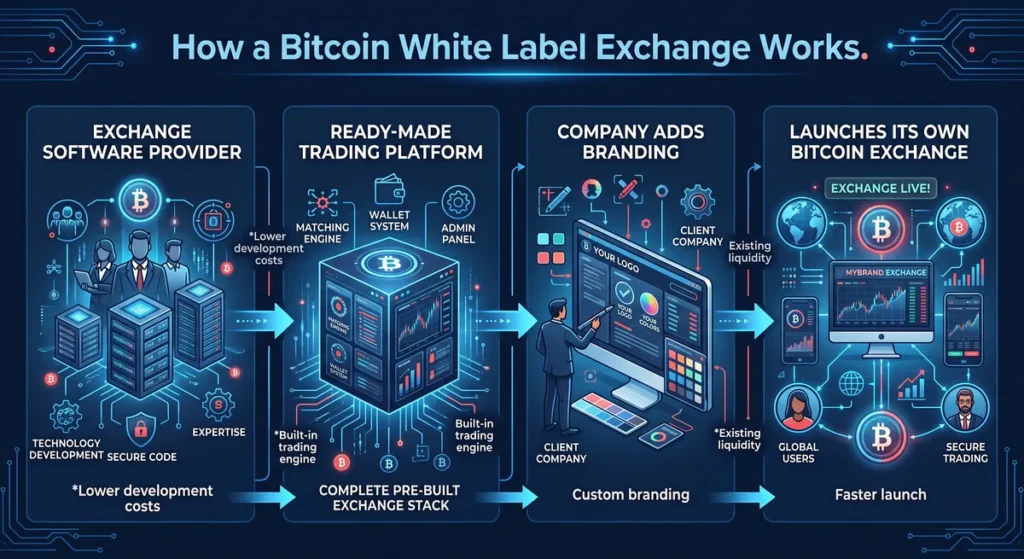
Sometimes you might use an exchange without realizing the company behind it did not build the technology from scratch. This brings us to the concept of a Bitcoin white label exchange.
Building a secure, high-volume trading platform requires years of development, millions of dollars, and a massive team of security experts. Many businesses want to enter the crypto market quickly without spending all that time and money. To solve this problem, software companies create a ready-made, fully functional exchange platform and sell it to other businesses. The buyer then puts their own logo, branding, and color scheme on the software.
A Bitcoin white label exchange allows a new brand to launch a trading platform in a matter of weeks rather than years. The provider handles the backend infrastructure, the matching engine, and the liquidity pools. The business owner focuses strictly on marketing, acquiring users, and providing customer support. This is a very common practice in the industry, and it explains why many different crypto platforms have surprisingly similar user interfaces.
Moving Your Funds: The Importance of Crypto Wallets
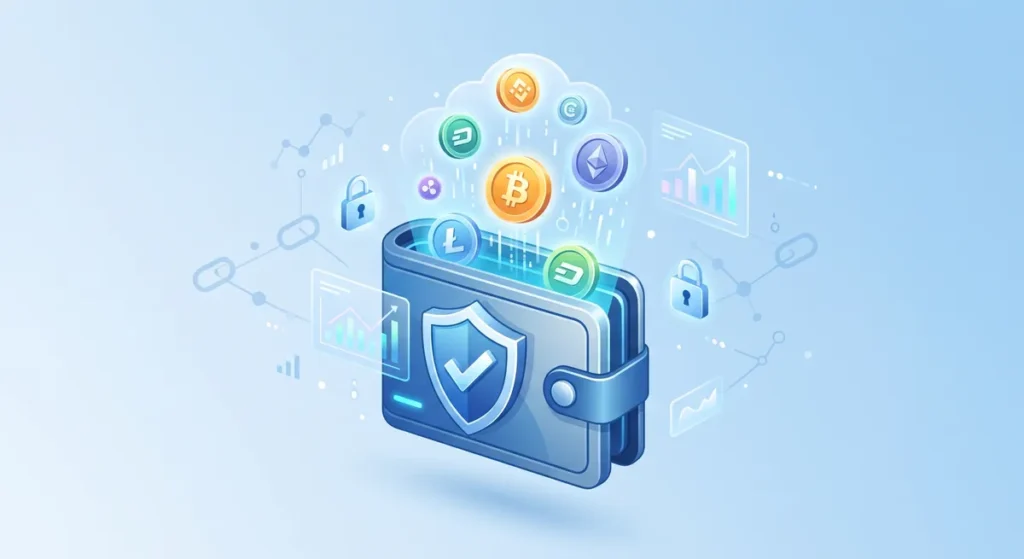
Buying crypto is only the first half of the journey. Storing it safely is just as important. Leaving your digital assets on an exchange carries inherent risk because the platform ultimately controls the private keys to your funds. If the exchange faces a massive hack or goes bankrupt, you could lose your investment.
Many investors choose to move their coins to a personal crypto wallet where they have total control. For instance, Trust Wallet provides an intuitive and beginner-friendly mobile app for holding a wide variety of tokens on the go. Alternatively, MetaMask serves as a popular browser extension specifically designed for interacting with decentralized finance applications on the Ethereum network. For those seeking maximum offline security, hardware wallets like Ledger keep your private keys completely disconnected from the internet.
Furthermore, if you want your digital assets to work for you instead of just sitting idle, you have specialized options. The IZAKA-YA Crypto lending wallet offers a highly accessible platform where users can securely manage, swap, and lend their digital assets to earn interest over time. Choosing the right storage solution ultimately comes down to balancing your need for security with your desire for growth and accessibility.
Trading Strategies for Beginners
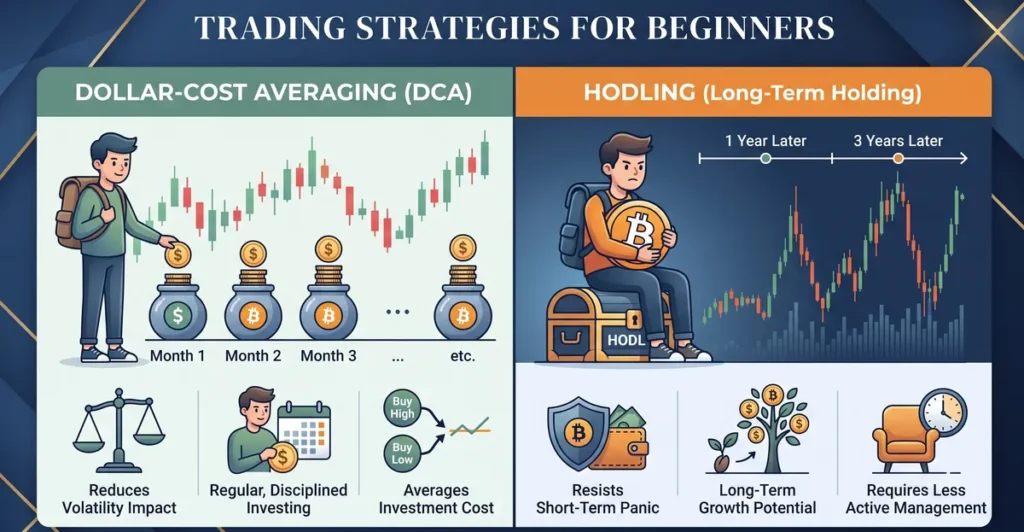
Once your account is funded, the blinking charts and rapidly changing numbers can feel overwhelming. Beginners often lose money because they trade purely on emotion, buying when prices skyrocket out of fear of missing out, and selling during crashes out of panic. You need a structured approach.
🚀 Dollar-Cost Averaging (DCA) This remains the most highly recommended strategy for newcomers. Instead of trying to guess the perfect time to buy, you invest a fixed amount of money at regular intervals. You might buy $50 worth of Bitcoin every Friday, regardless of the current price. When the price drops, your $50 buys more Bitcoin. When the price rises, your $50 buys less. Over time, this strategy averages out the cost of your investment and completely removes the stress of trying to time the market.
🔐 The HODL Strategy In the crypto community, holding onto your assets long-term is known as “HODLing.” This strategy requires you to buy Bitcoin and simply refuse to sell it for years, ignoring all short-term market crashes and media hype. Historically, investors who have held Bitcoin through multiple four-year market cycles have seen significant returns on their initial investments.
Common Trading Mistakes to Avoid
The crypto market moves at lightning speed, and beginners often fall into the same predictable traps. By recognizing these pitfalls early, you can protect your capital.
First, never invest money you might need for upcoming rent, bills, or emergencies. Cryptocurrency remains a highly volatile asset class. The value of your portfolio can drop by 20% in a single weekend. If you are forced to sell during a dip to pay a real-world bill, you lock in your losses permanently.
Second, avoid chasing obscure, low-value tokens just because they seem cheap. Many beginners look at a token priced at a fraction of a penny and assume it has a better chance of making them rich than buying a fraction of a Bitcoin. Market capitalization dictates value, not the price of a single coin. Stick to established assets with proven track records while you learn the ropes.
Beyond simply holding your assets in cold storage, the following section provides a clear, step-by-step walkthrough on how to set up your IZAKA-YA account and fund your first lending subscription to start earning passive yield
Step-by-Step: Getting Started with IZAKA-YA
Step 1: Creating Your Account
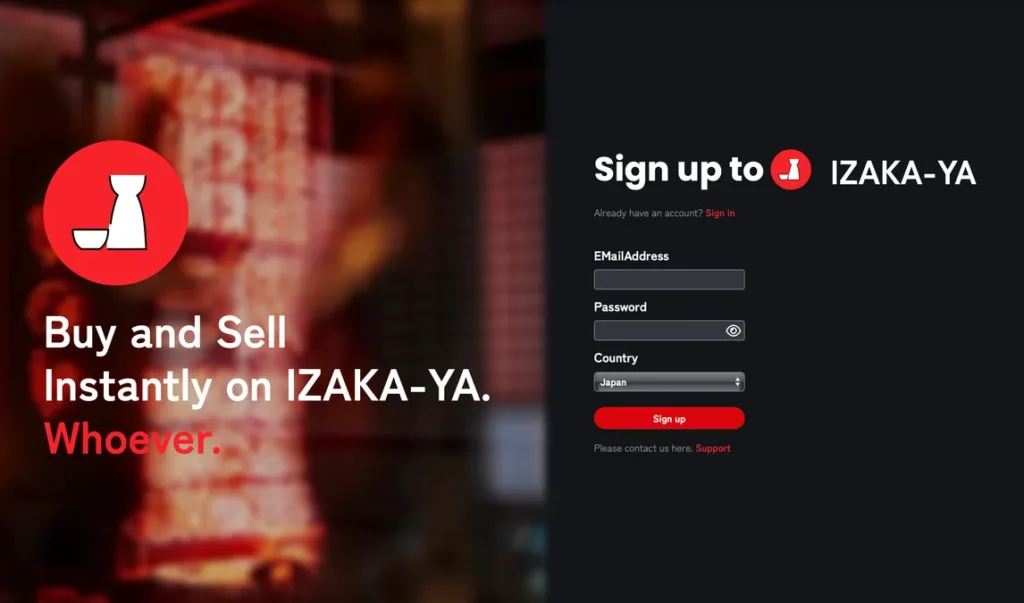
Get started by visiting the registration page to set up a secure profile.
- Provide Credentials: Enter your email address and choose a strong, unique password.
- Set Your Location: Pick your country of residence from the drop-down menu.
- Submit: Click the red Sign up button to move forward.
Step 2: Verifying Your Email
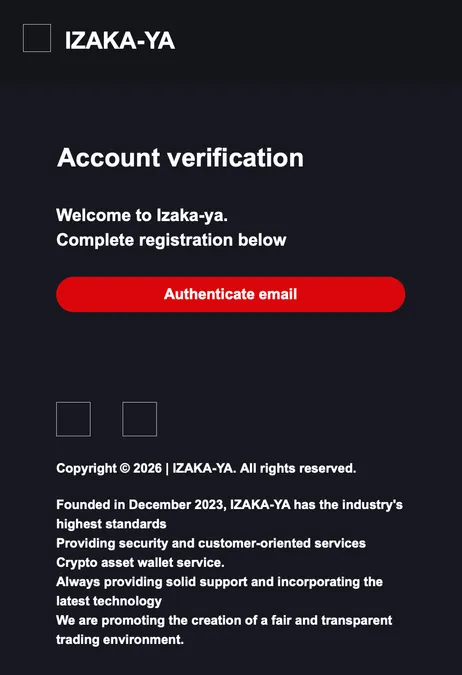
After submitting your details, head over to your email inbox to complete the security check.
- Confirm Registration: Open the verification message sent by the platform and click the prominent red Authenticate email button to officially activate your account.
Step 3: Selecting a Crypto Asset
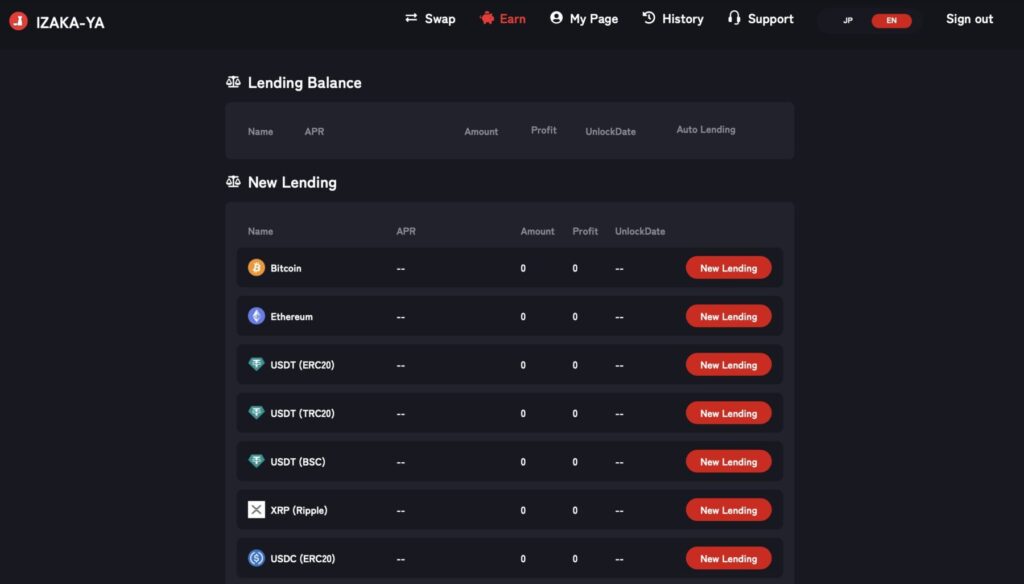
Once logged into your new dashboard, navigate to the Earn tab at the top of the screen to view your passive income options.
- Review Supported Coins: Look through the New Lending panel to view available options, including Bitcoin, Ethereum, XRP, USDC, and various network versions of USDT (ERC20, TRC20, and BSC).
- Get Started: Locate the specific cryptocurrency you wish to deploy and click the corresponding red New Lending button on the right side of the screen.
Step 4: Setting Up Your Strategy
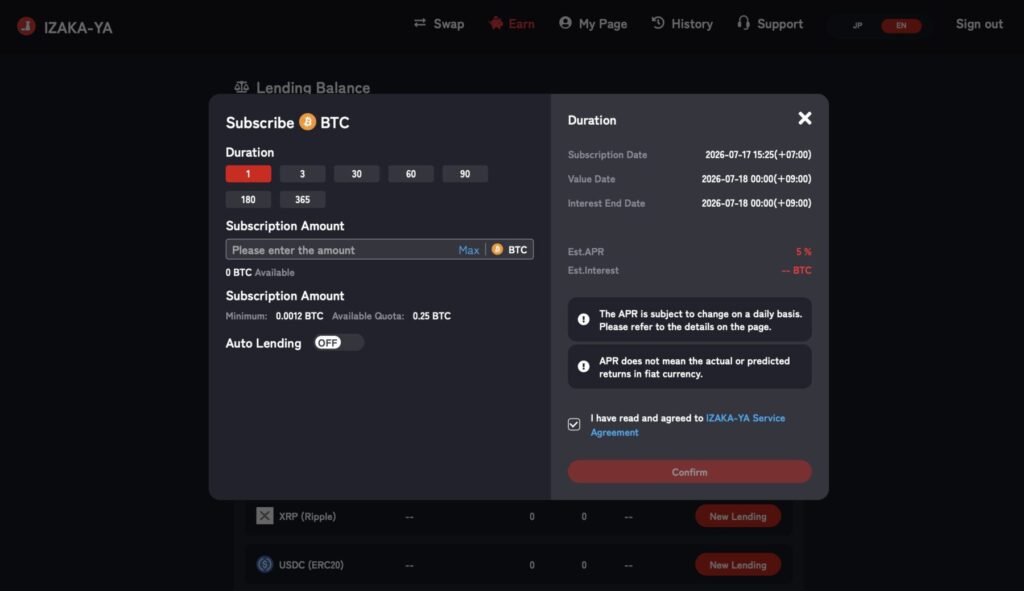
A detailed Subscribe window will appear, allowing you to fully customize how your funds are handled.
- Choose a Timeline: Select your preferred lock-up duration from the available options
- Input the Funds: Type in the amount of crypto you want to allocate, keeping an eye on the minimum balance requirements and your remaining daily allocation limit.
- Check Earnings Estimates: Review the summary on the right to see key timelines (such as the value date and interest end date) alongside your estimated annual percentage rate (Est.APR) and total estimated return (Est.Interest).
- Automate Growth: If you want your balance and earnings to automatically roll over into a new term once the timeline ends, toggle the Auto Lending switch to the ON position.
- Finalize Deployment: Carefully review the risk disclosures regarding floating APRs and fiat conversion approximations. Check the box to accept the service agreement, then click the red Confirm button to put your crypto to work.
Register IZAKA-YAkeyboard_arrow_right
Frequently Asked Questions (FAQs)
No, digital assets generally lack government-backed insurance. If the platform loses your crypto, legal recourse is limited. However, reputable exchanges often keep your fiat currency (like US Dollars) in regulated bank accounts that carry banking insurance.
Mainly through trading fees, taking a tiny percentage of each transaction. They also earn revenue from crypto withdrawal fees and processing charges on credit card deposits.
It is a ready-made trading platform that businesses license and customize with their own branding. This allows companies to launch their own exchange quickly and affordably without building the technical infrastructure from scratch.
Yes. You simply copy the unique Bitcoin deposit address from your receiving exchange and paste it into the withdrawal section of the exchange you are sending from.
A basic password reset can be done quickly via email. However, if you lose your Two-Factor Authentication (2FA) device, you will need to submit photo ID verification to the support team.


