



If you already own crypto, you may have noticed Bitcoin ETFs appearing everywhere in financial news. You may also have seen headlines about record-breaking BTC ETF inflows, institutional demand, or investors moving billions of dollars into Bitcoin-related funds. But what exactly is a Bitcoin ETF?
In simple terms, a Bitcoin ETF is an investment fund that allows people to gain exposure to Bitcoin through a traditional investment account. Instead of buying Bitcoin directly from a crypto exchange and managing a wallet, investors can buy shares of a fund through a conventional brokerage.
In this comprehensive guide, we will explore exactly how these financial instruments work, highlight the impact of institutional money entering the space, and help you determine if this investment vehicle aligns with your personal financial goals.
What Is a Bitcoin ETF?
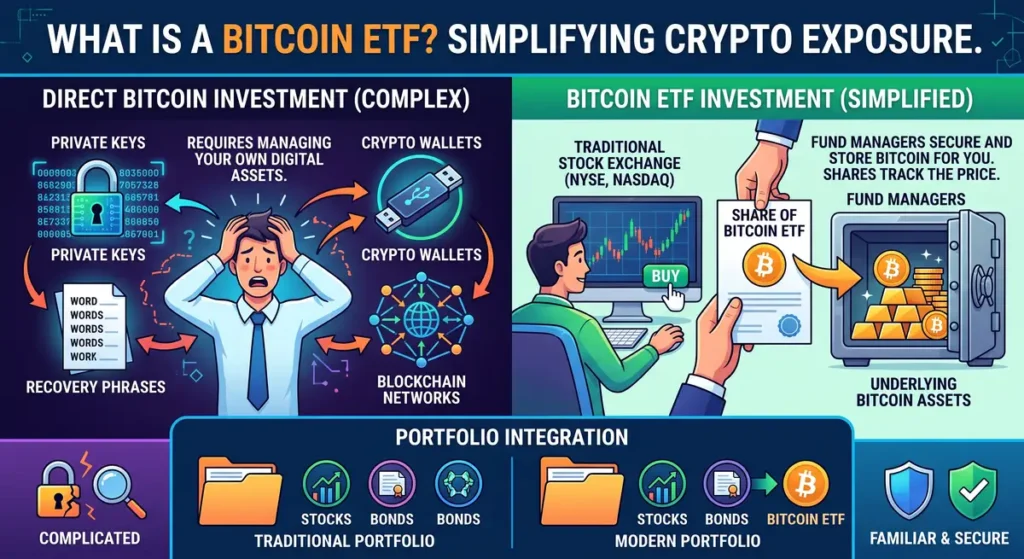
If you’ve ever wondered, “What is a Bitcoin ETF?”, you’re not alone. The world of crypto can seem complicated at first, with unfamiliar terms like private keys, recovery phrases, wallets, and blockchain networks.
A Bitcoin ETF offers a simpler way to get exposure to Bitcoin without having to deal with all of that yourself.
First, let’s quickly understand what an ETF is. An ETF, or exchange-traded fund, is an investment product that you can buy and sell on a traditional stock exchange, just like a stock. Think of it as a basket that holds a particular asset or group of assets. When you buy a share of the ETF, you are buying a small piece of that investment.
A Bitcoin ETF works in a similar way, but its purpose is to give you exposure to the price of Bitcoin. Instead of buying Bitcoin directly through the best Bitcoin exchange and storing it in a crypto wallet, you purchase shares of the fund on a traditional stock exchange like the NYSE or Nasdaq. The fund managers handle the complicated parts of securing and storing the actual digital assets. Your shares simply track the price movements of the cryptocurrency.
This means you can gain exposure to Bitcoin while keeping your investment alongside other assets in your portfolio. You also don’t have to worry about setting up a wallet, remembering a recovery phrase, or managing your own private keys.
Breaking Down the Basics: What Is a Bitcoin ETF?
For beginners, this can make investing in Bitcoin feel much more familiar. You are essentially using the traditional financial system to gain exposure to a digital asset.
‼️ The trade-off is that you don’t directly own or control the Bitcoin held by the fund. Instead, you own shares in the ETF, while the fund and its custodians take care of the underlying Bitcoin.
In short, a Bitcoin ETF gives you a way to participate in Bitcoin’s price movements without having to navigate the technical side of crypto yourself.
How Does a Bitcoin ETF Work?
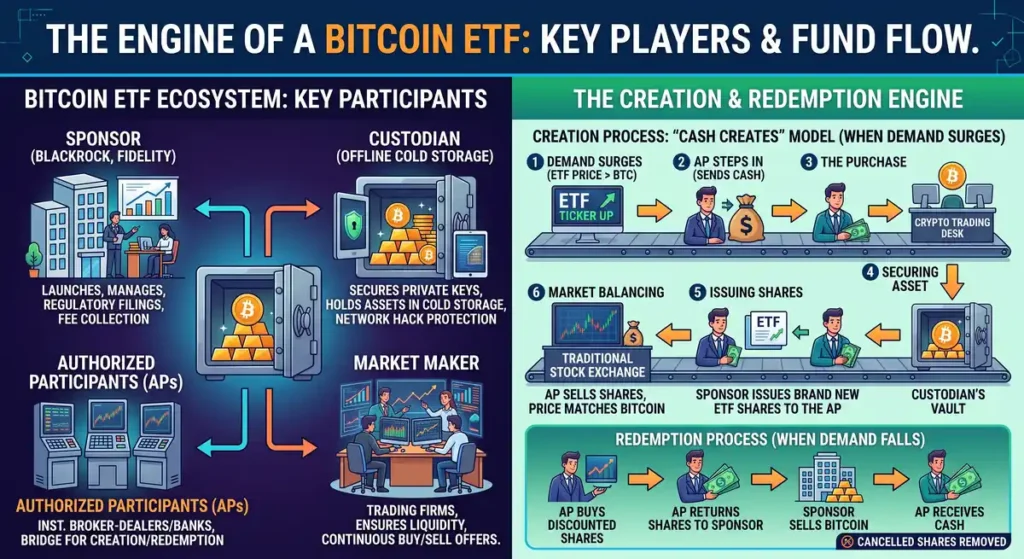
A financial company, known as a fund issuer, manages the entire process. They create shares that represent the underlying digital currency, and you can buy or sell these shares directly on a traditional stock exchange.
To see exactly how this financial vehicle works, we need to break down the key participants and the precise flow of funds.
The Key Players in the Ecosystem
The entire system relies on a network of distinct entities working together to ensure the fund remains secure and its price stays accurate.
The Sponsor: This is the financial firm that launches and manages the ETF. Companies like BlackRock or Fidelity serve as sponsors. They market the fund, manage all regulatory filings, and charge an annual management fee for their services. The Custodian: The sponsor does not physically hold the cryptocurrency. Instead, they hire a specialized, regulated trust company to act as the custodian. The custodian secures the private keys to the digital wallets, keeping the assets entirely in offline “cold storage” to eliminate the risk of network hacks. Authorized Participants (APs): These are large institutional broker-dealers or banks. They act as the crucial bridge between the cryptocurrency market and the traditional stock exchange by executing the creation and redemption process. The Market Maker: These trading firms ensure there is always enough liquidity on the stock exchange. They provide continuous buy and sell offers so retail investors can easily trade shares without experiencing extreme price slippage.
The Engine: Creation and Redemption
The most critical part of an ETF is how it keeps its share price perfectly aligned with the actual market price of Bitcoin. This is handled through a continuous cycle of creating new shares and redeeming old ones. In traditional equity ETFs, this is often done “in-kind,” meaning APs deliver actual stocks to the fund in exchange for shares. However, due to strict regulatory frameworks in markets like the US, most Bitcoin ETFs operate using a “cash creates” model. Here is the exact step-by-step breakdown of how new shares enter the market when investor demand is high:
When demand falls and investors sell off their shares, the exact reverse happens. The AP buys the discounted shares, hands them back to the sponsor, the sponsor sells the underlying Bitcoin, and the AP receives cash. The canceled shares are then permanently removed from existence.
Custody: Who Actually Owns the Crypto?
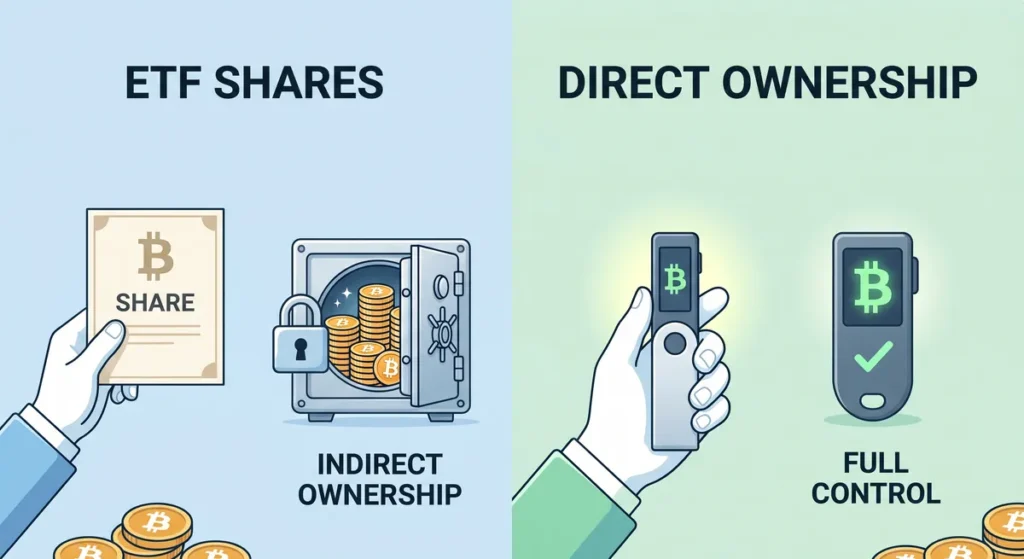
When you purchase ETF shares, the fund itself holds the underlying cryptocurrency. A regulated third-party custodian physically secures the assets in offline vaults on behalf of the fund. You, as the investor, simply own shares of that overall trust.
Therefore, buying an ETF does not give you the same level of absolute control as owning the digital currency directly. You cannot withdraw the specific coins, send them to a friend, or use them to interact with decentralized finance applications. Your investment remains securely locked inside the traditional banking system.
For investors who prefer complete financial sovereignty, holding assets directly is still the preferred route. Utilizing alternative wallets like a Ledger hardware device or a mobile-based software wallet like Exodus ensures you maintain total control over your private keys. Additionally, if you want to put those directly owned assets to work, you can seamlessly connect to IZAKA-YA, a crypto lending wallet to earn competitive interest rates on your holdings.
Price Accuracy: The Creation and Redemption Process
You might be wondering how the ETF maintains an accurate price compared to the highly volatile crypto market. Behind the scenes, large financial institutions known as authorized participants keep everything running smoothly.
These specialized entities have the unique ability to create or redeem ETF shares based on current market demand. If the ETF share price temporarily drifts away from the actual price of the underlying digital currency, these authorized participants step in to buy or sell the difference. This constant balancing act helps the ETF price stay securely anchored to the real-time value of the asset.
For the everyday investor, the practical takeaway is very simple. You can easily trade your shares during normal stock market hours without needing to understand the complex backend plumbing. Knowing that this institutional mechanism exists simply gives you confidence that your chosen ETF accurately reflects true market value.
What Is a Spot Bitcoin ETF vs. Futures ETF?
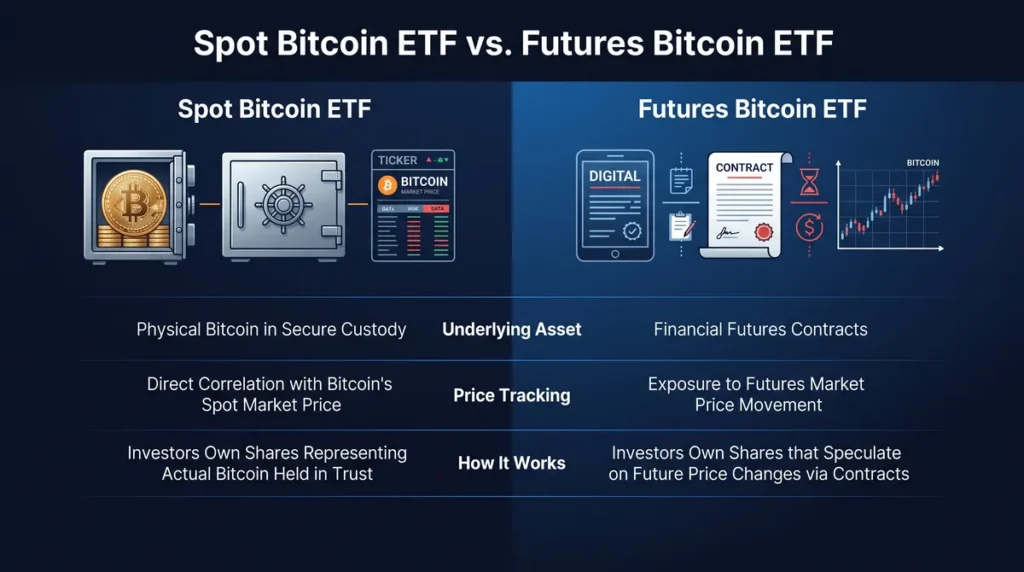
As you dive deeper into this topic, you will inevitably encounter different variations of these funds. The most common point of confusion is the difference between spot and futures products. If you are asking what a spot Bitcoin ETF is, you are inquiring about the most direct way to invest.
A spot fund actually holds real Bitcoin in a secure digital vault managed by a professional custodian. When the fund issues shares, those shares are directly backed by the physical digital currency sitting in their reserves. If the price of the cryptocurrency goes up, the value of your shares rises proportionately.
On the other hand, a futures ETF does not hold any actual cryptocurrency. Instead, it holds complex financial contracts that speculate on the future price of the asset. Because futures contracts expire and must be rolled over, these funds can sometimes experience performance drag, meaning their price might not perfectly match the actual current price of the cryptocurrency.
The Core Mechanics of a Spot Bitcoin ETF
When you invest in a spot Bitcoin ETF, the fund is backed entirely by actual cryptocurrency. The entire system operates in three simple steps:
- The fund holds the asset: The issuer purchases real Bitcoin on the open market.
- The fund issues shares: They create ETF shares representing that stored digital currency.
- Investors trade seamlessly: You buy and sell those shares through your normal brokerage account.
The value of the ETF is specifically engineered to track the real-time market price of the digital asset, minus minor annual management expenses.
This structure is highly appealing because it allows you to gain exposure to the market without interacting directly with blockchain technology. You do not need to create a digital wallet, safeguard a recovery seed phrase, or worry about accidentally sending funds to the wrong address. Instead, your investment journey feels exactly like buying a regular corporate stock.
Here is a simple breakdown to clarify the differences:
| Feature | Spot Bitcoin ETF | Futures Bitcoin ETF |
| Underlying Asset | Actual Bitcoin held in custody | Financial contracts betting on future prices |
| Price Accuracy | Closely matches real-time market price | Can deviate due to contract rollover costs |
| Complexity | Straightforward and easy to understand | Complex financial mechanics involved |
| Best For | Long-term holders wanting direct exposure | Short-term traders speculating on trends |
Tracking the Money: Making Sense of BTC ETF Inflows
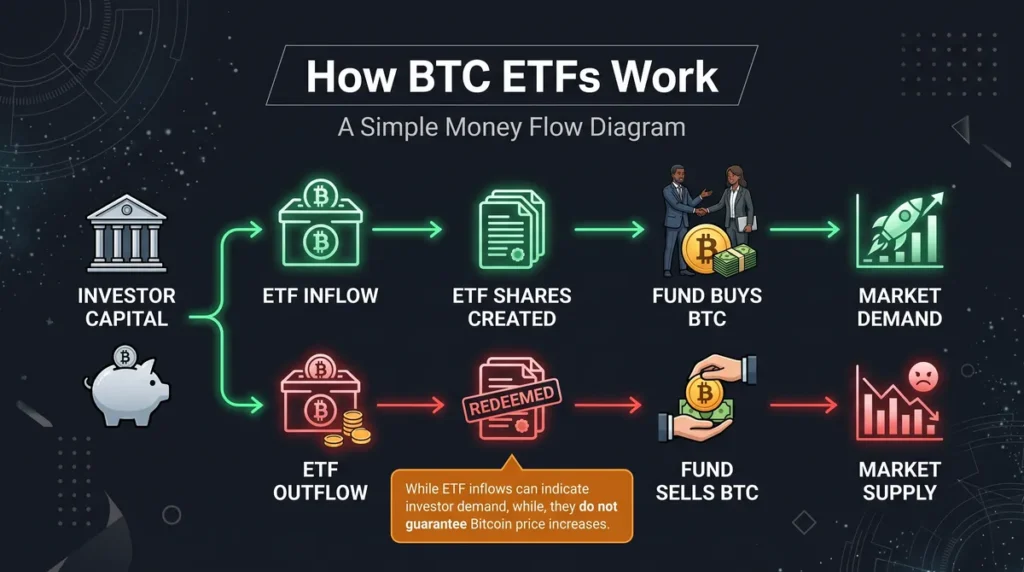
Once you understand the basic mechanics, it is fascinating to look at how these funds impact the broader financial ecosystem. In the financial world, money moving into a fund is referred to as an inflow, while money moving out is an outflow. Since their high-profile approval by regulatory bodies, BTC ETF inflows have become one of the most closely watched metrics in the entire industry.
When large institutions like pension funds or wealth managers decide to allocate a portion of their portfolios to digital assets, they rarely do so by opening a standard crypto exchange account. They use regulated ETFs. Therefore, tracking these inflows gives us a clear picture of institutional demand. In early 2024 and continuing into 2026, we saw billions of dollars flow into these products, signaling a massive shift in how traditional finance views digital currency.
Why Do BTC ETF Inflows Matter for the Market?
You might be wondering why everyday investors should care about the daily tracking of these numbers. The answer comes down to basic supply and demand dynamics.
- Supply Absorption: When a spot ETF receives new cash from investors, the fund managers must go into the open market and purchase actual Bitcoin to back those new shares. This removes available supply from the market.
- Price Support: Consistent inflows provide a strong baseline of purchasing power, which can help stabilize prices during periods of market uncertainty.
- Market Sentiment: High inflows generally indicate strong confidence from traditional financial players, which often encourages retail investors to enter the market as well.
The Pros and Cons of Investing in a Bitcoin ETF
Before making any financial decisions, it is crucial to weigh the advantages and potential drawbacks of using these funds compared to buying the asset directly.
| Pros of a Bitcoin ETF | Cons of a Bitcoin ETF |
| Simplicity: Buy and sell through your normal stockbroker. | No Direct Ownership: You cannot transfer or spend the actual asset. |
| Security: Regulated custodians handle storage and prevent hacks. | Trading Hours: You can only buy or sell during standard stock market hours. |
| Tax Efficiency: Easily fits into tax-advantaged retirement accounts. | Management Fees: Ongoing costs eat into your long-term returns. |
| Regulatory Oversight: Monitored by government financial agencies. | Counterparty Risk: You are relying on the fund manager to act responsibly. |
Finding the Right Fit: What Is the Best Bitcoin ETF?
With numerous asset managers offering similar products, deciding what is the best Bitcoin ETF for your portfolio requires careful consideration. Since most spot funds do the exact same thing (hold the asset and issue shares), your decision will mostly come down to costs and track record.
⚡️ The most critical factor is the expense ratio. This is the annual fee the fund manager charges you to cover administrative and storage costs. Over a long-term investment horizon, even a tiny difference in fees can compound into significant amounts of money. Popular options like BlackRock’s iShares Bitcoin Trust (IBIT) or the Fidelity Wise Origin Bitcoin Fund (FBTC) have attracted massive capital largely due to their highly competitive fee structures and trusted brand names. 🚀 In addition to fees, you should consider the fund’s liquidity. A highly liquid fund with billions in assets under management will generally have tighter bid-ask spreads, making it cheaper and easier for you to buy and sell shares whenever you want. Always review the prospectus of any fund you are considering to ensure their custodial security practices meet your personal standards.
With those factors in mind—low fees, high liquidity, and trusted custody—here are five of the most competitive spot Bitcoin ETFs currently on the market:
1. iShares Bitcoin Trust (IBIT)
-
Issuer: BlackRock
-
Expense Ratio: 0.25%
-
The Breakdown: As the largest spot Bitcoin ETF by a wide margin, IBIT offers massive trading volume and holds over $86 billion in assets. This scale translates to incredibly tight bid-ask spreads, making it one of the most liquid and cost-efficient options for both retail and institutional investors.
2. Fidelity Wise Origin Bitcoin Fund (FBTC)
-
Issuer: Fidelity Investments
-
Expense Ratio: 0.25%
-
The Breakdown: FBTC is unique because Fidelity manages both the ETF and its own proprietary digital asset custody platform. While most other issuers rely on third parties like Coinbase, Fidelity offers an all-in-one institutional structure that provides peace of mind for security-conscious investors.
3. Grayscale Bitcoin Mini Trust (BTC)
-
Issuer: Grayscale
-
Expense Ratio: 0.15%
-
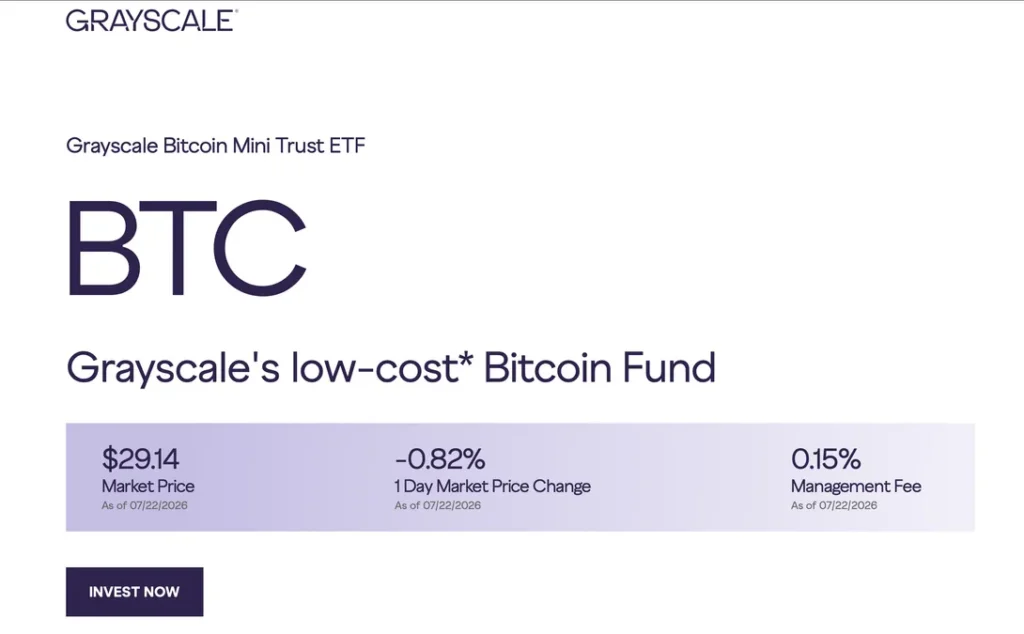
The Breakdown: While Grayscale’s original GBTC fund carries a high 1.5% fee, this “Mini Trust” was launched specifically to compete on cost. It currently boasts one of the absolute lowest expense ratios available for straightforward Bitcoin exposure.
4. Bitwise Bitcoin ETF Trust (BITB)
-
Issuer: Bitwise
-
Expense Ratio: 0.20%
-
The Breakdown: Backed by a crypto-native asset manager, Bitwise places a heavy emphasis on market research and transparency. It is a highly cost-efficient option that gained early popularity for making its digital asset holdings easily verifiable on the blockchain.
5. ARK 21Shares Bitcoin ETF (ARKB)
-
Issuer: ARK Invest & 21Shares
-
Expense Ratio: 0.21%
-
The Breakdown: This fund combines Cathie Wood’s disruptive technology focus with 21Shares’ specialized crypto expertise. It maintains a very competitive fee structure and strong liquidity, making it a reliable vehicle for long-term holds.
Frequently Asked Questions (FAQs)
If the asset management company managing the fund goes out of business, your investment is generally safe. The fund would likely be liquidated, and the value of the underlying assets would be returned to the shareholders.
No, they do not. Because Bitcoin itself does not generate revenue, pay interest, or issue dividends, a spot ETF that strictly holds the asset will not provide any passive income distributions.
Unlike the cryptocurrency market, which operates 24 hours a day and 7 days a week, ETFs can only be traded when the stock market is open.
For retail investors, the answer is no. The creation and redemption process involving actual cryptocurrency is restricted to “Authorized Participants,” which are massive financial institutions.
Expense ratios are calculated as a percentage of your total investment and are deducted automatically. During a bear market when the price of the asset is falling, the fund manager still collects their management fee.

