

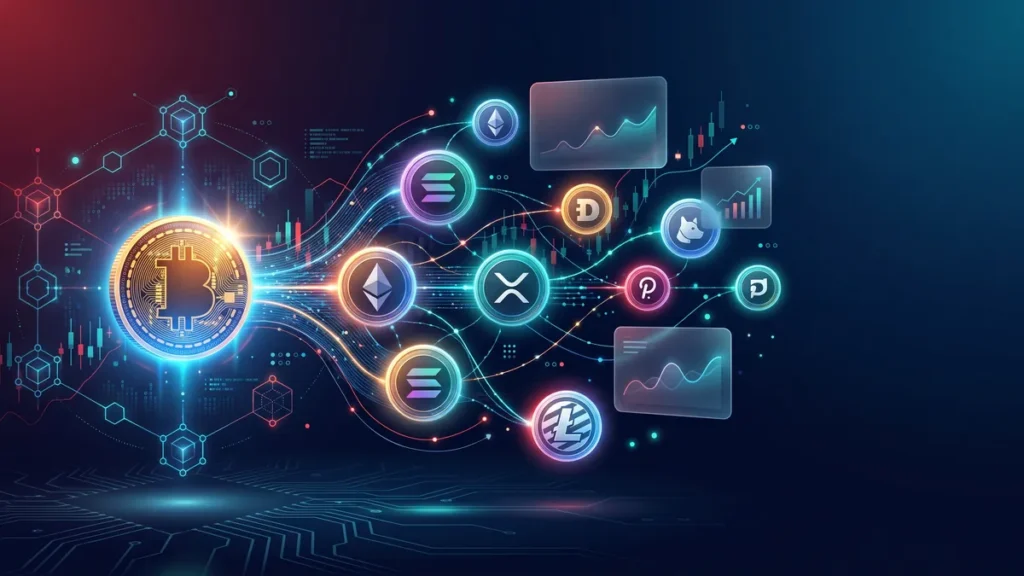
When new investors enter the cryptocurrency space, they usually buy Bitcoin first. Bitcoin is the king of the industry. However, you will quickly notice thousands of other digital currencies trading on various exchanges. These alternative cryptocurrencies are called altcoins.
If you are wondering what altcoins are, the answer is quite simple. The term combines “alternative” and “coin.” Therefore, an altcoin is any cryptocurrency that is not Bitcoin. This guide will explore everything from the technology behind these digital assets to the best altcoins available today.
What Are Altcoins in Crypto?
Before buying any digital asset, you need to understand the underlying mechanics. Bitcoin was created to function as a decentralized peer-to-peer payment system. Its primary goal is to store value and facilitate transactions without a central bank.
Altcoins in crypto take that foundational blockchain technology and apply it to entirely different use cases. While Bitcoin focuses on being digital gold, altcoins attempt to solve other problems. Some developers create altcoins to process transactions faster. Other creators build altcoins to host complex decentralized applications. Some even create altcoins simply as internet jokes.
Because of this diversity, the altcoin market is incredibly broad. You will find stablecoins pegged to fiat currencies, utility tokens used within specific software ecosystems, and governance tokens that give holders voting rights. Rather than viewing altcoins as mere Bitcoin competitors, you should see them as different tools built for specific digital ecosystems.
What Makes Altcoins Different from Bitcoin?
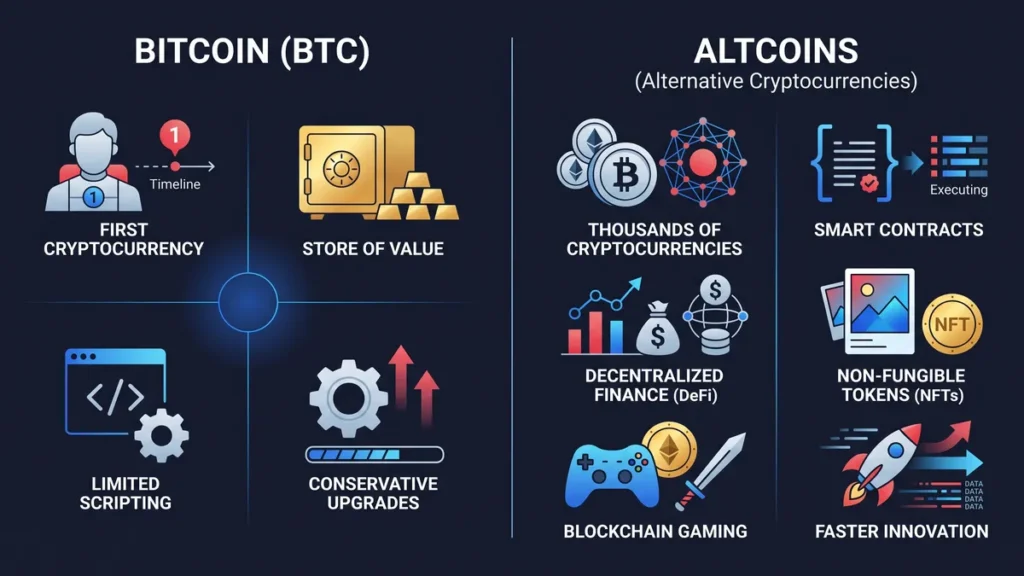
While Bitcoin prioritizes security, decentralization, and long-term stability. Many altcoins prioritize innovation, scalability, or additional functionality.
Some common uses include:
- Running decentralized applications (dApps)
- Powering blockchain games
- Supporting decentralized finance (DeFi)
- Providing governance rights within blockchain projects
- Facilitating cross-border payments
- Issuing digital assets and NFTs
Each blockchain ecosystem introduces different innovations. As a result, no single altcoin solves every problem.
For example:
Cryptocurrency
Primary Purpose
Ethereum
Smart contracts and decentralized applications
Solana
High-speed blockchain for DeFi and NFTs
Chainlink
Connects blockchain with real-world data
Dogecoin
Community-driven digital currency
Avalanche
Scalable blockchain infrastructure
How Many Altcoins Are There?
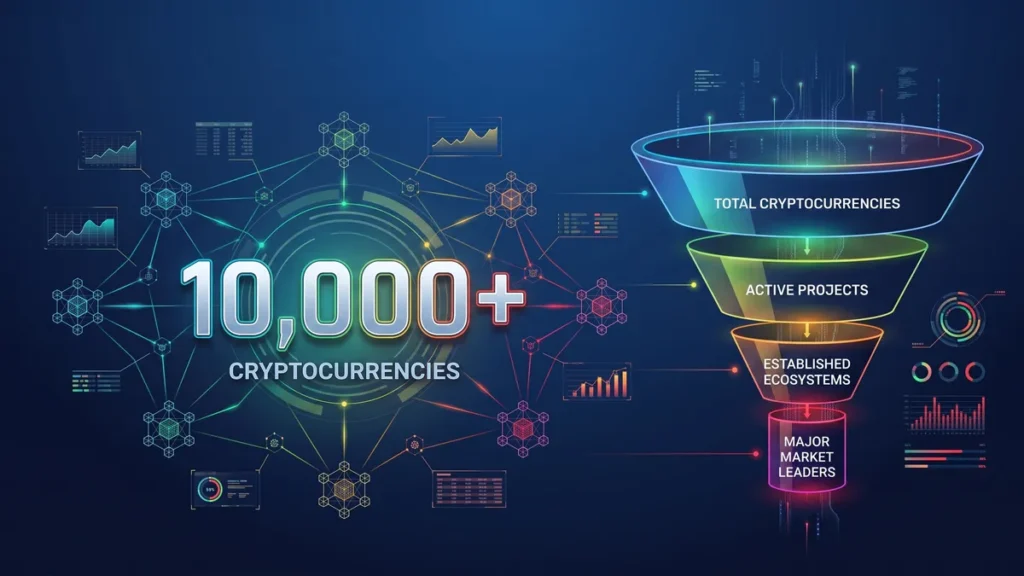
As you dive deeper into the crypto ecosystem, you might ask how many altcoins are there currently. The exact number changes every single day. As of late 2026, data platforms such as CoinMarketCap track tens of thousands of different altcoins.
Creating a new token is relatively easy. Anyone with basic coding knowledge can launch an altcoin on networks like Ethereum or Solana in just a few minutes. Consequently, thousands of new projects appear monthly. However, most of these projects lack real-world utility. Many are abandoned by their developers shortly after launch.
Out of the massive total, only a few hundred altcoins possess significant trading volume, active development teams, and dedicated communities. When searching for the best altcoins, investors generally look at the top 100 projects by market capitalization. These higher-ranking projects usually have audited code and transparent business models.
To evaluate an altcoin, you must look at its market capitalization instead of its individual token price. Market capitalization is calculated by multiplying the current price of one coin by the total number of coins in circulation. A token priced at $1 is not necessarily “cheaper” or a better deal than a token priced at $100. If the $1 token has a circulating supply of ten billion, its market cap is $10 billion. If the $100 token has a circulating supply of one million, its market cap is only $100 million. Understanding this mathematical concept is crucial for managing your expectations and avoiding common investment traps.🚀 Understanding Market Capitalization
Exploring the Best Altcoins by Category
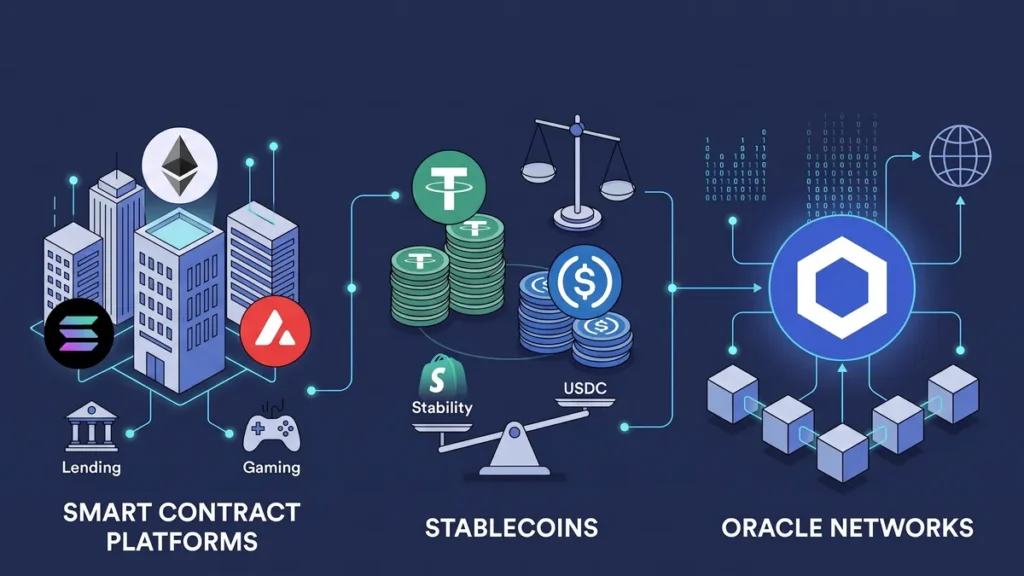
Grouping the best altcoins by their underlying technology helps you understand their potential value. The crypto industry contains several distinct sectors.
Smart Contract Platforms
Smart contract platforms act as the foundational infrastructure for Web3 and decentralized applications. By utilizing self-executing computer programs, these networks enable automated, transparent, and tamper-proof agreements that eliminate the need for traditional intermediaries. This foundational technology allows developers to build complex ecosystems ranging from decentralized finance (DeFi) tools to non-fungible tokens (NFTs) and gaming.
Leading examples:
-
Ethereum (ETH)
-
Solana (SOL)
-
Avalanche (AVAX)
Stablecoins
Cryptocurrencies are notoriously volatile, making them difficult to use for everyday payments, trading liquidity, or predictable accounting. Stablecoins solve this barrier to adoption by pegging their value to stable, real-world assets, most commonly the US Dollar. They provide the price stability of traditional fiat money while retaining the speed, transparency, and borderless nature of blockchain technology.
Leading examples:
-
DAI / USDS
Oracle Networks
Blockchains are closed systems; they cannot natively request or verify external, off-chain data (a limitation known in the industry as the “oracle problem”). Decentralized oracle networks solve this by acting as a secure bridge between blockchains and the outside world. They pull data from external APIs, verify its accuracy through decentralized nodes, and feed it into smart contracts.
Leading examples:
-
Chainlink (LINK)
-
Pyth Network (PYTH)
-
API3
What Are the Top 10 Altcoins?

Investors frequently want to know what are the top 10 altcoins to add to their portfolios. The crypto market moves incredibly fast, and rankings fluctuate based on market cycles. However, several foundational projects consistently dominate the top spots based on market capitalization.
- Ethereum (ETH): Ethereum is the largest altcoin in existence. It introduced smart contracts to the world. These programmable contracts execute automatically when specific conditions are met. Ethereum serves as the primary foundation for decentralized finance and digital collectibles.
- Tether (USDT): Tether is a stablecoin. Its value is pegged to the US Dollar. Traders use USDT to hold their profits during volatile market swings without cashing out to a traditional bank account.
- BNB (BNB): Originally launched as a utility token for the Binance exchange, BNB now powers its own massive blockchain ecosystem. Users hold BNB to pay for discounted trading fees and interact with decentralized applications.
- USD Coin (USDC): Similar to Tether, USDC is a prominent stablecoin. It is known for strict regulatory compliance and transparent reserve audits.
- XRP (XRP): Designed for enterprise use, XRP focuses on making cross-border payments instant and incredibly cheap. It partners with traditional financial institutions to improve global money transfers.
- Solana (SOL): Solana is a high-performance blockchain known for extreme speed and very low transaction fees. It is a major hub for decentralized finance and digital art trading.
- TRON (TRX): TRON aims to decentralize the internet and digital entertainment. It is widely used for sending stablecoins globally due to its low network fees.
- Dogecoin (DOGE): What started as a meme in 2013 became a multi-billion dollar asset. Dogecoin has a massive community and is occasionally used for online tipping and retail payments.
- Hyperliquid (HYPE): As decentralized trading platforms grow, tokens powering these high-speed exchanges have climbed the ranks, offering users deep liquidity and governance rights.
- Zcash (ZEC): Privacy remains a core demand in the crypto space. Zcash allows users to shield their transaction data, keeping financial histories completely private.
The Risks and Rewards of Investing
Adding altcoins to your portfolio offers massive upside potential. Because their market caps are smaller than Bitcoin, successful altcoins can multiply in value much faster during a bull market.
However, the risks are equally high. The altcoin market is highly speculative. Regulatory crackdowns, software bugs, and shifts in market sentiment can cause sudden price crashes. Diversification is your best defense. Never invest money you cannot afford to lose, and always research the development team behind a token before buying it.
Secure Storage and Crypto Wallets
Once you decide which altcoins to purchase, you need a secure place to store them. Leaving your assets on a centralized exchange can be risky if the platform experiences a security breach.
A great alternative is IZAKA-YA, which lets you securely store your cryptocurrencies while earning passive yield on eligible assets. It’s a practical option for long-term holders who want their crypto to work for them instead of sitting idle.
In the next section, you’ll learn how to buy altcoins on the IZAKA-YA platform, from funding your account to making your first purchase.
Step 1: Create Your IZAKA-YA Account
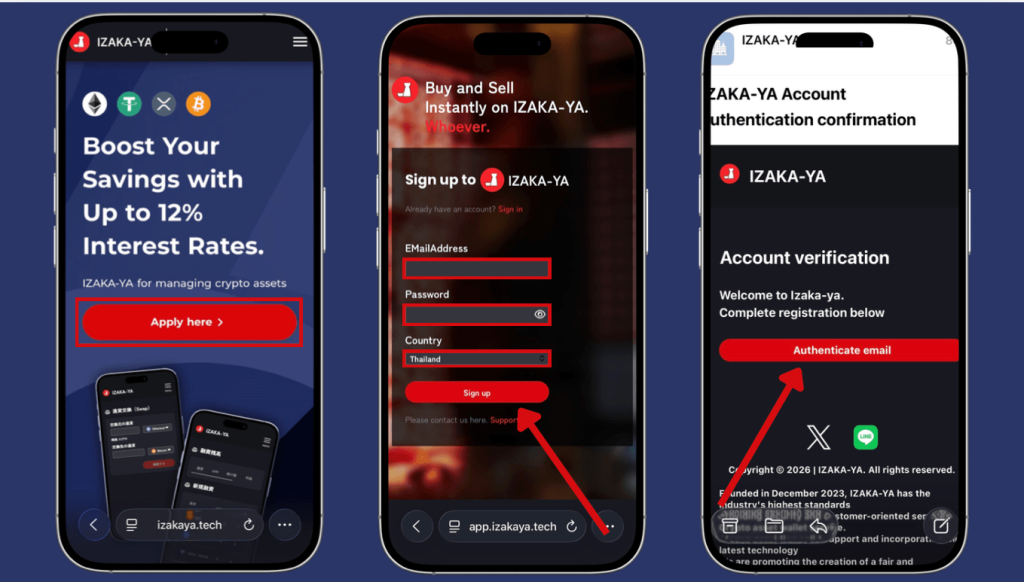
- Visit the IZAKA-YA registration page.
- Enter your email address, create a strong password for your account.
- Review your information, then click the red “Sign Up” button to create your account.
After signing up, you’ll be taken to the account verification page.
- Click the red “Authenticate Email” button.
- Check your inbox for the verification email from IZAKA-YA.
- Open the email and follow the verification instructions to activate your account.
Once your email has been verified, you’re ready to log in and access the platform.
Step 2: Open the Earn Dashboard
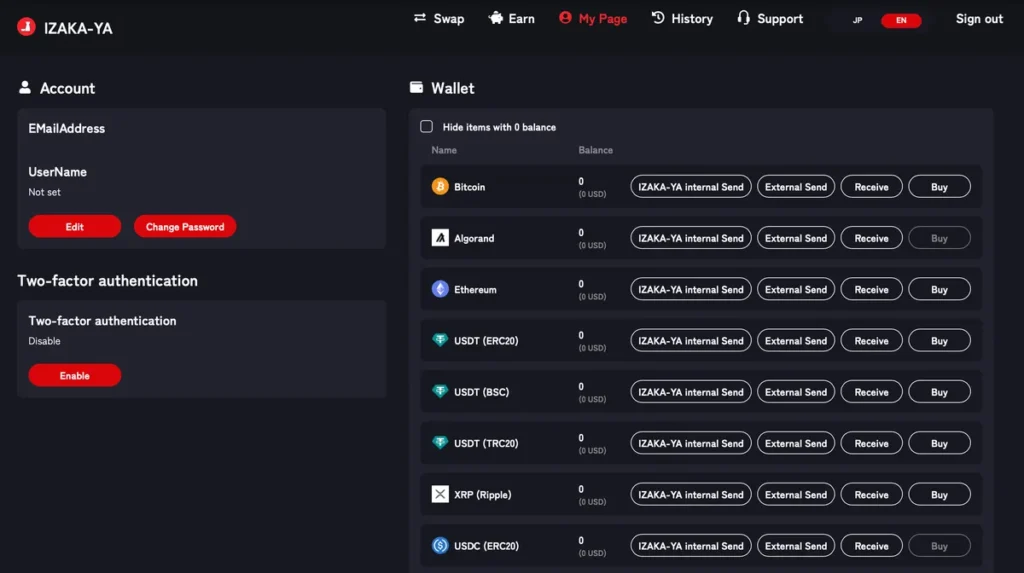
- Log in to your IZAKA-YA account.
- From the top navigation bar, click My Page.
- Browse the list of supported cryptocurrencies available for buying.
- Find the cryptocurrency you want to purchase.
- Click the red “Buy” button on the right of that asset to continue.
Step 3: Setting Up Your Transaction
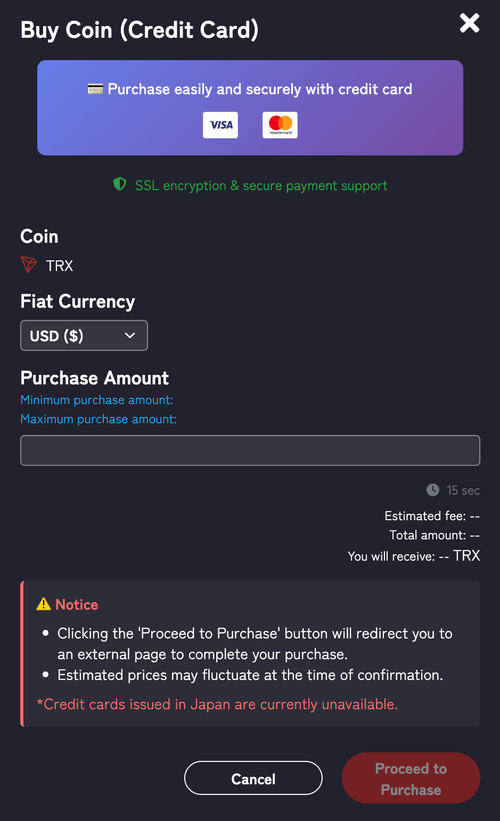
Clicking the “Buy” option will open the Buy Coin (Credit Card) window.
- Under Fiat Currency, select the currency you want to pay with, such as USD, from the drop-down menu.
- Enter the amount of fiat currency you wish to spend in the Purchase Amount field.
- The platform will automatically calculate and display the estimated transaction fee, the total amount you’ll pay, and the approximate amount of cryptocurrency you’ll receive.
Carefully review all the details before continuing. Once you’re satisfied with the information, click “Proceed to Purchase” at the bottom of the window to move on to the payment process.
Register IZAKA-YAkeyboard_arrow_right
Frequently Asked Questions
Bitcoin controls the majority of the market share and sets the overall sentiment for the industry. When Bitcoin rises, investors feel confident and move profits into smaller altcoins. When Bitcoin drops, fear takes over, and investors sell their altcoins to reduce risk.
While technologically possible, it is highly unlikely. Bitcoin has secured its position as a decentralized store of value with massive institutional backing. Most top altcoins now aim to complement Bitcoin rather than replace it.
If a development team abandons a project, the token will likely lose its value as updates stop and community interest fades. The token may still exist on the blockchain forever, but finding a buyer on an exchange will become nearly impossible.
No. Just like Bitcoin, almost all altcoins are highly divisible. You can purchase a small fraction of a token depending on how much money you want to invest.
Most reputable stablecoins keep traditional fiat currency or equivalent safe assets in a real-world bank account. For every digital token issued on the blockchain, there is a physical dollar sitting in reserve to back it up.