



Who is Satoshi Nakamoto? Satoshi Nakamoto is the pseudonym used by the creator of Bitcoin, the first major decentralized cryptocurrency. In 2008, Satoshi published the Bitcoin white paper and launched the network in 2009 before gradually stepping away.
Nearly two decades later, Satoshi’s real identity remains unknown. Several candidates have been proposed over the years, and new reporting in 2026 has once again brought the mystery into the spotlight.
Who Created Bitcoin? Who Is Satoshi Nakamoto?
The accepted answer is Satoshi Nakamoto, although the real person or people behind the name have never been conclusively identified. If you’re wondering ‘who is Satoshi Nakamoto’, the answer is more complicated than simply naming Bitcoin’s creator, as Satoshi’s true identity has never been confirmed.
Bitcoin first appeared publicly in October 2008, when Satoshi published Bitcoin: A Peer-to-Peer Electronic Cash System. The paper outlined a way to make digital payments directly between users without relying on a bank or other central intermediary.
Satoshi then released the first Bitcoin software and helped the network get off the ground. This involved much more than writing the original white paper.
What Did Satoshi Do?
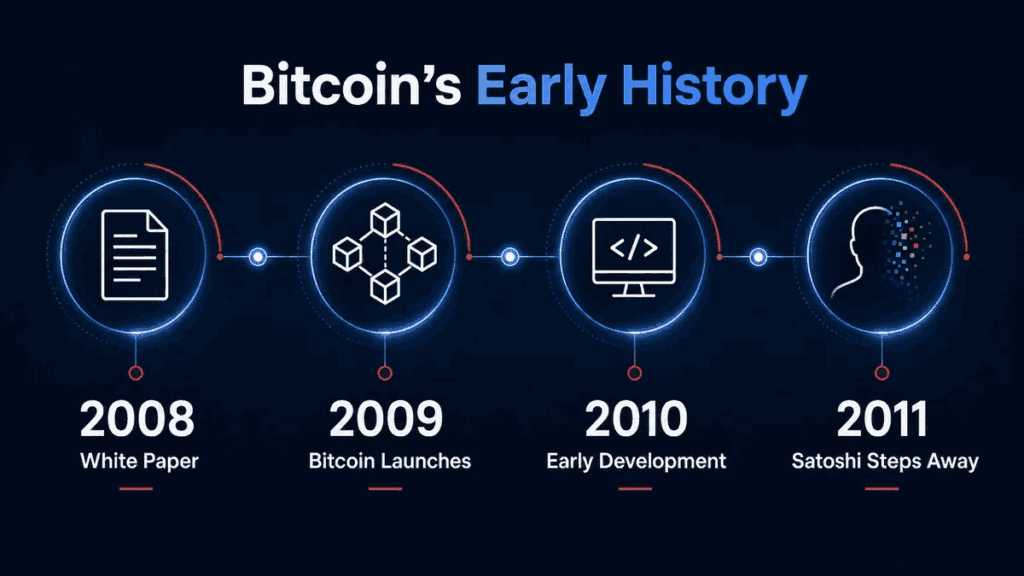
Satoshi was involved in several important parts of Bitcoin’s early development:
- Published the Bitcoin white paper: Introduced the technical design behind Bitcoin.
- Released the original software: Turned the concept into a functioning network.
- Helped launch Bitcoin: The first block, known as the genesis block, was created in January 2009.
- Worked with early contributors: Satoshi communicated with developers and users as the project developed.
- Stepped away from the project: Bitcoin eventually continued without its original creator directing development.
It is also worth remembering that Bitcoin did not emerge from a vacuum. Earlier work on cryptography, digital cash, peer-to-peer networks, and proof-of-work helped create the foundation on which Bitcoin was built.
Satoshi’s major contribution was bringing many of those ideas together into a practical system for digital money.
What Made Bitcoin Different?
The idea behind Bitcoin was not simply to create another form of online payment. The bigger challenge was figuring out how people could transfer digital money without having to trust a bank or another central authority.
With traditional electronic payments, a financial institution usually keeps the official record of who owns what. Bitcoin took a different approach.
Its blockchain provides a public record of transactions, while the network uses cryptography and a consensus mechanism to agree on which transactions are valid. This innovative approach is also part of what makes the question who is Satoshi Nakamoto so fascinating, as the creator introduced a system that could operate without a central authority.
The result was a payment system designed to operate without a central institution controlling the ledger.
That idea was at the heart of Satoshi’s original proposal and remains one of Bitcoin’s defining characteristics.
Who Is Satoshi Nakamoto? Why Did He Stay Anonymous?
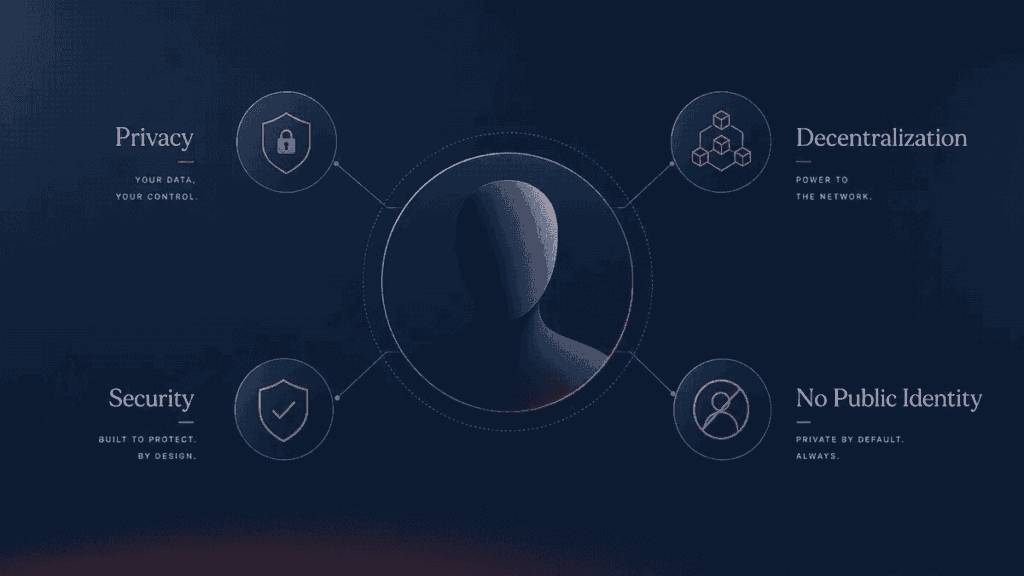
Satoshi never gave a confirmed explanation for remaining anonymous, so the reasons are impossible to know for certain.
A few possibilities make sense:
- Privacy: Creating a new monetary system could attract significant attention.
- Personal safety: Remaining anonymous reduced the risks of becoming the public face of a controversial financial technology.
- Decentralization: Bitcoin was designed without a central authority, so a permanent founder could have conflicted with that philosophy.
- Project independence: Leaving the project allowed Bitcoin to develop without relying on one recognizable leader.
Whatever the reason, Satoshi’s anonymity became a defining part of Bitcoin’s history.
Latest Updates on Satoshi Nakamoto in 2026
The Satoshi mystery has been around for years, but 2026 has produced some genuinely interesting developments.
New Investigation Puts Adam Back in the Spotlight
In April 2026, a New York Times investigation reignited speculation that British cryptographer Adam Back could be Satoshi Nakamoto.
The investigation examined archived material, writing patterns, timelines, and Back’s connections to the early cryptography community. Back is a particularly notable candidate because he created Hashcash, a proof-of-work system that Satoshi referenced in the Bitcoin white paper.
Back has denied being Satoshi.
The evidence presented in the investigation is circumstantial rather than conclusive, so it would be premature to describe Back as Bitcoin’s confirmed creator. The renewed attention simply makes him one of the most closely examined Satoshi candidates in 2026.
Dormant Satoshi-Era Bitcoin Moved
Another notable development came in June 2026, when a Bitcoin address holding 35.55 BTC since March 2011 moved its coins after more than 14 years of inactivity. The address was connected to a broader New York legal dispute involving thousands of dormant Bitcoin wallets.
However, there is an important distinction.
The wallet was described as containing “Satoshi-era” Bitcoin because of its age. That does not mean the coins belonged to Satoshi.
Many people were mining and using Bitcoin during the network’s early years. Unless an address can be reliably linked to Satoshi, moving old BTC is not evidence that Satoshi has returned.
Satoshi’s Estimated Bitcoin Holdings Remain a Major Topic
Researchers have long tried to estimate how much Bitcoin Satoshi may have mined during the network’s earliest days.
One widely cited estimate puts the figure at roughly 1 million BTC, while some more recent estimates place it closer to 1.1 million BTC. These figures are based on blockchain analysis rather than an official record identifying Satoshi’s wallets.
That distinction matters. Questions about who is Satoshi Nakamoto also extend to which early Bitcoin addresses can actually be attributed to the creator.
There is no crypto wallet labeled “Satoshi Nakamoto” on the Bitcoin blockchain, and the exact amount of BTC controlled by the creator has never been officially confirmed.
Who Could Be Satoshi Nakamoto?
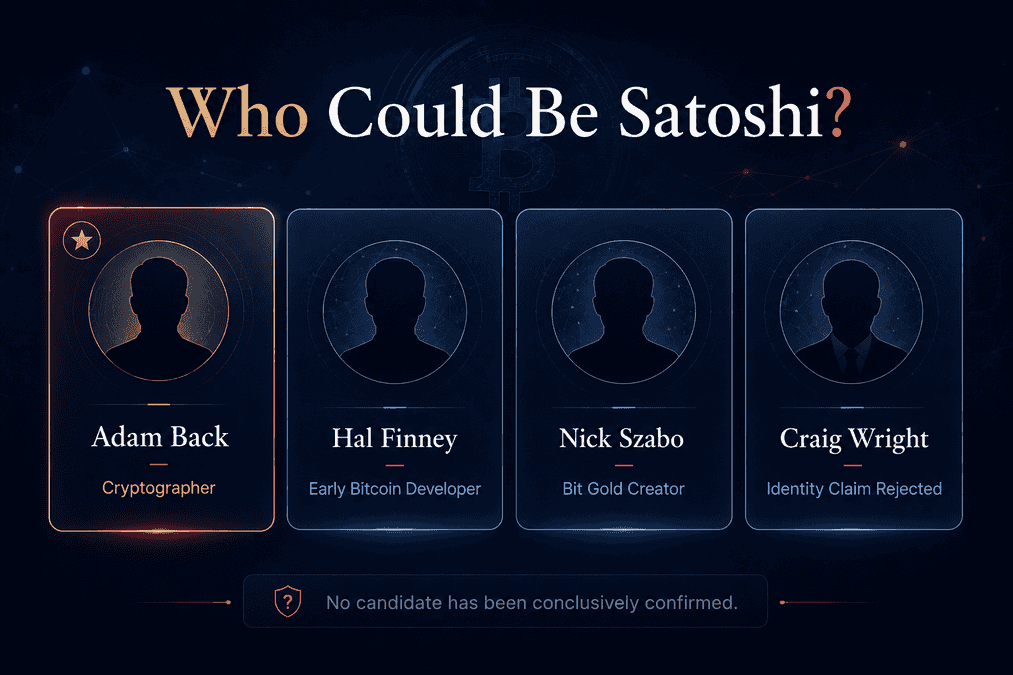
Over the years, several people have been suggested as the person behind the pseudonym. Some were early Bitcoin contributors, while others became candidates because of their work in cryptography or digital money.
None has been conclusively proven to be Satoshi.
Adam Back
Adam Back is arguably the most prominent Satoshi candidate in the 2026 discussion.
His background fits several pieces of the Satoshi puzzle. He is a cryptographer, was active in the cypherpunk community, and created Hashcash, which is referenced in Bitcoin’s original white paper.
The 2026 investigation added further arguments based on writing and historical connections.
Still, Back denies being Satoshi, and the available evidence has not provided definitive proof.
For now, Adam Back should be described as a candidate, not as the confirmed creator of Bitcoin.
Hal Finney
Hal Finney was one of Bitcoin’s earliest developers and users.
He received the first Bitcoin transaction from Satoshi and was deeply involved in the project’s early development. His technical background and close connection to Bitcoin’s launch have made him a long-standing candidate.
However, there is no conclusive evidence that Finney was Satoshi.
Nick Szabo
Nick Szabo is another frequently discussed candidate.
Before Bitcoin existed, Szabo proposed Bit Gold, a concept for decentralized digital money that shared some similarities with Bitcoin.
Researchers have also compared Szabo’s writing with Satoshi’s, but those comparisons have never established that he was behind the pseudonym.
Szabo has denied being Satoshi.
Craig Wright
Craig Wright spent years claiming to be Satoshi Nakamoto.
That claim was tested in the UK High Court. In 2024, Justice James Mellor ruled that Wright was not the person behind the Satoshi Nakamoto pseudonym and was not the creator of Bitcoin. The court also found that he was not the author of the Bitcoin white paper or the initial Bitcoin software.
Wright therefore should not be presented as a confirmed Satoshi candidate.
Is Satoshi Nakamoto One Person or a Group?
We still do not know.
The name Satoshi Nakamoto could refer to one individual, but some researchers have suggested that several people may have worked together under the same pseudonym.
There is no conclusive evidence for either explanation.
What we do know is that the person or group behind Satoshi Nakamoto had the technical knowledge to design Bitcoin, write its initial software, and communicate with early members of the project.
Who Owns Bitcoin?
A common question is who owns Bitcoin. The answer depends on what exactly we mean by “own.”
No single person or company owns the Bitcoin network. Bitcoin is open-source and operates through a decentralized network rather than a central organization.
Individual entities, however, can own BTC.
Who Can Own BTC?
- Individuals can buy and hold Bitcoin.
- Companies can keep BTC as part of their treasury.
- Investment funds can gain exposure to Bitcoin on behalf of investors.
- Governments can hold Bitcoin that they acquire or seize.
- Satoshi Nakamoto may control a large amount of early-mined BTC, although this has never been definitively established.
So, creating Bitcoin does not mean owning or controlling the Bitcoin network.
Satoshi may have significant Bitcoin holdings, but the creator does not have special authority over the protocol today.
How Rich Is Satoshi Nakamoto?

How rich is Satoshi Nakamoto? There is no exact answer.
The main reason is simple: nobody has conclusively identified all of Satoshi’s Bitcoin addresses.
Blockchain researchers have studied early mining patterns and identified a large collection of coins that may have been mined by the same early participant, often associated with the “Patoshi” miner. Some estimates put the amount linked to this activity at around 1.1 million BTC.
If those coins really belong to Satoshi and remain accessible, the creator of Bitcoin would rank among the world’s wealthiest individuals.
But there are several uncertainties:
- The addresses cannot all be proven to belong to Satoshi.
- The estimated holdings are not an official figure.
- Some early coins may have belonged to other miners.
- It is unknown whether Satoshi still controls the relevant private keys.
- The value of any BTC holdings changes with Bitcoin’s market price.
For that reason, it is more accurate to discuss Satoshi’s estimated Bitcoin holdings than to give a precise net worth.
Why Has Satoshi’s Bitcoin Never Been Spent?
This is one of the most interesting parts of the story.
Many of the coins believed to be associated with Satoshi’s early mining activity have remained untouched for years. That has naturally led to speculation about what happened to the private keys and who is Satoshi Nakamoto.
Possible explanations include:
- Satoshi deliberately chose not to spend the coins.
- The private keys were lost.
- Satoshi died or became permanently unable to access the funds.
- Some of the addresses were incorrectly attributed to Satoshi in the first place.
There is no evidence that allows us to confidently choose one explanation.
This is also why an actual transaction from a reliably Satoshi-linked address would be such a major event. It would demonstrate control of the corresponding private keys, although it would not automatically reveal the person’s real-world identity.
What Happened to Satoshi Nakamoto?
Satoshi gradually withdrew from Bitcoin’s development around 2010 and early 2011.
Instead of remaining the project’s public leader, Satoshi handed more responsibility to other developers and contributors.
Then the communications stopped.
There was no dramatic public announcement explaining where Satoshi went. The project simply continued without its creator.
That turned out to be important for Bitcoin’s development. Unlike many technology projects that remain closely tied to a founder, Bitcoin eventually became much more independent from Satoshi.
What Would Happen If Satoshi Revealed Their Identity?
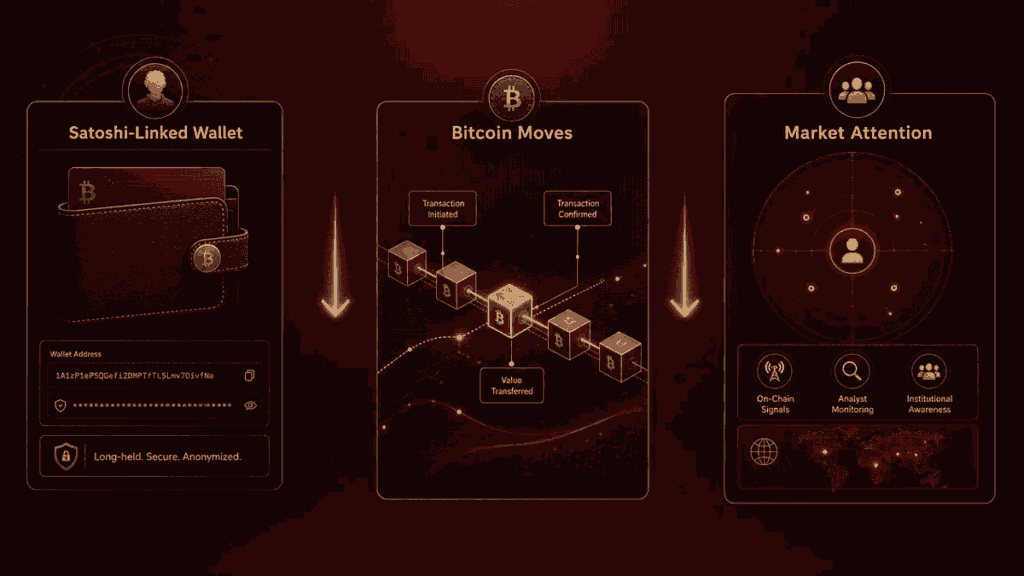
A confirmed Satoshi appearance would almost certainly become one of the biggest events in cryptocurrency history.
But simply claiming to be Satoshi would not be enough.
The strongest evidence would probably be cryptographic proof, such as signing a message with a private key connected to Bitcoin addresses that can convincingly be attributed to Satoshi.
If Satoshi were proven to control a large amount of dormant Bitcoin, the market would also pay close attention to those coins.
A movement of a large Satoshi-linked balance could have a significant psychological effect on investors, particularly because those coins have been dormant for so long.
Why Does Satoshi Nakamoto Still Matter?
Bitcoin has become much larger than the person who created it, but Satoshi’s identity still matters for a few reasons.
- Bitcoin’s origins: Identifying Satoshi could provide more insight into why certain design decisions were made.
- Early Bitcoin holdings: Satoshi is widely believed to have mined a substantial amount of BTC.
- Decentralization: Satoshi’s disappearance is part of the story of how Bitcoin developed without a permanent central leader.
- Market impact: If Satoshi-linked coins ever moved, the event would likely attract enormous attention.
- Historical significance: Bitcoin’s creation was a major development in the history of digital money.
In other words, the identity is interesting not simply because it is a mystery, but because it is connected to Bitcoin’s technology, history, and potentially significant holdings.
Final Thoughts: Who Is Satoshi Nakamoto?
The honest answer is that we still do not know.
Satoshi created Bitcoin, published its white paper in 2008, helped launch the network in 2009, and eventually disappeared from the project. Several candidates have been investigated, with Adam Back receiving renewed attention in 2026, but no one has conclusively proven their identity.
For now, the mystery remains unsolved. What is certain is that Bitcoin continued to grow long after its anonymous creator stepped away.
Frequently Asked Questions: Who Is Satoshi Nakamoto?
The name became publicly associated with Bitcoin in 2008, when the original Bitcoin white paper was published. The Bitcoin network launched the following year.
Yes, in principle. Anyone wondering who is Satoshi Nakamoto would need more than a personal claim; the strongest evidence would be cryptographic proof using private keys associated with Bitcoin addresses reliably linked to Satoshi’s early activity.
A 2026 investigation highlighted similarities involving Back’s technical background, writing, and connections to the early cryptography community. Back has denied being Satoshi, and the evidence remains inconclusive.
It is possible, although there is no conclusive evidence showing that multiple people used the Satoshi Nakamoto name. The available historical record does not settle the question.
The BTC would remain recorded on the blockchain, but it could not be spent without the corresponding private keys. Bitcoin has no central authority that can reset access to those funds.
If privacy matters, IZAKA-YA offers a non-custodial wallet with no KYC, giving users more control over their wallet and personal information. However, Bitcoin transactions remain publicly visible on the blockchain. Read our How to Buy Bitcoin Anonymously Guide here.
If you’re wondering, “Is Bitcoin dead?”, the answer is no. Bitcoin remains active and widely used, with its decentralized network continuing to operate worldwide.