

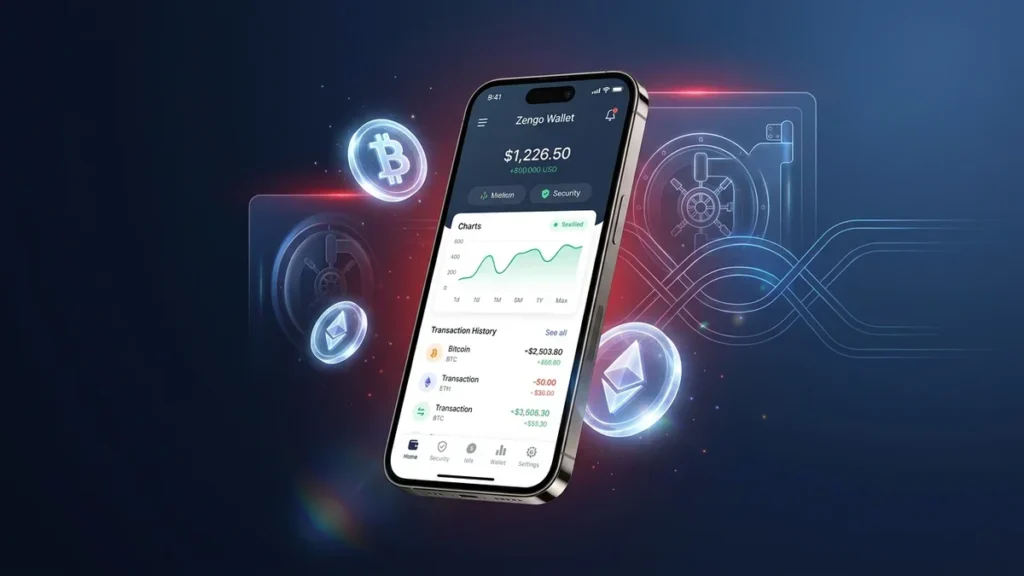
Crypto wallets have become much easier to use over the last few years, but security is still one of the biggest hurdles for anyone holding digital assets. Managing a 12- or 24-word seed phrase is stressful, and losing it means losing your funds forever.
This is where the Zengo wallet stands out. Instead of relying on traditional seed phrases, Zengo uses an enterprise-grade security model, Multi-Party Computation (MPC), designed to make crypto storage virtually unhackable while remaining remarkably simple for everyday users.
Whether you are a long-term Bitcoin holder, an active altcoin investor, or someone looking for a safer self-custody option that won’t require a metal plate to store your passwords, this guide covers everything you need to know about Zengo in 2026.
What Is a Zengo Wallet?

Launched in 2018, Zengo is a non-custodial, mobile-first crypto wallet. “Non-custodial” means you own your assets, not a centralized exchange. However, unlike traditional non-custodial wallets (like MetaMask or Trust Wallet) that rely on a single private key, Zengo splits the responsibility.
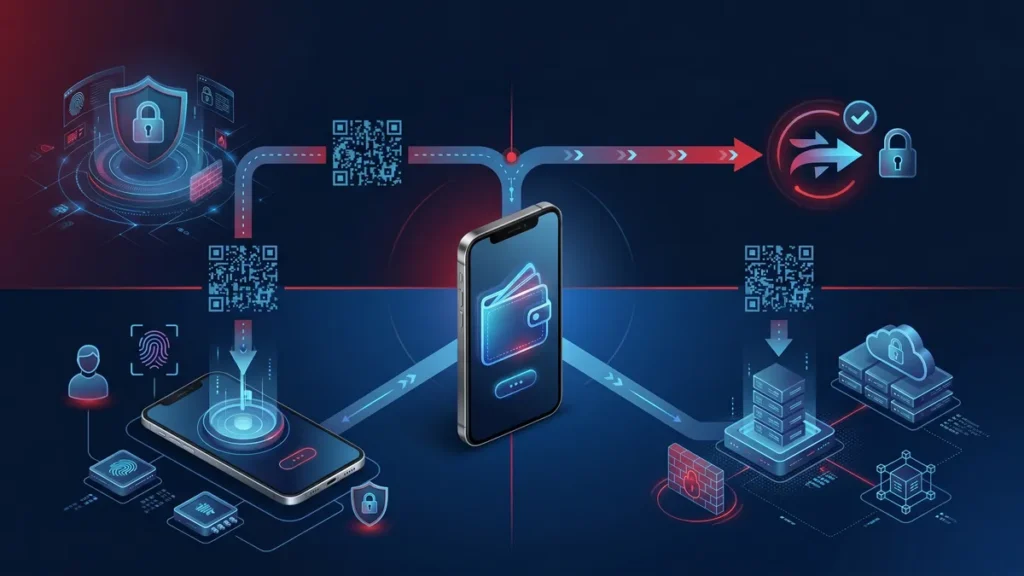
It uses MPC technology to generate mathematical “secret shares” instead of a single private key. One share lives securely on your mobile device (protected by your phone’s secure enclave), and the other lives on Zengo’s servers. A transaction can only occur when both shares interact, but the shares themselves never meet.
This approach completely removes the need to store or memorize a vulnerable seed phrase.
Core Features (Zengo Essentials)
The free version of Zengo covers everything most users need for daily crypto management:
- Multi-Chain Support: Manage over 100 assets across major networks including Bitcoin, Ethereum, Polygon, Solana, BNB Chain, and Avalanche.
- Built-in Swaps & Trading: Swap supported cryptocurrencies directly inside the wallet for a standard 0.5% fee via decentralized liquidity pools.
- Staking for Yield: Stake assets like Tezos (XTZ) and Ethereum (ETH) directly through the app to earn passive rewards.
- Web3 & NFT Access: Seamlessly connect to dApps like Uniswap, OpenSea, or The Sandbox using WalletConnect.
- 24/7 Live Support: Zengo features integrated in-app human support, which is incredibly rare in the self-custody space.
Is Zengo Wallet Safe?
Zengo has an exceptional security track record and it has never suffered a wallet-draining breach. The foundation of this security is its seedless architecture, but it goes much further.
If you lose your phone, you don’t lose your crypto. Zengo uses a 3-Factor Authentication (3FA) system for recovery.
- Email Verification to confirm your identity: You confirm access to the email address originally linked to your Zengo account via a magic link.
- Cloud Recovery File to fetch the encrypted backup: Zengo retrieves your encrypted recovery file, which is automatically backed up to your personal cloud (iCloud or Google Drive) during setup.
- 3D FaceLock Scan to decrypt the file: You perform a live biometric face scan. This acts as the decryption key for the recovery file, allowing your new phone to reconstruct your local MPC share.
What if Zengo goes out of business? Zengo has a mechanism called Chill Storage. Independent third-party trustees hold master recovery keys. If Zengo’s servers ever go offline permanently, these keys are released, allowing an open-source recovery app to reconstruct your private keys so you can move your funds elsewhere.
Zengo Wallet Fees Explained
The Zengo app is completely free to download and use (unless you opt into Zengo Pro). Because it is a self-custodial wallet, Zengo does not charge fees just to hold your crypto. However, you will encounter fees when moving or trading assets:
- Network (Gas) Fees: Paid directly to the blockchain miners/validators when you send crypto. Zengo does not take a cut of this.
- Swapping Crypto: Zengo charges a flat 0.5% fee to swap assets within the app.
- Buying Crypto with Fiat: Zengo uses third-party providers (like MoonPay or Banxa) to let you buy crypto with a credit card, Apple Pay, or bank transfer. These providers charge processing fees (often between 1.5% and 4%) and typically require a minimum purchase of around $80.
Zengo vs. The Alternatives
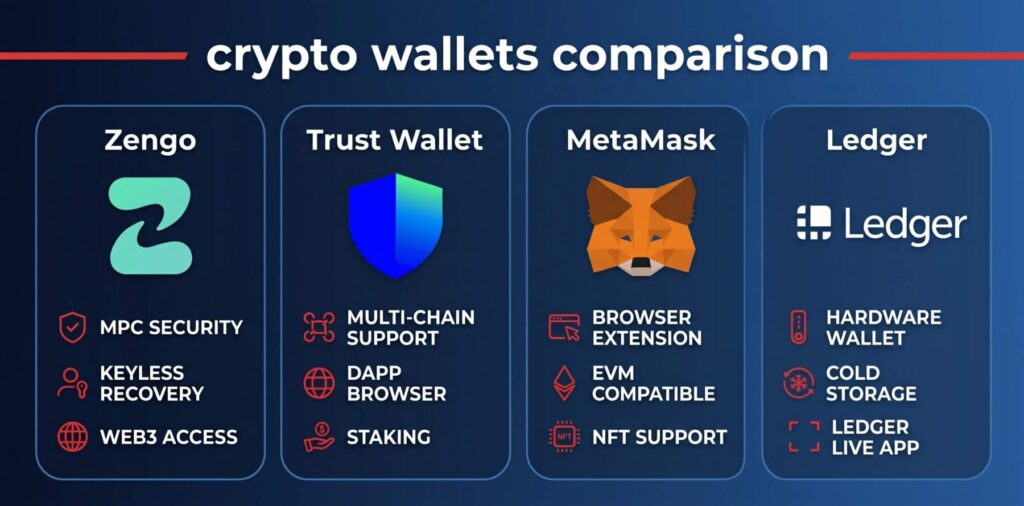
How does Zengo stack up against the heavyweights in the wallet space?
| Feature | Zengo | Trust Wallet | Ledger (Hardware) |
| Security Model | MPC (Seedless) | Single Private Key (Seed Phrase) | Offline Secure Element |
| Best For | Beginners & security-conscious | DeFi users wanting broad token access | Long-term “cold” storage |
| Recovery | Email + Cloud + Biometrics | 12-word seed phrase | 24-word seed phrase |
| Customer Support | 24/7 In-App Live Chat | Ticket-based / Forums | Ticket-based |
| Cost | Free (Pro available at $20/mo) | Free | $79 – $279 upfront |
- Zengo vs. Trust Wallet / MetaMask: Trust Wallet and MetaMask offer wider support for obscure micro-cap tokens, but you are entirely responsible for your seed phrase. If you are terrified of losing your seed phrase, Zengo is the clear winner.
- Zengo vs. Ledger: Hardware wallets like Ledger provide the ultimate offline security, but they cost money upfront and are clunky for daily trading or dApp interaction. Zengo bridges the gap, offering near-hardware-level security natively on your phone.
While traditional alternatives like Trust Wallet and Ledger focus purely on standard storage and basic proof-of-stake (PoS) staking, users looking specifically to maximize their idle assets are shifting toward specialized yield platforms.
For instance, the IZAKA-YA Crypto Lending Wallet is gaining significant traction among investors who want to unlock passive income opportunities through structured lending pools while still maintaining flexible access to their digital assets—bridging the gap between strict cold storage and active capital deployment.
Register IZAKA-YAkeyboard_arrow_right
The Upgrade: Is Zengo Pro Worth It?
In recent years, Zengo introduced Zengo Pro, an optional premium subscription aimed at high-net-worth users or those with elevated security concerns. For $20/month, Pro users unlock advanced tools:
| Pro Feature | What It Does |
| Asset Withdrawal Protection | Mandates a live 3D FaceLock biometric scan for any outgoing transaction. Even if someone steals your unlocked phone, they cannot send your funds. |
| Legacy Transfer | A decentralized inheritance system. Designate a trusted contact to inherit your assets if your wallet is inactive for a pre-set amount of time. |
| Web3 Firewall | Real-time threat detection that simulates transactions and alerts you to malicious smart contracts or phishing attempts before you sign. |
| Fee Discounts | Pro users receive up to 50% off fiat purchase fees and limited free gas for Layer-2 transactions. |
| Priority Support | Guaranteed response times of under an hour for urgent troubleshooting. |
Final Verdict
The Zengo wallet has successfully solved the biggest UX nightmare in crypto: the seed phrase.
By leveraging MPC cryptography, it provides a highly secure, non-custodial environment that feels as easy to use as a traditional banking app. The addition of Zengo Pro introduces groundbreaking features like biometric withdrawal limits and decentralized inheritance, pushing the boundaries of what a software wallet can do.
Who should use it? If your primary goal is safely storing major assets like Bitcoin or Ethereum without the anxiety of managing paper backups, Zengo is arguably the best mobile wallet on the market.
Who should skip it? If you are a hardcore DeFi “degen” who needs to interact with obscure testnets, or if you refuse to use any service that isn’t 100% open-source (Zengo is only partially open-source), you may prefer MetaMask or a dedicated hardware wallet.
When to Look Elsewhere: If your primary goal is generating competitive yields on stablecoins or major assets via decentralized lending. While Zengo offers standard validator staking, it doesn’t feature an optimized crypto lending framework. For aggressive yield generation, a dedicated alternative like the IZAKA-YA is better suited for capturing passive interest on your portfolio.
Register IZAKA-YAkeyboard_arrow_rightFrequently Asked Questions (FAQ)
Zengo wallet is a non-custodial mobile crypto wallet that uses MPC technology instead of traditional seed phrases for security and account recovery.
Many users consider Zengo wallet safe because it eliminates seed phrase vulnerabilities and includes biometric authentication plus multi-factor recovery systems.
The app itself is free, but users may pay blockchain network fees, swap fees, or third-party payment processing fees depending on their activity.
Yes. Zengo supports NFT storage and Web3 connectivity through WalletConnect integrations.
Other options include WAX Wallet, Uphold Wallet, and Bybit Wallet, which support different blockchain networks and use cases depending on the user’s needs.